Replacement Windows: What Actually Affects Energy Efficiency?
Quick answer: Replacement windows can improve comfort, reduce drafts, and lower heating and cooling costs, but the glass is only part of the equation. The frame, spacer system, air leakage, condition of the existing opening, and installation method all affect how the finished window performs.
The U.S. Department of Energy says heat gain and heat loss through windows account for about 25% to 30% of residential heating and cooling energy use. That does not mean replacing your windows will cut your utility bills by 25% to 30%. ENERGY STAR says installing certified windows, doors, and skylights can reduce heating and cooling costs by an average of up to 13% nationwide compared with non-certified products. Your actual result depends on what you are replacing, your home, your climate, and how the new windows are installed.
If you are comparing replacement windows in Lancaster, Lebanon, Dauphin, York, Berks, Cumberland, or elsewhere in south-central Pennsylvania, the better question is not simply, “Which window has the best glass?” It is: How will the entire window system perform once it is installed in my house?

Start With the Whole Window, Not a Marketing Term
Terms such as “triple-pane,” “Low-E,” “argon-filled,” and “high efficiency” can all describe useful window features. None of them tells you everything about the product by itself.
The National Fenestration Rating Council, or NFRC, provides independent ratings that let homeowners compare complete window products. ENERGY STAR uses NFRC-certified ratings when determining whether a window meets its efficiency requirements for a particular climate zone.
| NFRC rating | What it measures | What to know |
|---|---|---|
| U-Factor | How readily heat moves through the window | Lower numbers indicate better resistance to heat flow. |
| Solar Heat Gain Coefficient (SHGC) | How much solar heat the window allows into the home | Lower numbers block more solar heat. The right target depends on climate, orientation, and how the room is used. |
| Visible Transmittance | How much visible daylight passes through the window | Higher numbers allow more natural light. |
| Air Leakage | How much air passes through the window assembly under test conditions | Lower leakage is better, but the installation around the window also has to be air-sealed correctly. |
| Condensation Resistance | How well the product resists interior condensation under standardized conditions | Higher numbers indicate greater resistance to condensation. |
What matters most when comparing products: look at the NFRC rating for the whole window , not just a center-of-glass number. Whole-window U-Factor includes the glazing, frame, and spacer system, which makes it a more useful comparison between finished products.
See NFRC window performance ratings and ENERGY STAR guidance for residential windows, doors, and skylights.
What Is Thermal Bridging Around a Window?
Thermal bridging is heat moving through a material or connection that conducts heat more easily than the insulated areas around it. Around a window, that can involve the frame, edge-of-glass area, fasteners, or the connection between the window and the wall.
This is a real building-science issue, but it is not a reason to assume the glass “does not matter.” Glass, frame construction, spacers, gas fills, air leakage, and installation all work together. A high-performing glass package can still be held back by a weak frame or poor air sealing, while an excellent installation cannot turn a poorly performing window into a high-performance one.
Frame Material Affects Window Performance
The Department of Energy notes that improving the thermal resistance of the frame can improve the overall energy performance of a window. Vinyl, wood, fiberglass, composites, and metal frames all have different strengths and tradeoffs.
| Frame material | Energy-performance consideration | Other considerations |
|---|---|---|
| Vinyl | Provides good moisture resistance, and hollow frame cavities can be insulated in some products. | Low maintenance and widely used in replacement applications. |
| Fiberglass | Dimensionally stable and can include insulated cavities for strong thermal performance. | Often chosen when strength and low maintenance are priorities. |
| Wood | Wood frames insulate relatively well. | They generally require more maintenance unless protected by exterior cladding. |
| Metal or aluminum | Metal conducts heat readily, so thermally improved products use thermal breaks to reduce heat flow. | Strong, light, and low maintenance. |
| Composite | Performance varies by product; some composites provide strong thermal and moisture resistance. | Construction and materials vary, so compare the actual NFRC rating rather than assuming one composite is like another. |
The safest comparison is the tested whole-window rating. A material may have good insulating properties on paper, but the finished window design determines the performance you actually buy.
Read the Department of Energy guide to window types and technologies.
Low-E Glass, Argon, Krypton, and Spacers: What Each One Does
Low-E coatings
Low-emissivity, or Low-E, coatings are very thin coatings applied to glass to control heat transfer. Different coatings can be designed to manage heat gain differently depending on climate and application. The Department of Energy reports that windows manufactured with Low-E coatings can reduce energy loss through the window compared with regular glazing.
Instead of choosing a window because the brochure says “Low-E,” compare the complete U-Factor and SHGC for the exact glass package you are considering.
Argon and krypton gas fills
Argon and krypton are inert gases used between panes of insulated glass to reduce heat transfer. DOE says argon is commonly used because it performs well in a typical insulated-glass space and is relatively inexpensive. Krypton can provide better thermal performance in narrower spaces, but it costs more.
Again, the gas by itself is not the rating. The NFRC label shows how the full combination of glass, coatings, gas, spacers, frame, and sash performs.
Warm-edge spacers
Spacers hold panes of glass the correct distance apart and help seal the insulated glass unit. DOE recommends looking for “warm-edge” spacer designs because they are intended to reduce heat transfer at the edge of the glass and can help reduce edge condensation.
Installation Can Make or Break a Good Window
The rough opening around a window is one of the places where air leakage can occur if the gap between the window and framing is not sealed correctly. Department of Energy building-science guidance recommends air sealing those gaps with appropriate materials such as caulk, backer rod, or canned spray foam, and specifically calls for low-expansion foam designed for windows and doors when foam is used.
That distinction matters. The goal is to seal the opening without putting excessive pressure on the frame or interfering with how the window operates.
Air sealing is only one part of installation. The window also needs to be supported, aligned, flashed, and integrated with the wall so water is directed away from the opening. Product-specific installation instructions matter because different windows and wall assemblies can require different details.
For a deeper look at what should happen behind the trim, read 5 Window Installation Details That Matter More Than Most Homeowners Realize.
See the Department of Energy Building Science Education guidance on rough-opening air sealing.
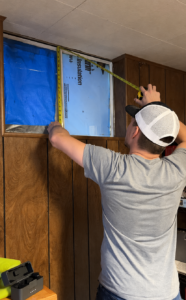
Insert Replacement vs. Full-Frame Replacement
An insert replacement, sometimes called a pocket replacement, installs a new window within the existing window frame. A full-frame replacement removes the old frame and installs the new window into the rough opening.
| Method | When it can make sense | What to consider |
|---|---|---|
| Insert replacement | The existing frame and sill are sound, reasonably square, and structurally suitable for an insert. | Interior and exterior finishes can often remain in place, but the new unit sits inside the old frame and may reduce glass area. |
| Full-frame replacement | The existing frame is deteriorated, badly out of square, or the project needs full access to the rough opening. | More of the opening is exposed, creating an opportunity to correct air or water leakage around the old frame, but the project is more invasive and may require trim or finish work. |
Neither method is automatically right for every house. The Efficient Windows Collaborative notes that inserts are appropriate when the existing frame is in good condition and structurally sound, while full replacement provides access to address deterioration and leakage around the old frame.
Compare insert and full-frame replacement guidance from the Efficient Windows Collaborative.
Do You Actually Need a Full Window Replacement?
Not every window problem requires replacing the entire unit. A broken piece of hardware, failed balance, damaged screen, worn weatherstripping, or isolated glass problem may be repairable depending on the window and the availability of parts.
Replacement becomes more likely when the frame itself is deteriorated, the opening has structural or water-damage issues, the window no longer operates correctly despite repair, or the homeowner is intentionally upgrading the entire window system for comfort, performance, appearance, or function.
That is why the diagnosis matters. The best answer is not always the biggest project.
Joyland Windows & Doors offers both replacement work and certain window and door repairs, so homeowners can start with the actual problem instead of assuming every issue requires a new window.
What Replacement-Window Shoppers in Pennsylvania Should Ask
| Ask this | Why it matters |
|---|---|
| Can I see the NFRC ratings for the exact window and glass package? | It gives you standardized U-Factor, SHGC, and other performance information instead of a vague efficiency claim. |
| Is this product ENERGY STAR certified for the climate zone where my home is located? | ENERGY STAR window requirements vary by climate zone. Certification in one zone does not automatically mean the same configuration is certified everywhere. |
| Are you recommending an insert or full-frame replacement, and why? | The condition of the existing frame and opening should help determine the installation method. |
| How will the rough opening be air-sealed and flashed? | Those hidden details affect drafts, water management, and long-term performance. |
| What product warranty and installation warranty will I receive? | The window itself and the labor may be covered differently, so both should be clear before work begins. |
ENERGY STAR provides a climate-zone finder so homeowners can check the correct requirements for their location.
A Note for Homes Built Before 1978
Window replacement can disturb painted surfaces around the opening. For pre-1978 homes, that can trigger federal lead-safe requirements when paid contractors disturb lead-based paint.
The U.S. Environmental Protection Agency says window replacement is a covered renovation activity under the Renovation, Repair and Painting Rule when applicable. Homeowners with older houses should ask whether the contractor is properly certified for lead-safe work and how painted surfaces will be handled before demolition begins.
Read the EPA's guidance for homeowners planning renovations in pre-1978 homes.
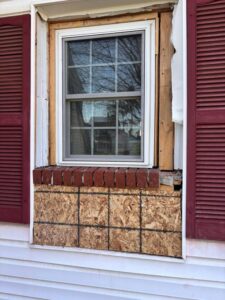
Before: The existing window was usable, but the opening around it needed to be rebuilt.
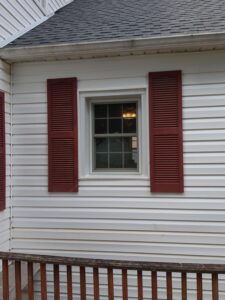
After: Joyland reinstalled the same sound window after correcting the surrounding opening and exterior details.
So, What Matters Most When Buying Replacement Windows?
A good replacement window project is not about finding one magic feature. It is about matching the product and installation method to the house.
Compare whole-window NFRC ratings. Make sure the product is appropriate for your climate. Understand what the frame, glass, gas fill, spacer, and operating style contribute. Then make sure the installation addresses the actual condition of the opening, including air sealing, flashing, alignment, and any deterioration that is uncovered.
That is a much more useful way to shop than assuming “triple-pane” automatically means best, or that every older window needs to be ripped out down to the framing.
Need Help Deciding Between Window Repair and Replacement?
If you are dealing with drafty windows, hard-to-operate sashes, damaged glass, aging frames, or windows that simply are not performing the way you want, start with an assessment of the actual problem.
Explore replacement window options from Joyland Windows & Doors , or visit our window and door repair page if the issue may be repairable.
Joyland serves homeowners throughout south-central Pennsylvania, including Lancaster, Lebanon, Dauphin, York, Berks, Cumberland, and surrounding areas.
Sources
This article was fact-checked using guidance from the U.S. Department of Energy, ENERGY STAR, the National Fenestration Rating Council, the U.S. Environmental Protection Agency, and the Efficient Windows Collaborative.
- U.S. Department of Energy: Home Upgrades
- U.S. Department of Energy: Window Types and Technologies
- U.S. Department of Energy Building Science Education: Rough Opening Air Sealing
- ENERGY STAR: Residential Windows, Doors, and Skylights
- National Fenestration Rating Council
- Efficient Windows Collaborative: Insert and Full Window Replacement
- U.S. EPA: Renovation, Repair and Painting Program for Consumers