Clean Gutters Still Overflowing? 4 Problems to Check Before Replacing Them
James Wesser
October 9, 2026
Clean Gutters Still Overflowing? 4 Causes to Check Before Replacing Them
You cleaned your gutters. You pulled out the leaves,
twigs, and whatever else had been sitting up there.
Then the next rainstorm rolled through, and water
came pouring over the edge anyway.
So what gives?
Believe it or not, overflowing gutters aren't
always caused by debris. Sometimes water is
getting trapped somewhere you can't see.
Other times, it's traveling in the wrong direction,
coming off the roof too quickly at one spot,
or missing the gutter entirely.
Quick answer:
If your gutters are clean but still overflowing,
the four things to investigate are a blocked
downspout, incorrect slope or sagging,
concentrated water from a roof valley,
and gutter capacity or positioning problems.
You may not need new gutters at all.
For homeowners throughout Lancaster, Lebanon,
York, Harrisburg, and surrounding south-central
Pennsylvania communities, figuring out the
cause before replacing anything can save
a lot of unnecessary work.
Where is the gutter overflowing?
Before assuming your gutters are too small,
look at where the water is coming out.
That location can be a surprisingly useful clue.
What you notice
Possible cause
What to investigate
Water backs up near the downspout
Hidden blockage
Outlet, elbows, downspout, or underground pipe
Water pools or spills from a low section
Incorrect pitch or sagging
Gutter slope, hangers, and fascia board
Water shoots over an inside corner
Roof valley concentrating runoff
Water entry point and possible overshooting
A long section overflows in heavy rain
Capacity or gutter placement
Gutter size, downspouts, outlets, roof edge
These are starting points, not guaranteed
diagnoses. A home can have more than one
drainage issue at a time.
In the video below, John Esh from Joyland Roofing
walks through these common problems and shows
what homeowners can look for before deciding
whether the gutters actually need replacing.
1. The downspout might be clogged even when the gutter is clean
This is the first thing to check, because
there's a difference between a clean gutter
and a clear drainage system.
You may have removed every leaf from the
gutter, but debris can still collect inside
the outlet, an elbow, or farther down the
downspout.
Some downspouts also connect to underground
drainage pipes. A blockage below ground
can cause the gutter to back up even when
everything above it looks perfectly clear.
A gutter can look clean while a blockage
remains hidden in the downspout or
underground drainage connection.
How can you tell if the downspout is blocked?
Start by watching the system during rain.
If water backs up near the downspout but
little comes out at the bottom, you may
have a restriction somewhere in the line.
A garden hose can also help you test
the drainage, provided the gutter is
accessible safely.
Run water into the gutter.
Watch whether it moves toward the downspout.
Check whether water exits freely at the bottom.
Look for water backing up near the outlet.
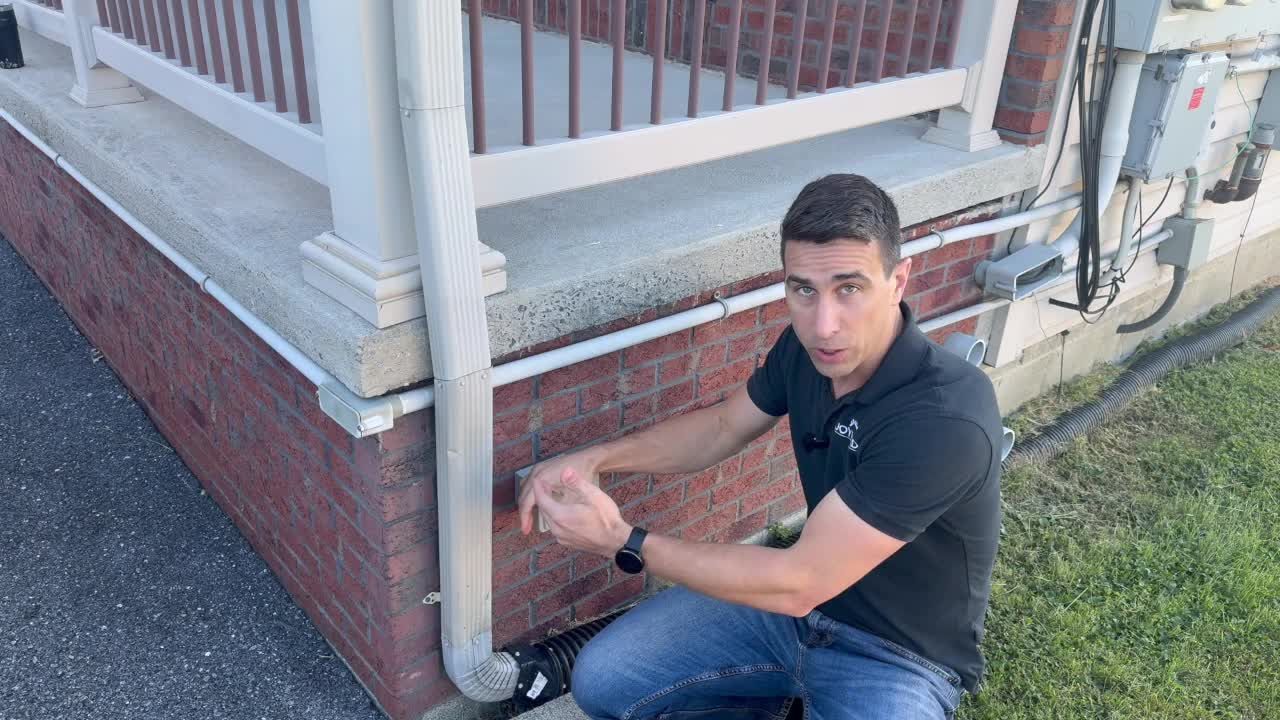
Check the underground connection if the downspout disappears into the ground.
In the video, John recommends allowing
the water to run for several minutes
to see whether the system backs up.
A quick splash isn't always enough
to reveal a partial blockage.
If the downspout is clogged, clearing
that blockage may solve the problem
without replacing any gutters.
The takeaway:
Before spending money on bigger gutters,
make sure the water has a clear path
out of the existing system.
If debris keeps building up,
Joyland also explains when gutter guards are worth considering.
Guards may help reduce debris accumulation,
but they won't correct a blocked underground
drain or an improperly sloped gutter.
2. The gutter might have the wrong slope or be sagging
Gutters aren't supposed to be perfectly
level. They need a slight downward pitch
to help rainwater travel toward the
downspout instead of collecting
in the middle.
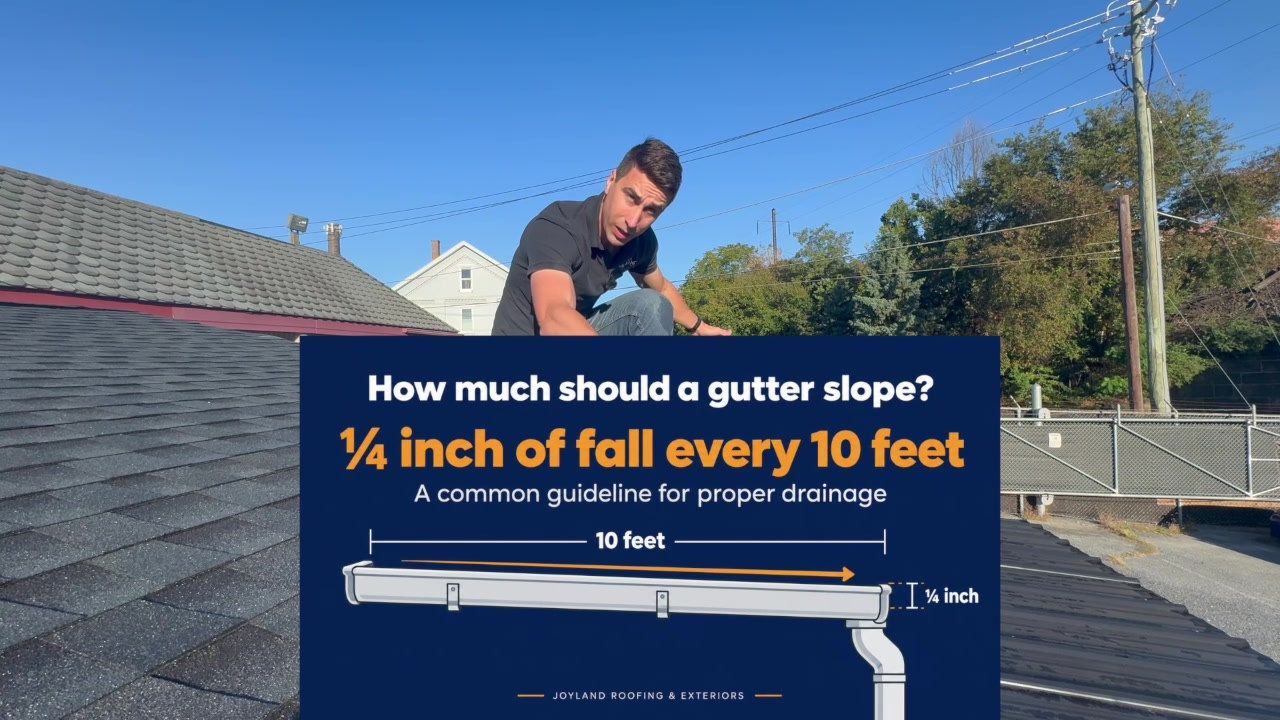
A commonly recommended guideline is approximately 1/4 inch of fall
for every 10 feet of gutter run.
For example, under that guideline,
a 20-foot gutter draining in one
direction would have approximately
1/2 inch of drop from its high point
to the outlet.
A common guideline is about
1/4 inch of slope for every 10 feet,
directing rainwater toward the
downspout.
This measurement is also discussed in This Old House's gutter installation guide.
The actual installation should still
account for the layout and manufacturer
recommendations.
Signs the gutter pitch might be wrong
Water sits in the gutter after rain stops.
One section looks visibly lower than the rest.
Water collects away from the downspout.
Gutter hangers are pulling loose.
Overflow repeatedly happens at a low point.
A sagging section creates a low spot
where water can collect. During heavy
rain, that area can fill and spill
over the front edge.
Sometimes the solution is straightforward:
resetting or replacing the hangers and
correcting the pitch.
But there's another possibility John
brings up in the video: the fascia board could be damaged.
The fascia is the board behind the gutter
that supports its attachment. If the wood
has deteriorated, the gutter hangers may
no longer have a solid place to fasten.
In that situation, simply installing
more screws into rotten wood won't
solve the underlying problem.
The damaged fascia may need repair
before the gutter can be secured again.
The takeaway:
Standing water or sagging doesn't
automatically mean you need new gutters.
The problem may be the slope,
hangers, or fascia behind them.
3. A roof valley might be sending too much water into one spot
Sometimes the gutters are clean,
properly pitched, and draining normally,
but water still shoots over the edge
in one specific location during
a heavy storm.
When that happens, look at the roof
above the overflowing section.
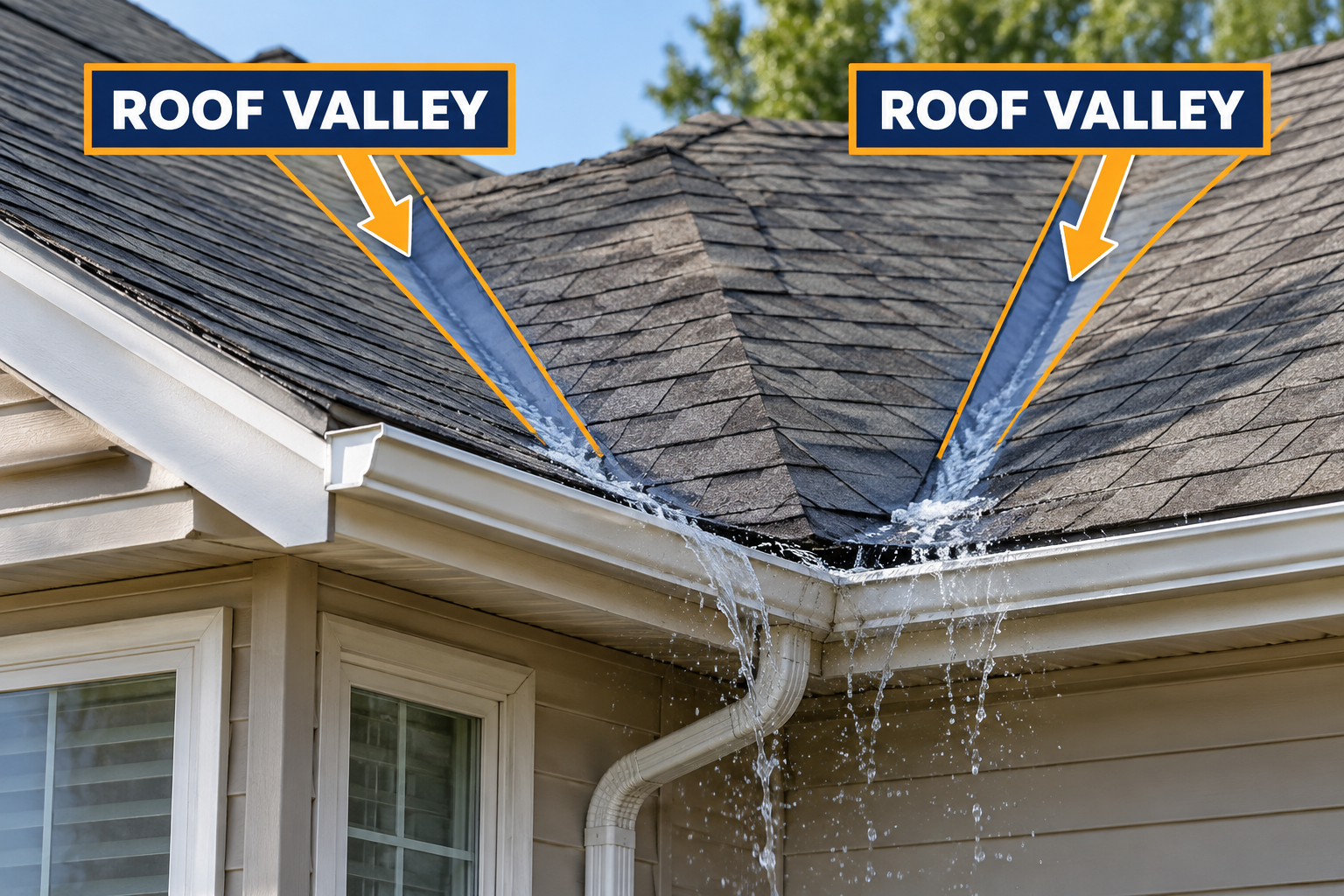
A roof valley
forms where
two sloping roof planes meet, creating
a channel that collects runoff from
both sections.
The orange lines highlight the two roof
valleys where adjoining roof sections
direct rainwater toward the gutters.
During heavy rain, concentrated runoff
can overwhelm these areas.
During a heavy storm, a large amount
of runoff can reach the same inside
corner of a gutter in a short time.
Sometimes the water travels fast enough
to shoot over the front edge rather
than collecting inside.
Is the gutter filling up or is the water shooting over it?
This distinction is important.
If the gutter is filling to the top
and spilling over, it may have a
drainage or capacity issue.
But if there's still plenty of room
inside the gutter and water is
shooting over the front, the problem
may be how the runoff enters it.
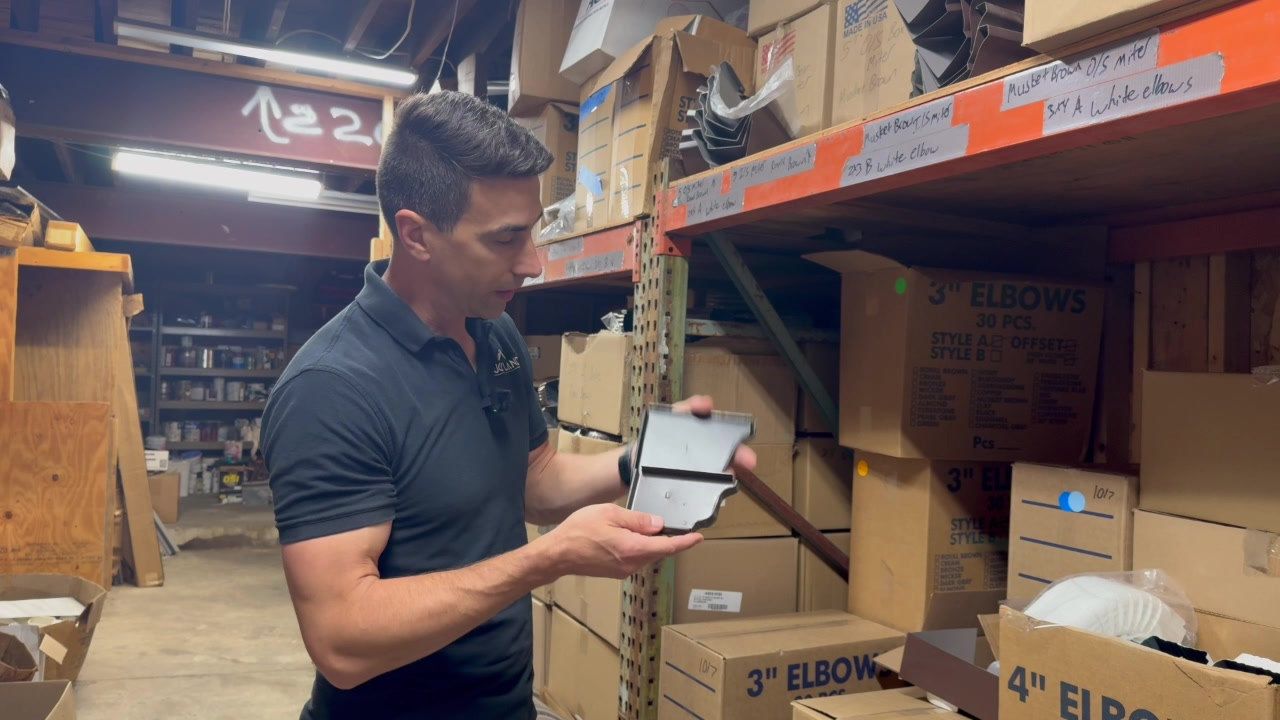
In the video, John demonstrates a gutter splash guard.
This small metal piece can help
keep concentrated runoff inside
the gutter at certain corners.
A splash guard isn't a universal fix.
The gutter's position and the
path of the runoff still matter.
The takeaway:
If water only overshoots at one
roof valley, investigate that
location before replacing
the entire gutter system.
4. The gutter size or placement might be the problem
Now we're getting into capacity.
Sometimes the gutter system really
does struggle to handle the amount
of rainwater coming off the roof.
But installing bigger gutters
isn't automatically the right answer.
Several factors determine how much
water the system can manage:
The roof area draining into the gutter.
The roof's shape and number of valleys.
How intense the rainfall is.
The length and dimensions of the gutter.
The number and size of downspouts.
The location of the outlets.
The gutter's position relative to the roof edge.
The SMACNA Downspout and Gutter Sizing Calculator
uses engineering methods to evaluate
gutter and downspout sizing based on
factors including roof design area
and rainfall intensity.
5-inch vs. 6-inch gutters: Does bigger mean better?
In the video, John compares two common
residential K-style gutter profiles:
5-inch and 6-inch gutters.
Comparing 5-inch and 6-inch
K-style gutters. A larger
gutter can collect more water,
but the outlet and downspout
system also affect drainage.
Feature
5-inch K-style
6-inch K-style
Nominal width
5 inches
6 inches
Common application
Many residential roofs
Roofs requiring greater drainage capacity
Typical downspout pairing
2 x 3 inches
3 x 4 inches
Best choice?
Depends on roof area, rainfall intensity,
gutter placement, and drainage layout.
Roof catchment area (sq. ft.)
x rainfall depth (inches)
x 0.623 = gallons
Rainwater volume from one inch of rainfall
Roof catchment area
Approximate volume
Comparison
500 sq. ft.
312 gallons
1,000 sq. ft.
623 gallons
1,500 sq. ft.
935 gallons
2,000 sq. ft.
1,246 gallons
Source: Rutgers Cooperative Extension.
Figures represent theoretical rainfall
volume before losses, based on horizontal
catchment area. They are not measurements
of a particular gutter's flow capacity.
There's an important difference between
one inch of rain falling over an entire
day and the same amount falling during
a short, intense storm.
The total water volume is the same,
but the drainage system must move
that water much faster during
the downpour.
That's why rainfall intensity
matters so much when sizing
gutters and downspouts.
When should you call a professional about overflowing gutters?
Start with what you can observe
safely from the ground.
Pay attention to where water
overflows, whether it happens
during ordinary rain or only
heavy storms, and whether
any gutter sections appear
to sag or pull away.
Consider getting professional
help if:
The gutter is pulling away from the house.
The fascia board appears damaged or deteriorated.
A downspout or underground drain may be blocked.
Water repeatedly spills near the foundation.
The same section overflows after cleaning.
The gutter's position or capacity needs evaluation.
Avoid climbing onto a roof or
using an unsafe ladder to
investigate a drainage problem.
Repeated gutter overflow can
affect more than the gutters.
Runoff directed toward the house
can contribute to damage around
fascia, siding, landscaping,
and foundations.
If your gutters are clean but
still overflowing, start by
checking the downspout.
Then investigate the gutter
pitch, hangers, and fascia.
Look for concentrated runoff
at roof valleys.
Finally, consider whether
the gutter size, positioning,
and overall drainage layout
are appropriate.
Sometimes a relatively small
repair solves the problem.
Other times, part or all of
the gutter system may need
to be replaced.
The goal is to figure out
what's actually causing the
overflow before spending
money on the wrong fix.
Still dealing with overflowing gutters?
Joyland Roofing helps homeowners
throughout Lancaster, Lebanon,
York, Dauphin, Berks, Cumberland,
and surrounding south-central
Pennsylvania communities with
gutter repairs and replacements.
If you've worked through the
common possibilities and your
gutters still aren't doing
their job, we'd be happy
to take a closer look.
Frequently Asked Questions About Overflowing Gutters
Why are my gutters overflowing even though they're clean?
Clean gutters can still overflow if a downspout is
clogged, the gutter is sagging or sloped incorrectly,
water is overshooting at a roof valley, or the gutter
and downspout system cannot handle the amount of runoff.
The location of the overflow can help narrow down
which problem to investigate first.
How can I tell if my gutter downspout is clogged?
A common clue is water backing up near the downspout
while little water comes out at the bottom. If the
gutter is safely accessible, running water through
it with a garden hose can help reveal a blockage.
Remember that debris can also collect in elbows,
outlets, or underground drainage pipes.
How much slope should gutters have to drain properly?
A common residential guideline is approximately
1/4 inch of downward slope for every 10 feet of
gutter toward the downspout. The appropriate pitch
depends on the gutter layout and installation.
Standing water, low spots, or visible sagging
can indicate a drainage problem.
Why do my gutters overflow only during heavy rain?
Heavy rainfall increases the amount of water the
gutter system must move in a short period of time.
If a downspout is too small, there are too few outlets,
or a roof valley concentrates runoff into one spot,
the system may struggle during intense storms.
Poor gutter positioning can also allow fast-moving
water to shoot over the front edge.
Do I need 6-inch gutters instead of 5-inch gutters?
Not necessarily. Six-inch gutters generally offer
greater water collection capacity than comparable
five-inch profiles, but bigger gutters won't fix
a blocked downspout, improper slope, or loose hangers.
The correct size depends on roof drainage area,
rainfall intensity, gutter position, and the number
and size of downspouts.
Why does water overflow where two roof sections meet?
The area where two sloping roof sections meet is
called a roof valley. Valleys collect runoff from
both roof planes and direct it toward one section
of gutter. During heavy rain, the concentrated water
may overshoot the gutter. In some situations,
a properly installed splash guard can help,
but the water flow and gutter placement should
be evaluated first.
Will gutter guards stop my gutters from overflowing?
Gutter guards can help reduce leaves and other
debris entering the system, but they cannot fix
incorrect gutter slope, undersized downspouts,
damaged hangers, or poor gutter positioning.
If your gutters overflow even when they're clean,
identify the underlying problem before investing
in guards.
When should I call a professional about overflowing gutters?
Consider calling a professional if your gutters
continue overflowing after cleaning, sections
are pulling away from the house, fascia boards
appear damaged, or water repeatedly collects near
your foundation. A gutter contractor can evaluate
the roof edge, gutter slope, drainage capacity,
and downspout layout to determine whether repair,
adjustment, or replacement makes sense.