February 7, 2026
TPO vs EPDM: Why the "Better" Membrane Might Be the Wrong One for Your Building
Author
If you’ve been comparing TPO vs EPDM, chances are you’ve already heard the usual pitch: one membrane is more energy-efficient, the other lasts longer. Sales reps love to frame it as a simple material comparison. It isn’t.
After decades of real-world commercial roofing inspections, one thing becomes clear quickly: the “best” roofing membrane on paper can easily become the wrong one for your building. Maintenance expectations, installation variables, foot traffic, climate swings, and even how your team handles routine inspections can matter more than the membrane spec sheet.
That’s why building owners who focus only on up-front price or advertised performance numbers often end up dealing with unexpected maintenance costs, premature repairs, or warranty surprises years later.
Understanding how different roofing systems actually behave over time—especially on flat or low-slope commercial buildings—is the key to making a decision you won’t regret. If you want a deeper look at what real long-term care looks like for these systems, check out our guide on commercial roof maintenance tips for business owners to see what most roofing proposals leave out.
Because when it comes to TPO vs EPDM, the membrane itself isn’t always the deciding factor. The real difference shows up after the roof is installed.
Table of Contents
- TL;DR
- The Maintenance Burden Nobody Warns You About
- What Most Contractors Won't Tell You About Installation Variables
- The Seam Problem That Separates Theory from Reality
- Why Your Building's Foot Traffic Matters More Than You Think
- Temperature Swings and the Membrane Lifespan Nobody Discusses
- The Hidden Cost Structure Beyond the Invoice
- Warranty Language That Actually Protects You (and What Doesn't)
- Making the Decision Without Regret
TL;DR
Here's what the sales pitch won't tell you: maintenance costs differ wildly between TPO and EPDM, installation quality matters more than the membrane itself, and your building's foot traffic might matter more than any spec sheet. Those heat-welded TPO seams everyone brags about? They're either bulletproof or catastrophic failures with nothing in between. EPDM's boring consistency beats TPO's theoretical superiority when real-world conditions aren't perfect. Temperature extremes age each material differently in ways that make climate more critical than most contractors admit. True lifecycle costs include maintenance you'll actually do (not the maintenance you should do), repair complexity when things go wrong at 2 AM, and replacement timing that never matches the warranty period. And those warranties? Most are worthless the moment your contractor cuts corners or you skip a documented inspection.
The Maintenance Burden Nobody Warns You About
"Install it and forget it." Every roofing contractor I know uses this line. It's bullshit. I've been inspecting commercial roofs since 2001, and I've never seen a membrane that doesn't need attention. The question isn't whether you'll maintain it. It's what that maintenance will actually cost you.
Both TPO and EPDM get sold as low-maintenance solutions. Each membrane demands different maintenance approaches over time, and these differences hit your operating budget in ways that don't show up on the initial proposal.
The maintenance reality comes down to what property managers deal with daily: cleaning requirements, inspection frequencies, and how accessible minor repairs are when problems emerge. We're talking about practical ownership experience, not theoretical performance specs that sound impressive in sales presentations.
TPO's Reflective Surface Isn't Self-Maintaining
You've heard about TPO's energy efficiency benefits. The white reflective surface reduces cooling costs. That's genuinely true in the first few years. What the sales pitch skips is how quickly dirt, algae, and atmospheric pollutants trash that reflectivity.
I've seen TPO roofs lose 30-40% of their reflective value within five years in urban or industrial areas. That's physics, not a defect. The smooth surface that makes TPO energy-efficient also makes it a magnet for airborne particles.
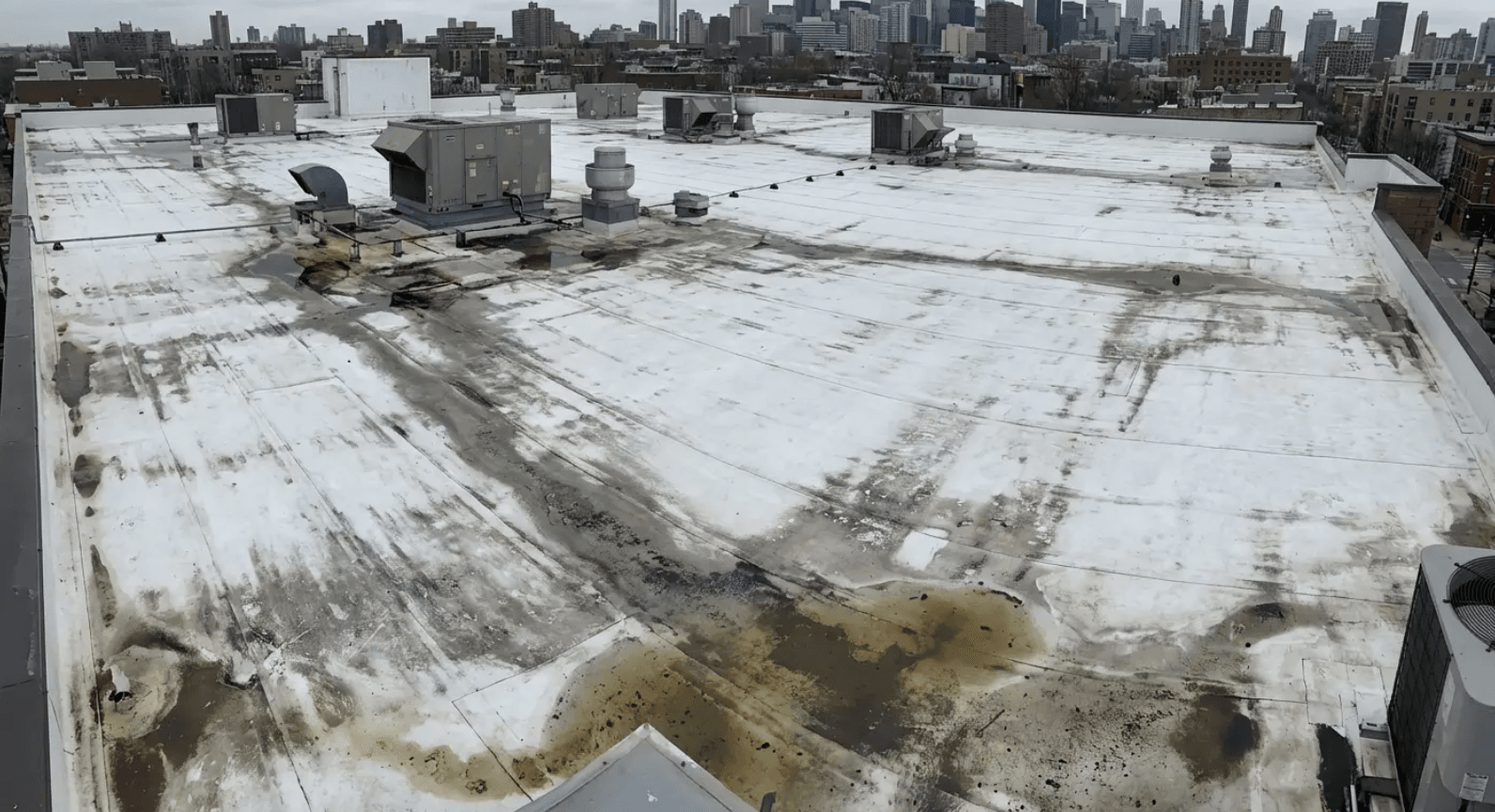
Restoring that reflectivity means regular cleaning. Not just hosing it down. You need proper detergents and sometimes professional equipment to avoid damaging the membrane.
I worked with this distribution center outside Atlanta. 2018, they went with TPO for the energy savings. Building manager was pumped about the white roof. Fast forward to 2023, and he's calling me pissed off because his cooling costs are back up. HVAC system's fine. Roof looks fine from the ground. Get up there with a reflectometer? The white surface is basically gray now. Industrial fallout and algae everywhere. Cost him $3,180 to get it professionally cleaned. Now he's got to do that every year. Nobody mentioned that in the sales pitch. The building manager told me if he'd known about this ongoing expense, he would've reconsidered whether the energy savings justified the maintenance commitment.
TPO cleaning is preventive maintenance, not optional upkeep. Skip it, and you're paying higher cooling costs while thinking you invested in an energy-efficient roof. The irony is brutal.
EPDM Hides Its Problems Until They're Expensive
EPDM takes the opposite approach to maintenance visibility. The black surface doesn't show dirt, which sounds convenient until you realize it also doesn't show early-stage damage. Small punctures, developing cracks, and seam separation can progress for months before anyone notices.
Property managers often prefer this "out of sight, out of mind" quality. Less pressure to schedule cleaning, and the roof looks fine from ground level. The tradeoff comes during inspections. You need more thorough examinations because visual sweeps won't catch issues early.
I recommend biannual professional inspections for EPDM, compared to annual checks for TPO (assuming regular cleaning). That difference in inspection frequency adds up, but it's the only reliable way to catch problems before they become leaks. Factor this into your long-term cost projections, because most contractors won't mention it until you're already committed.
The maintenance visibility difference shapes how you manage the roof throughout its lifespan. TPO forces you to stay proactive with cleaning. EPDM demands vigilance during inspections because problems hide in plain sight.
Repair Accessibility Changes Your Maintenance Strategy
Both membranes can be repaired, but the ease and durability of those repairs differ significantly. TPO repairs require heat welding, which means you need a qualified technician with proper equipment. Field repairs are possible, but they're not simple patch jobs.
EPDM repairs are more forgiving in the field. Adhesive patches work well for small punctures, and most maintenance teams can handle minor repairs without specialized equipment. This accessibility matters when you're dealing with emergency leaks or damage from rooftop equipment work.
The counterpoint? EPDM patches are more visible and can become weak points if not done correctly. TPO heat-welded repairs, when done right, are nearly as strong as the original membrane. You're choosing between repair simplicity and repair durability, and your building's maintenance capabilities should inform that choice.
What Most Contractors Won't Tell You About Installation Variables
Installation quality determines real-world performance more than any material specification. I've inspected enough failed roofs to know that the difference between a 15-year roof and a 30-year roof comes down to what happened during installation, not which membrane was chosen.
The problem is that comparisons focus on ideal installations. Nobody talks about how each material responds to common installer mistakes, weather conditions during installation, or substrate preparation variations. TPO is less forgiving of installation errors, while EPDM's flexibility can compensate for some substrate imperfections.
This reframes the decision around your specific project constraints and contractor capabilities. The "better" membrane in theory might perform worse in practice if your installation conditions aren't ideal.
TPO Demands Installation Precision You Can't Compromise
TPO's heat-welded seams are its greatest strength and its biggest vulnerability. When installed correctly, those seams create a monolithic membrane that's incredibly watertight. When rushed or done in suboptimal conditions, they become the failure points that plague the entire system.
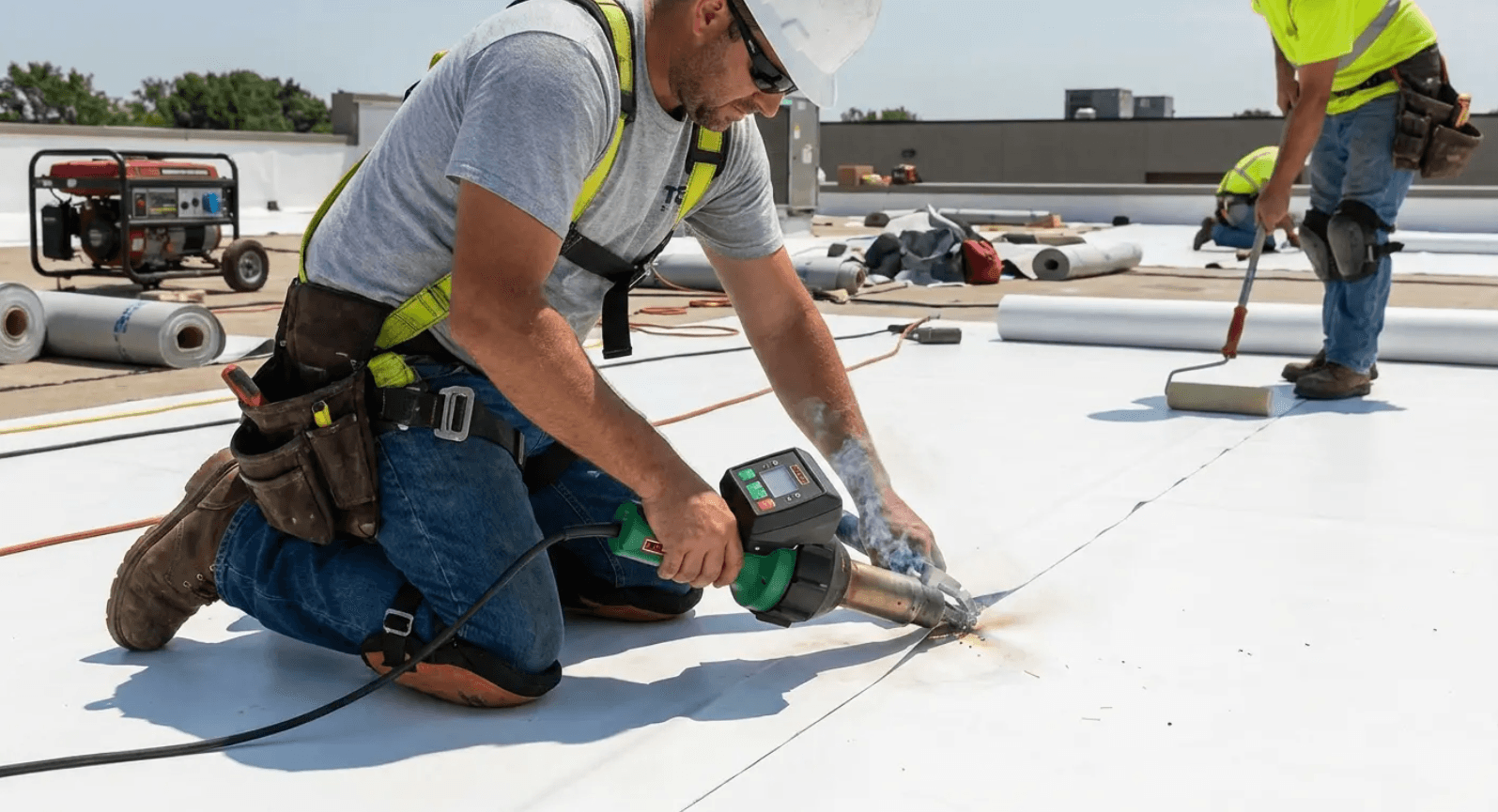
I've inspected TPO roofs where 80% of leaks originated at seams installed during temperature extremes or windy conditions. The welding equipment requires specific temperature ranges to create proper bonds. Too cold, and the seam doesn't fully fuse. Too hot, and you burn through the material. There's a narrow window for optimal installation.
Your contractor's experience with TPO specifically matters more than their general roofing experience. The learning curve is steep, and the material doesn't forgive shortcuts. If you're getting competitive bids and one comes in significantly lower, question whether they're accounting for proper installation time and conditions. Rushed TPO installation is worse than no roof at all because it fails unpredictably.
TPO Installation Quality Verification Checklist
Look, your contractor will hate this list. Make them do it anyway. Before you pay the final invoice, you need proof of:
- Ambient temperature logs for all welding days (must be within manufacturer specifications)
- Wind speed readings during seam welding (excessive wind compromises bond quality)
- Seam pull test results for every 100 linear feet of welded seam (minimum)
- Photographic documentation of all field seams, penetration flashings, and corner details
- Heat welder calibration certificates dated within 30 days of project start
- Installer certifications from membrane manufacturer (not just general roofing credentials)
- Moisture readings of substrate before membrane installation
- Written confirmation that no seam welding occurred during precipitation or high humidity
I've never had a contractor give me all this without pushing back. Insist anyway.
EPDM's Flexibility Compensates for Substrate Imperfections
EPDM's rubber composition gives it dimensional flexibility that TPO can't match. This matters enormously when your existing substrate isn't perfectly smooth or has minor irregularities. EPDM conforms to these variations without creating stress points.
Older buildings with settled decks, slight depressions, or repaired sections are often better candidates for EPDM because of this forgiving nature. TPO's rigidity means substrate preparation becomes more critical and more expensive. You might spend the cost savings on deck repairs before you can even install the membrane.
That said, EPDM's flexibility doesn't excuse poor substrate preparation. It compensates for minor issues, not structural problems. If your deck has significant damage or moisture retention, neither membrane will perform well without proper remediation. The difference is that EPDM gives you a slightly wider margin for acceptable substrate conditions.
Weather Windows Affect Each Material Differently
Installation timing impacts both membranes, but in distinct ways. TPO installation can proceed in cooler temperatures (above 40°F typically), but seam welding becomes challenging. EPDM adhesive application requires warmer, drier conditions for proper bonding, but the material itself handles cold installation better.
This creates a practical consideration most property managers overlook: your project timeline and local climate might favor one membrane over the other regardless of other factors. If you're in a region with short construction seasons or need installation during shoulder months, the weather-compatible membrane might be your best choice even if the other looks better on paper.
I've seen projects delayed by months because the specified membrane couldn't be properly installed during available weather windows. That delay cost more than any material price difference. Talk to your contractor about realistic installation windows for each option based on your local climate patterns, not just national averages.
The decision sometimes comes down to when you can schedule the work, not which material performs better in your climate long-term.
The Seam Problem That Separates Theory from Reality
Most membrane failures occur at seams, yet this gets glossed over in material comparisons. We need to talk about why TPO's heat-welded seams are theoretically superior but practically vulnerable, while EPDM's adhesive or tape seams are less elegant but often more reliable in real-world conditions.
Seam failure patterns differ based on building movement, thermal cycling, and membrane tension. Some buildings are inherently better suited to one seam type over the other, and understanding your specific building characteristics should influence this decision more than generic performance specs.
Heat-Welded Seams Create Single Points of Catastrophic Failure
TPO's heat-welded seams should create a continuous, watertight membrane. In theory, they're stronger than the base material. In practice, a failed heat-weld can allow water to travel laterally between the membrane and substrate, creating widespread damage from a single seam failure.
The problem isn't the welding technology itself. It's the binary nature of the bond. Either the seam is properly welded (excellent performance) or it's not (immediate vulnerability). There's minimal middle ground. EPDM's adhesive seams degrade more gradually, often giving you warning signs before complete failure.
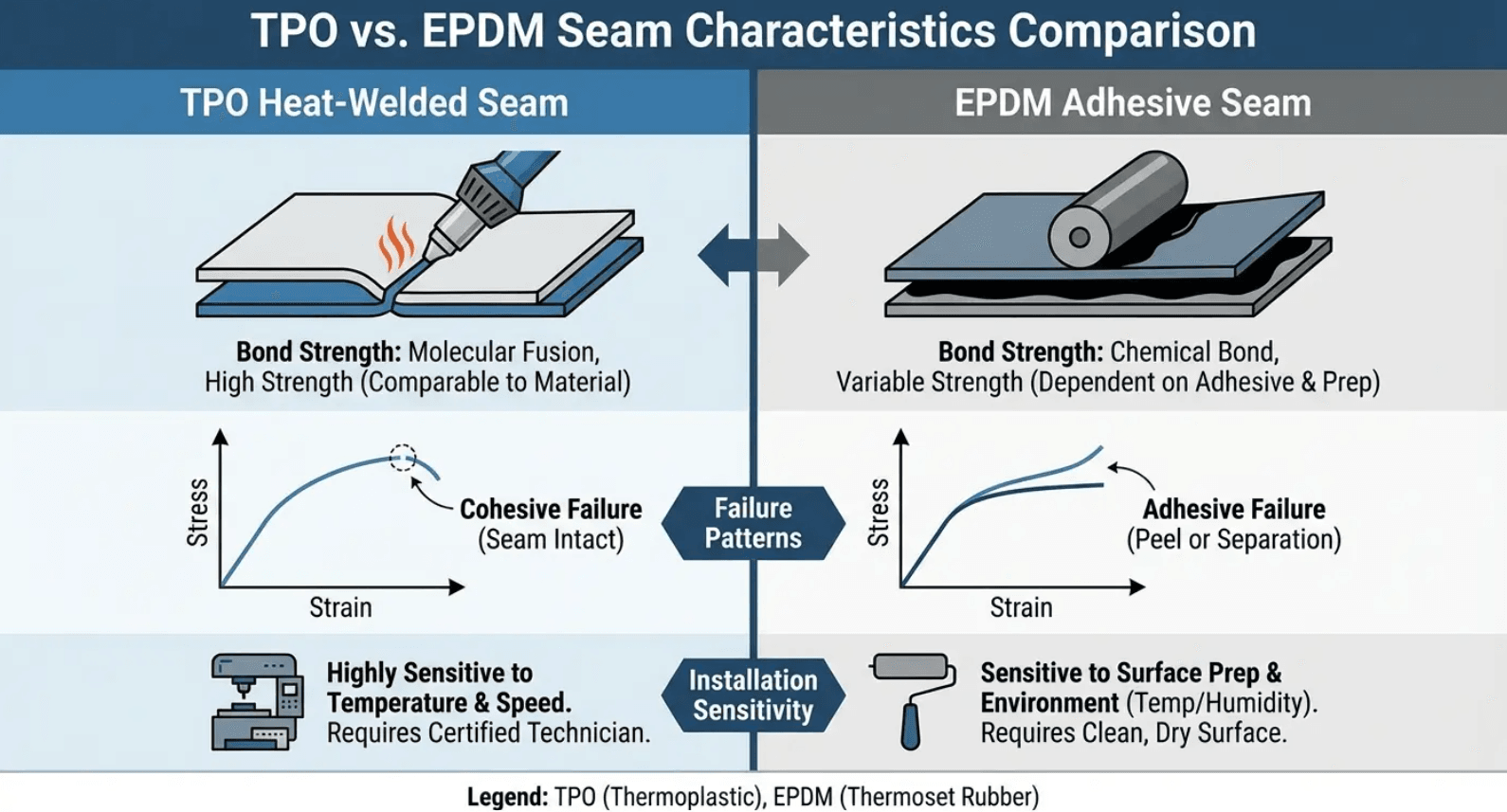
You can test TPO seams after installation, and reputable contractors do exactly that. But testing is time-consuming and adds cost. Some installers skip it or do spot checks rather than comprehensive testing. If you're specifying TPO, insist on documented seam testing for the entire roof. That documentation becomes crucial if you have warranty claims later.
| Seam Characteristic | TPO Heat-Welded | EPDM Adhesive/Tape |
|---|---|---|
| Bond Strength | 4x stronger than EPDM when properly installed | Lower initial strength but more consistent |
| Failure Pattern | Binary (complete bond or complete failure) | Gradual degradation with warning signs |
| Installation Sensitivity | Highly sensitive to temperature, humidity, wind | Moderate sensitivity to temperature/moisture |
| Testing Requirements | Requires specialized pull testing equipment | Visual inspection and manual testing sufficient |
| Repair Complexity | Requires heat welding equipment and certified tech | Field-repairable with adhesive and basic tools |
| Water Migration Risk | High (lateral water travel if seam fails) | Lower (failures typically remain localized) |
| Long-term Reliability | Excellent if installed correctly, poor if not | Consistent performance across installations |
| My Take | Go with TPO if you can verify installation quality | Choose EPDM if you want consistent, predictable results |
Building Movement Stresses Seams Differently
Your building moves. Temperature changes cause expansion and contraction. Wind creates uplift forces. Settling affects dimensional stability. These movements concentrate stress at seams, and each membrane type responds differently.
TPO's rigidity means movement stress can break seam bonds if the membrane is installed too tightly or if the building moves more than anticipated. EPDM's elasticity absorbs some of this movement, distributing stress across a wider area rather than concentrating it at seam.
I worked with this warehouse in Phoenix. Metal deck, massive temperature swings, the works. They went with TPO because the bid was cheaper. Seven years later, seams were failing everywhere. Know what the contractor said? "Metal decks move too much for TPO." Yeah, no shit. Would've been nice to mention that in 2016. The building owner replaced the failed TPO with EPDM, which has now performed without seam issues for over a decade. The EPDM's flexibility allows it to move with the deck's expansion and contraction rather than resisting it. The contractor who installed the replacement system told me that metal deck buildings in desert climates represent the worst-case scenario for rigid membrane seams.
Seam Repair Complexity Affects Long-Term Costs
When seams fail (and eventually, some will), repair complexity becomes your next concern. TPO seam repairs require returning to the site with welding equipment and skilled technicians. You can't just patch over a failed heat-weld and expect lasting results.
EPDM seam repairs are more straightforward. Cleaning, priming, and applying new adhesive or tape can restore seam integrity without specialized equipment. This doesn't mean EPDM seam repairs are trivial, but they're within the capabilities of most commercial roofing maintenance teams.
The practical impact shows up in your emergency response capabilities. A TPO seam failure during a weekend storm might mean temporary patching until a qualified crew can properly repair it. EPDM seam failures can often be permanently repaired by on-call maintenance staff, reducing both damage and emergency service costs.
When evaluating your options, consider how seam repair complexity aligns with your maintenance resources and emergency response capabilities.
Why Your Building's Foot Traffic Matters More Than You Think
Rooftop access and traffic patterns get ignored in most material comparisons, but they directly affect membrane durability over time. I'm talking about mechanical equipment maintenance, HVAC servicing, and general rooftop access that happens throughout the membrane's lifespan.
TPO's puncture resistance is better in theory but worse in practice when subjected to regular foot traffic, dropped tools, and equipment vibration. EPDM's softer surface absorbs impact better than lab tests suggest.
Puncture Resistance Ratings Don't Predict Real-World Damage
Lab tests measure puncture resistance under controlled conditions, and TPO typically scores higher. Those tests use standardized probes with consistent force application. Your rooftop experiences dropped wrenches, dragged equipment, and concentrated loads from ladders and scaffolding.
I've found that EPDM's softer surface performs better under these real-world conditions because it absorbs and distributes impact force. TPO's harder surface can crack or puncture when hit with sharp, heavy objects even though its puncture resistance rating is superior. The difference lies in how force transfers through the material.
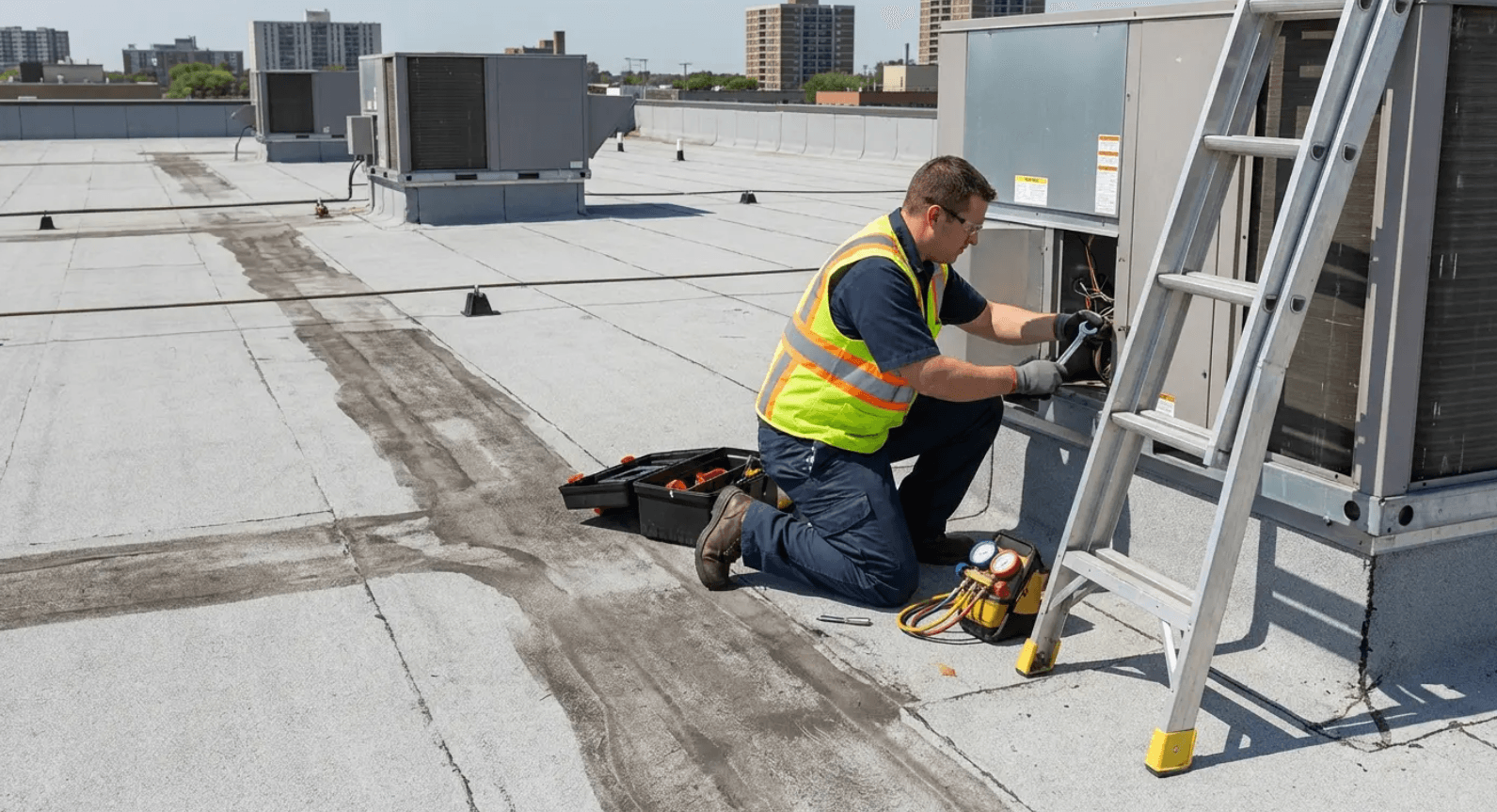
If your building has rooftop HVAC units requiring regular maintenance, multiple mechanical systems, or frequent contractor access, factor in realistic damage patterns rather than lab specifications. The membrane that survives actual use matters more than the one that wins controlled tests.
Buildings with weekly HVAC technician visits face different durability challenges than buildings with quarterly inspections. Match the membrane's real-world impact resistance to your building's traffic patterns, not theoretical ratings.
Equipment Vibration Creates Wear Patterns Nobody Discusses
Rooftop mechanical equipment vibrates. That vibration transfers through mounting systems into the membrane, creating wear patterns over years of operation. This isn't dramatic damage. It's gradual degradation that shortens membrane life in specific areas.
TPO's rigidity means vibration stress concentrates at specific points rather than dissipating. You'll often see premature aging in a ring around equipment mounts on TPO roofs. EPDM's flexibility allows it to move slightly with vibration, distributing wear across a larger area.
The solution isn't avoiding TPO on buildings with mechanical equipment (that would eliminate most commercial buildings). It's understanding that equipment-dense roofs might need more frequent inspections in those areas and potentially earlier localized repairs. Budget for this reality rather than expecting uniform membrane aging across the entire roof.
Walkway Systems Become Necessary Investments
Both membranes benefit from designated walkways in high-traffic areas, but TPO demands them more urgently. Creating permanent walkways adds upfront cost but dramatically extends membrane life in areas with regular access needs.
EPDM can tolerate occasional foot traffic without immediate damage, though repeated traffic in the same paths will eventually create wear patterns. TPO shows traffic damage more quickly, particularly in hot weather when the material softens and becomes more vulnerable to surface abrasion.
Calculate the cost of walkway systems into your initial investment rather than treating them as optional accessories. For buildings with weekly or daily rooftop access needs, walkways pay for themselves through extended membrane life and reduced repair frequency. The question isn't whether you need them. It's whether you install them proactively or reactively after damage appears.
Temperature Swings and the Membrane Lifespan Nobody Discusses
Temperature extremes and thermal cycling affect each membrane's aging process and ultimate lifespan in ways that standard specifications don't capture. I'm not just discussing heat reflectivity or cold-weather performance. I'm examining the cumulative effect of repeated temperature swings on material properties.
According to TurnKey Roofing Contractors' commercial division analysis (Press Connects), TPO and PVC membranes have estimated lifespans of 20 to 30 years with maintenance, while EPDM membranes have estimated lifespans of 25 to 35 years. That's a significant difference that reflects how each material's aging process responds to cumulative environmental stress over time.
TPO becomes more brittle with age and thermal stress, while EPDM's plasticizers evaporate over time, creating different failure modes. Understanding your climate's specific thermal patterns (not just average temperatures) should inform which membrane's aging characteristics align better with your expected ownership period.
TPO's Brittleness Increases With Thermal Cycling
TPO starts its life as a relatively flexible thermoplastic. Over years of thermal cycling, especially in climates with significant day-night temperature variations, the material gradually loses flexibility. This brittleness makes the membrane more vulnerable to impact damage and stress cracking as it ages.
The rate of this degradation varies based on formulation (different manufacturers use different plasticizer packages), but the trend is universal. A 15-year-old TPO roof doesn't behave like a 5-year-old TPO roof. It becomes progressively less forgiving of building movement, impact, and stress.
This matters for your replacement planning. TPO roofs often reach a point where minor damage becomes difficult to repair effectively because the surrounding membrane has become too brittle to create durable patches. You might face earlier replacement than the warranty period suggests, not because of catastrophic failure but because the membrane can no longer be maintained cost-effectively.
When weighing your options, consider how thermal cycling in your specific climate will affect long-term material properties, not just initial performance characteristics.
EPDM's Plasticizer Loss Changes Surface Properties
EPDM ages differently. The rubber compound contains plasticizers that keep it flexible. Over time, especially under intense UV exposure, these plasticizers gradually evaporate. The membrane becomes harder and less elastic, though it typically retains more flexibility than aged TPO.
The visible sign of this aging is surface chalking. You'll see a grayish powder on the membrane surface, which is the degraded rubber compound. This chalking is normal and doesn't indicate imminent failure, but it does signal that the membrane is past its prime performance period.
EPDM's aging pattern is more predictable and gradual than TPO's. You'll have clearer warning signs that replacement is approaching, allowing better budget planning. The membrane degrades from the surface inward rather than becoming uniformly brittle, which means it often remains repairable longer into its lifespan.
Climate Patterns Trump Average Temperature Specs
Most material specifications list temperature ranges for performance, but those ranges don't capture the cumulative effect of your specific climate pattern. A building in a climate with moderate average temperatures but extreme daily swings might stress membranes more than a location with higher average temperatures but stable conditions.
Desert climates (hot days, cold nights, intense UV) create different aging patterns than humid coastal climates (moderate temperatures, high moisture, salt exposure). Northern climates with freeze-thaw cycles stress membranes differently than southern climates with consistent heat and humidity.
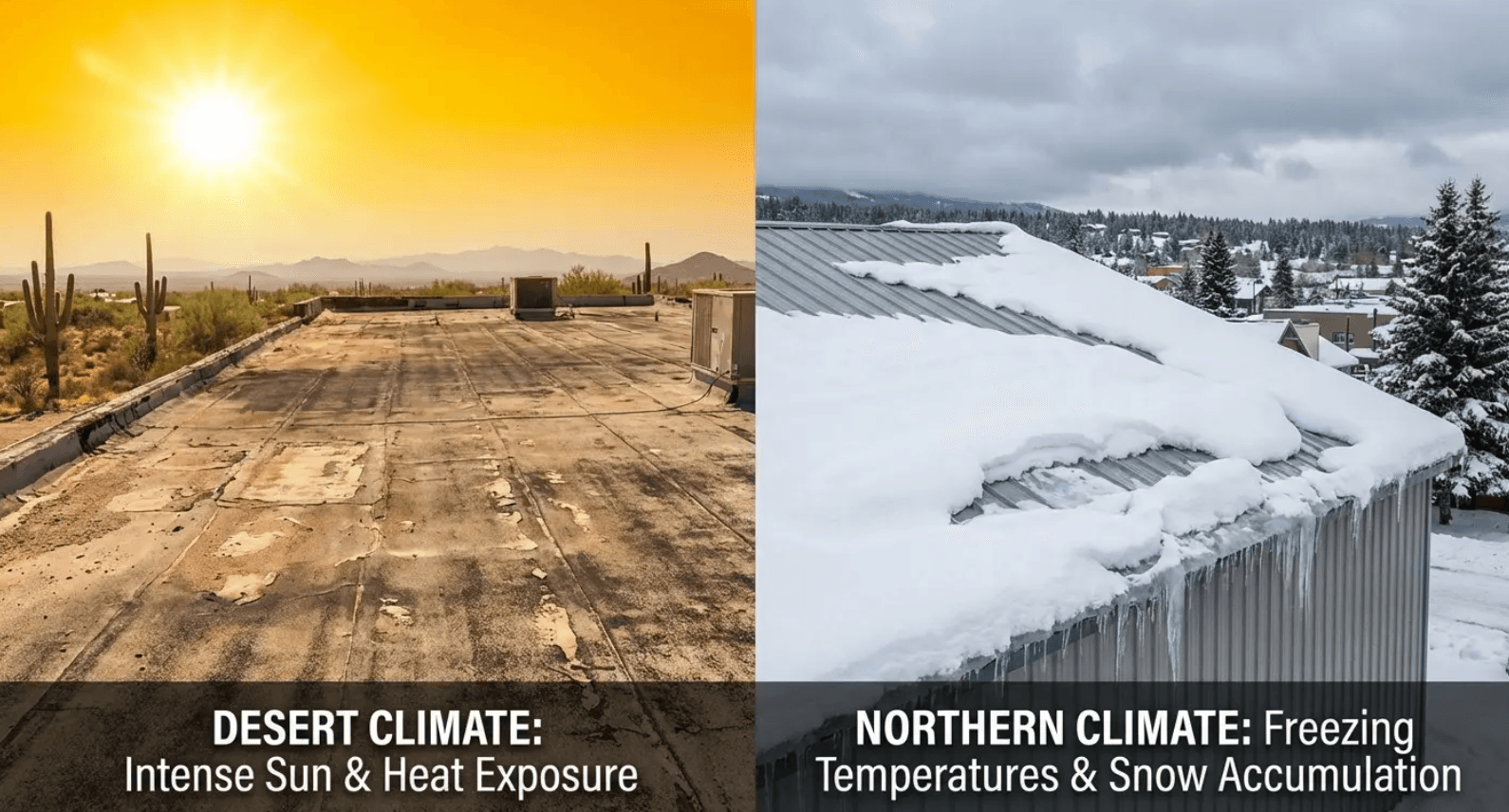
Talk to contractors familiar with your specific region, not just those who install both membranes nationally. Regional performance data matters more than manufacturer testing done in controlled environments. A membrane that excels in Phoenix might struggle in Chicago, and vice versa. Your climate's specific thermal pattern should weigh heavily in your decision, potentially overriding other factors if the mismatch is severe enough.
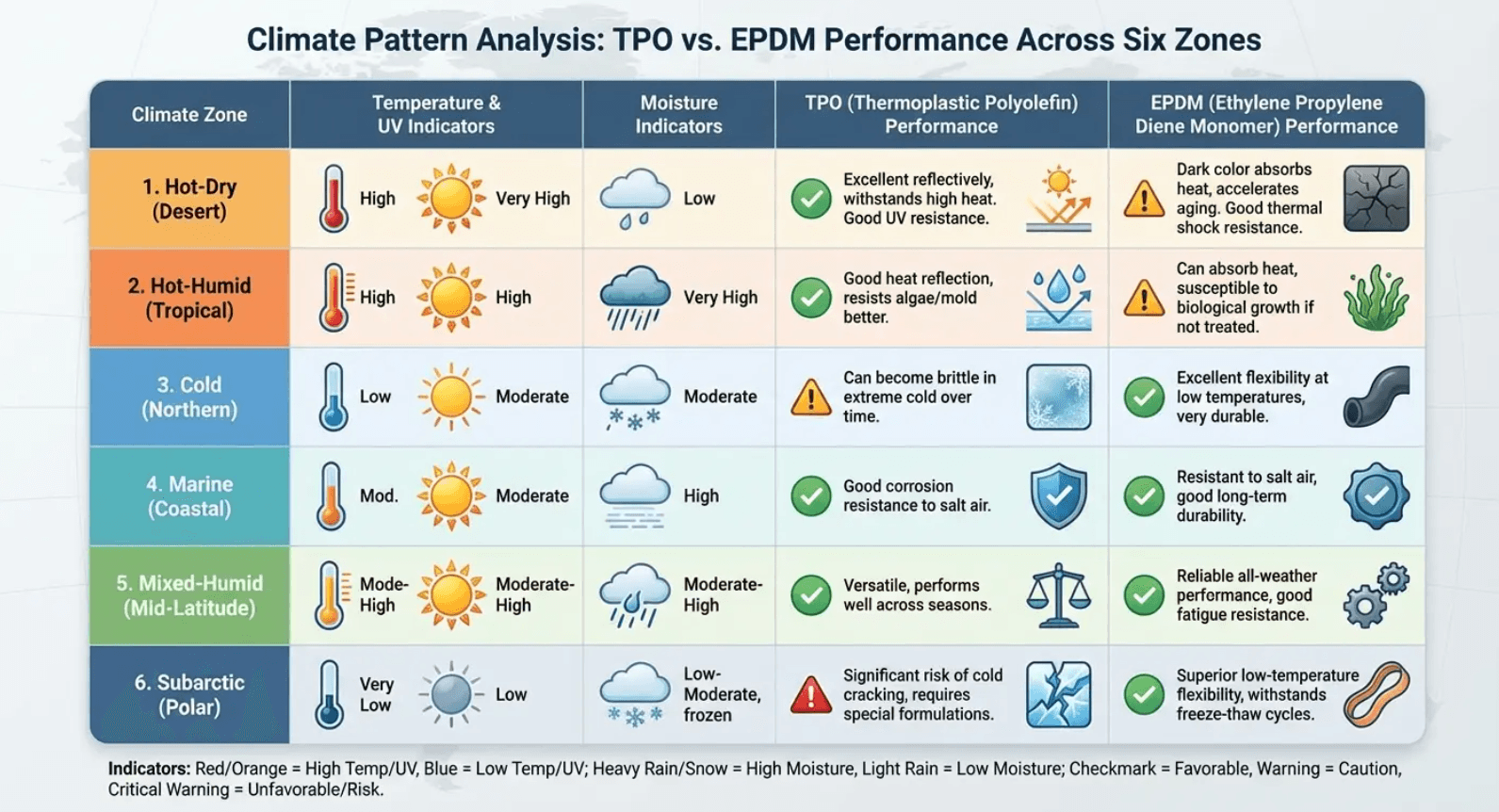
| Climate Pattern | TPO Performance Considerations | EPDM Performance Considerations |
|---|---|---|
| Desert (High UV, Extreme Daily Swings) | Accelerated brittleness from thermal cycling; excellent reflectivity when clean | Superior flexibility retention; UV resistance from carbon black; heat absorption may increase cooling costs |
| Northern (Freeze-Thaw, Snow Load) | Ice dam vulnerability at seams; brittleness worsens in extreme cold | Excellent cold-weather flexibility; handles freeze-thaw better; black surface aids snow melt and ice management |
| Humid Coastal (Moderate Temps, High Moisture, Salt) | Seam integrity critical in high-moisture environments; salt can affect surface | Moisture resistance excellent; seam adhesives may degrade faster; salt exposure minimal impact |
| Southern (Consistent Heat, High Cooling Loads) | Reflectivity provides maximum cooling benefit; requires frequent cleaning | Higher cooling costs offset by lower maintenance; longer lifespan may compensate |
| Urban Industrial (Pollution, Particulates) | Reflectivity degrades rapidly; requires aggressive cleaning schedule | Surface hides soiling; biological growth less visible but still occurs |
| Moderate Four-Season (Balanced Heating/Cooling) | Energy benefits less pronounced; thermal cycling moderate | Stable performance across seasons; fewer extreme stress events |
The decision hinges significantly on how each membrane responds to your specific climate's stress patterns over decades, not just how they perform in year one.
The Hidden Cost Structure Beyond the Invoice
True lifecycle costs extend far beyond material and installation price comparisons. I'm examining maintenance costs, repair frequency and complexity, energy performance degradation, and replacement timing. The cheaper upfront option often becomes more expensive over a 15-20 year ownership period when you account for operational realities.
Standard quotes don't capture these factors, leaving property managers to discover them years into ownership when budgets are already committed. I'm providing a framework for calculating total cost of ownership that includes factors most property managers miss when making the initial decision.
Installation Cost Differences Are Often Misleading
You'll typically see EPDM quoted at a lower installed cost than TPO. That price difference reflects material costs and installation labor, but it doesn't tell you much about long-term value. The gap has narrowed in recent years as TPO manufacturing has scaled, but EPDM usually maintains a 10-15% installation cost advantage.
That advantage disappears quickly when you factor in substrate preparation requirements. If your building needs extensive deck work or insulation upgrades, TPO's rigidity might demand more preparation investment. EPDM's conformability could save thousands in substrate work that the initial quote doesn't highlight.
I've seen projects where the "cheaper" TPO option ended up costing more after accounting for necessary substrate upgrades. Get detailed substrate assessments before comparing membrane quotes. The true installation cost includes everything required to properly install that specific membrane on your specific building, not just the membrane and labor in isolation.
A property management company in Minneapolis received bids for replacing the roof on a 1970s-era office building. The TPO bid came in at $285,000 while EPDM was quoted at $248,000. That's a $37,000 difference favoring EPDM. However, the structural engineer's deck assessment revealed multiple areas with slight depressions and minor irregularities from decades of settling. The TPO contractor revised their bid to $312,000 after including necessary substrate leveling to prevent stress points in the rigid membrane. The EPDM contractor's bid remained unchanged because the rubber membrane's flexibility could accommodate the existing deck conditions. The "cheaper" TPO option would have cost $64,000 more once substrate preparation was properly accounted for.
Energy Performance Degradation Affects Operating Costs
TPO's reflective advantage delivers real energy savings, but only if you maintain that reflectivity through regular cleaning. Factor in cleaning costs (materials, labor, or professional service) when calculating energy savings. Those costs might consume 20-30% of your cooling cost reductions.
EPDM doesn't offer the same cooling cost savings, but it also doesn't require the same maintenance investment to maintain its performance level. In northern climates where cooling costs are modest and heating dominates, this difference becomes less significant. In southern climates with high cooling loads, TPO's energy advantage might justify its higher maintenance requirements.

Calculate energy costs based on your specific building characteristics and local utility rates, not national averages. A highly insulated building in a moderate climate might see minimal energy differences between membranes. A poorly insulated building in an extreme climate might see dramatic differences that justify higher maintenance investments.
Repair Frequency Predictions Based on Building Type
Your building's characteristics predict likely repair frequency better than membrane specifications. Buildings with high rooftop traffic, multiple penetrations, and heavy mechanical loads will need more frequent repairs regardless of membrane choice. The question is which membrane's repair profile matches your maintenance capabilities.
TPO repairs are less frequent in ideal conditions but more complex and expensive when needed. EPDM repairs are more frequent but simpler and cheaper to execute. If you have in-house maintenance staff, EPDM's repair accessibility might save more than TPO's lower repair frequency.
Buildings with minimal rooftop access and few penetrations favor TPO's lower repair frequency. Buildings with regular rooftop activity and maintenance-intensive mechanical systems favor EPDM's repair simplicity. Match the membrane's repair profile to your operational reality, not to theoretical ideal conditions that don't exist in your building.
Total Cost of Ownership Calculation Template
Use this framework to compare true lifecycle costs over your expected ownership period:
Initial Investment
- Base membrane and installation cost: $______
- Substrate preparation requirements: $______
- Insulation upgrades (if needed): $______
- Walkway systems and accessories: $______
- Total Initial Investment: $______
Annual Operating Costs (multiply by ownership years)
- Cleaning/maintenance (TPO: $____ | EPDM: $____): $______
- Inspection costs (frequency × cost per inspection): $______
- Energy cost difference (calculate cooling vs. heating impact): $______
- Annual Operating Subtotal: $______
Periodic Repair Costs (estimate over ownership period)
- Minor repairs (frequency × average cost): $______
- Seam maintenance/re-sealing: $______
- Penetration flashing repairs: $______
- Emergency repair fund (3-5% of total): $______
- Repair Cost Subtotal: $______
End-of-Life Considerations
- Expected lifespan in your climate: _____ years
- Replacement timing within ownership period: Yes / No
- Salvage value or removal cost: $______
Total Cost of Ownership = Initial Investment + (Annual Operating × Years) + Repair Costs
TPO Total: $______ | EPDM Total: $______
The calculation becomes clearer when you account for every cost category over your actual ownership timeline, not just the installation invoice.
Warranty Language That Actually Protects You (and What Doesn't)
Warranty structures for both membranes focus on coverage length in marketing materials, but practical enforceability matters more. I'm examining the difference between material warranties and system warranties, prorated versus non-prorated coverage, and the maintenance requirements that void protection.
Longer warranties aren't necessarily better if they're difficult to enforce or require extensive documentation that most property managers don't maintain. Understanding which warranty provisions provide real protection versus marketing language helps you evaluate proposals more accurately.
Material Warranties Don't Cover Installation Failures
Most membrane manufacturers offer material warranties ranging from 15 to 30 years. These warranties cover manufacturing defects in the membrane itself, not installation errors, improper maintenance, or damage from external sources. Here's what kills most warranty claims: material warranties don't cover installation screw-ups. Period.
If your TPO seams fail because of improper heat welding, that's an installation issue, not a material defect. If your EPDM develops leaks at penetrations because of inadequate flashing, that's installation error. Material warranties protect you from the membrane falling apart due to manufacturing problems, which is rare with modern materials from reputable manufacturers.

The warranty that matters more is the contractor's workmanship warranty, which covers installation quality. These are typically much shorter (2-10 years) and only as reliable as the contractor's financial stability. A 30-year material warranty from the manufacturer means nothing if the contractor who improperly installed it goes out of business after five years.
Maintenance Requirements That Void Coverage
Both TPO and EPDM warranties include maintenance requirements that you must document to maintain coverage. These requirements vary by manufacturer but typically include regular inspections, prompt repairs, and specific cleaning protocols. Fail to document this maintenance, and your warranty claim gets denied even if the failure is legitimate.
TPO warranties often require annual inspections by certified contractors and documentation of any cleaning performed to maintain reflectivity. EPDM warranties typically require biannual inspections and documentation of any repairs or modifications. These requirements aren't unreasonable, but they demand administrative diligence that many property managers don't maintain.
Set up a maintenance documentation system before your roof is installed, not after you discover a leak. Digital photos with timestamps, inspection reports, repair invoices, and cleaning records create the paper trail that validates warranty claims. The membrane with the longest warranty period is worthless if you can't prove you maintained it according to manufacturer specifications.
Prorated Coverage Reduces Real Protection
Many warranties are prorated, meaning coverage decreases over time. A 20-year prorated warranty might provide 100% coverage for the first five years, then decrease by 5% annually. By year 15, you're getting 50% coverage. By year 20, you might get nothing beyond material replacement.
Non-prorated warranties maintain full coverage for the entire period, but they're less common and typically cost more upfront. Calculate the real value of warranty coverage based on the prorated schedule, not the headline warranty length. A 15-year non-prorated warranty might provide better protection than a 25-year prorated warranty when you factor in likely failure timing.
Membrane failures often occur in the 10-15 year range as materials age and installation defects become apparent. This is exactly when prorated warranties provide minimal coverage. If you're evaluating warranties as a decision factor, focus on coverage during the years when failures are most likely, not the total warranty period advertised in proposals.
When comparing options, warranty enforceability and coverage structure during critical years matter more than the total warranty duration advertised in proposals.
Making the Decision Without Regret
Real-world decision-making reveals how complex these choices become under pressure. In a recent case covered by South Shore News, the Marshfield Select Board faced intense debate over a $7.4 million school roof replacement project involving TPO versus EPDM selection. The discussion highlighted concerns about installation precision, seam reliability, and long-term cost implications, with experts warning that construction delays could trigger cost escalations of 3% or more, potentially adding $2-3 million in required accessibility upgrades if certain thresholds were exceeded. The case demonstrates how membrane selection intersects with budget constraints, timeline pressures, and regulatory requirements in ways that transcend simple material comparisons.
I'm synthesizing everything into a decision framework that you can apply to your specific situation. Rather than declaring one membrane superior, I'm providing a structured approach to evaluating which factors matter most for your building, climate, budget structure, and operational capabilities.
Prioritize Factors Based on Your Specific Building
You've absorbed a lot of information, and much of it probably contradicts what you've heard elsewhere. That's the nature of roofing decisions. There are legitimate arguments for both membranes depending on context. Your job isn't to find the objectively "better" material. It's to identify which membrane's strengths align with your building's specific needs and constraints.
Start by listing your building's characteristics: climate patterns, rooftop access frequency, mechanical equipment density, substrate condition, and available maintenance capabilities. Then list your priorities: upfront cost constraints, energy performance goals, maintenance simplicity, or maximum lifespan. Different priority combinations point toward different membranes.
A building in a moderate climate with minimal rooftop access and limited maintenance staff might favor TPO despite higher upfront costs. A building in an extreme climate with daily rooftop access and skilled maintenance teams might favor EPDM despite lower energy efficiency. Neither choice is wrong. They're optimized for different operational realities.
Question Contractors Who Push One Solution Universally
Contractors who exclusively install one membrane type will naturally recommend that membrane for every project. That's not necessarily dishonest. They're recommending what they know and install well. But it might not be what your building needs.
The best contractors assess your specific situation before recommending a membrane. They ask about your maintenance capabilities, budget structure, and operational priorities. They explain why their recommendation fits your needs rather than just listing their preferred membrane's advantages.
I've helped property managers sort through conflicting contractor recommendations by focusing the conversation on building-specific factors rather than generic membrane comparisons. When evaluating proposals, demand explanations that address your building's unique characteristics, not standardized sales presentations.
Plan for Your Actual Ownership Timeline
If you're planning to sell the building in five years, your decision criteria differ dramatically from someone expecting 20-year ownership. Short-term owners might prioritize upfront cost and immediate energy savings. Long-term owners should focus on total lifecycle costs and maintenance simplicity.
TPO's higher upfront cost and energy advantages might appeal to short-term owners who benefit from immediate cooling cost reductions and can sell before major maintenance needs arise. EPDM's lower upfront cost and simpler maintenance might better serve long-term owners who'll handle repairs and eventual replacement.
Be honest about your ownership timeline when making this decision. The "best" membrane for a five-year hold might be the wrong choice for a 20-year hold, and vice versa. Your investment horizon should inform your decision as much as any technical specification.
Accept That Perfect Information Doesn't Exist
You'll never have complete certainty about which membrane will perform better on your specific building over the next 20 years. Too many variables affect performance, and many of them won't be apparent until years after installation. You're making the best decision possible with available information, not a guaranteed perfect choice.
Both TPO and EPDM are proven, reliable membranes when properly installed and maintained. Your building will likely perform well with either option if you choose a qualified contractor and commit to proper maintenance. The decision matters, but it's not make-or-break for your building's future.
Focus on controllable factors: contractor selection, installation quality verification, maintenance documentation, and regular inspections. These factors often determine performance more than the membrane choice itself. A well-installed and maintained EPDM roof will outperform a poorly installed TPO roof every time, and vice versa.
Final Thoughts
Look, I've thrown a lot at you. Maybe too much. But here's what I actually want you to remember:
The contractor matters more than the membrane. I've seen EPDM roofs last 40 years and TPO roofs fail in 5. The difference? Installation quality.
If you're in a climate with extreme temperature swings, lean toward EPDM. If you've got high cooling costs and can commit to maintenance, TPO might work. If you have daily rooftop access, EPDM. If your roof is pristine and nobody goes up there, either works.
But honestly? Most of you will make this decision based on whoever gives you the lowest bid. I get it. Budgets are tight. Just know that the cheapest roof today often becomes the most expensive roof over 20 years.
One last thing: whatever membrane you choose, make them test the seams. Every single one. I don't care if it adds $5,000 to the project. Untested seams are where roofs go to die.
Good luck. You're going to need it.