
March 31, 2026
Instant Roof Quote: Why the Wrong Price Screws You Worse Than No Price At All
Author
An instant roof quote sounds convenient. Enter your address, answer a few questions, and get a price for a roof replacement in minutes.
But those quick estimates rarely tell the full story.
Most instant roof quote tools rely on satellite images and basic averages to calculate your price. They can estimate square footage, but they can’t see roof pitch changes, damaged decking, ventilation issues, or flashing problems around chimneys and skylights. Those hidden factors are often what drive the real cost of a roofing project.
This guide explains why instant roof quotes can be misleading, what they miss, and how homeowners can use them the right way—without setting unrealistic expectations for the actual cost of a new roof.
If you're evaluating roofing costs or trying to understand potential repairs, it also helps to know whether a roof leak repair can wait or needs immediate attention. Understanding the urgency behind roofing issues can help you make smarter decisions before relying on a quick online estimate.
TL;DR
- That instant quote you got in 2 minutes? It's based on satellite photos and guesswork. Your actual roof is way more complicated.
- The cheapest quote isn't a deal: it's the most optimistic guess about what's wrong with your roof.
- Use instant estimates to ballpark your budget, not to pick a contractor. The difference between the instant number and reality tells you how messy your roof actually is.
Fast Quotes Cost You Money Later
I know why you're here. Your roof is leaking, or your neighbor just got theirs done, or you're trying to figure out if you can afford this before winter. You want a number. Fast.
Last week, a woman called me furious. She'd gotten an instant roof quote online for $11,500, budgeted accordingly, and then had three contractors come out. All three came back around $16,000. She thought everyone was trying to rip her off.
They weren't. The algorithm just had no idea what it was looking at.

Here's what happens. You get that instant quote, lock in that number mentally, and then feel betrayed when reality doesn't match the algorithm's prediction. The frustration makes sense. You're just mad at the wrong people.
Look, most contractors aren't trying to scam you, and these instant quote systems aren't intentionally lying. The problem is simpler: roofs are complicated and algorithms aren't. Your roof has a story: decades of weather exposure, previous repairs, structural quirks, code compliance gaps that no algorithm can read from space.
What These Tools Actually See (And What They Miss)
Instant quote systems are good at exactly one thing: measuring your roof from space and multiplying by the going rate in your zip code.
That's it.
Everything else? They're guessing.
Cool, you've got square footage. Now what about everything else? Roof pitch affects both material waste and labor hours. A 4/12 pitch roof uses standard installation methods, but an 8/12 pitch requires additional safety equipment, slower work speeds, and potentially different material handling. Your online estimate treats them identically.
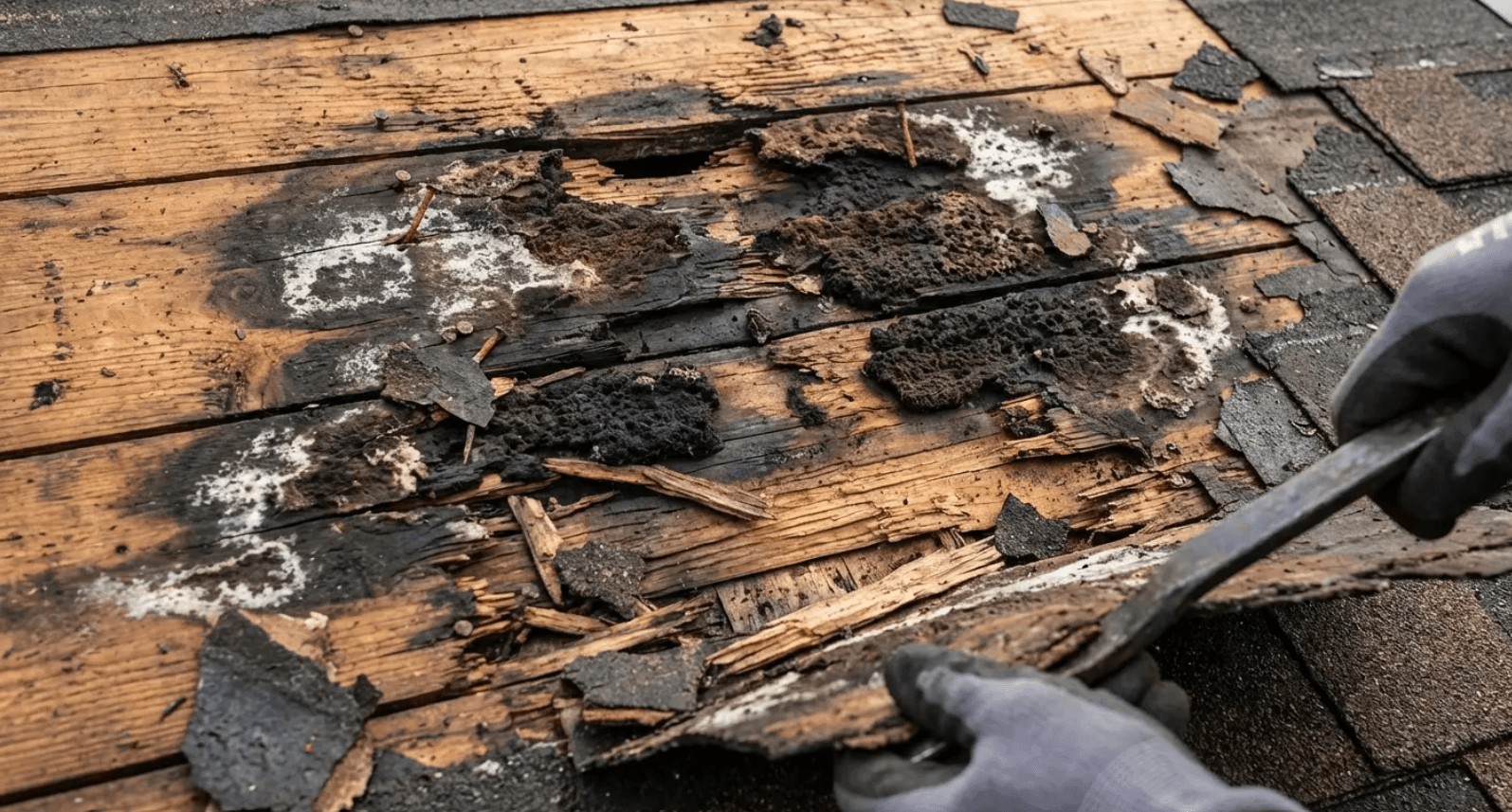
Substrate condition remains invisible until someone physically inspects your roof deck. You might need complete sheathing replacement in sections where water damage has compromised structural integrity. The algorithm assumes your decking is sound because it has no way to check.
The Complexity Factors Algorithms Ignore
Access challenges don't show up in satellite photos. Is your roof surrounded by mature trees that make material delivery difficult? Are there power lines restricting crane placement? Does your HOA require specific staging protocols that add time and cost?
None of that registers in an instant system.
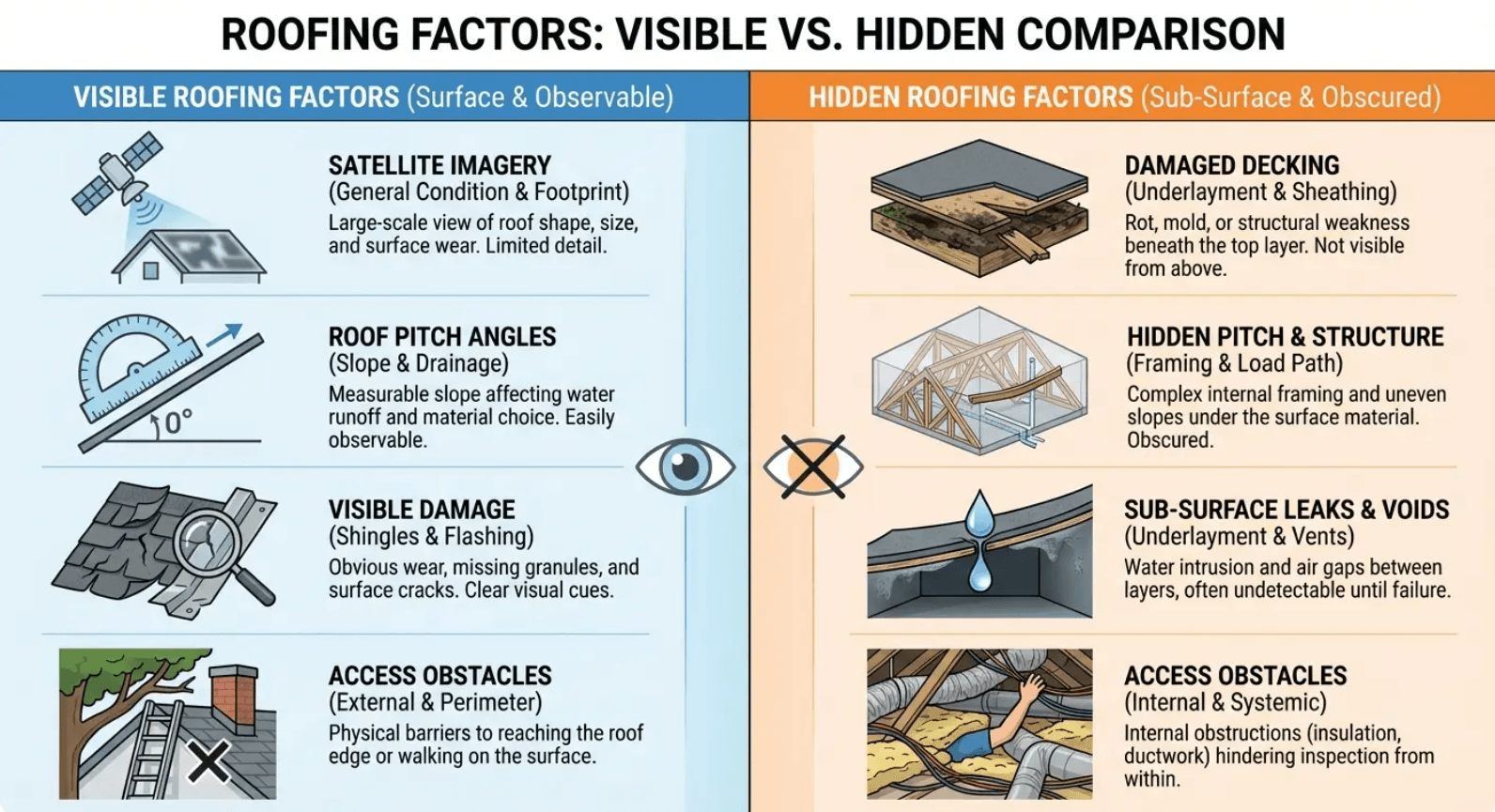
| What Instant Quotes Measure | What They Miss | Potential Cost Impact |
|---|---|---|
| Square footage from satellite imagery | Roof pitch variations (4/12 vs 8/12) | 15-25% labor increase |
| Regional average material costs | Substrate/decking condition | $2,000-$8,000+ in repairs |
| Basic labor multipliers | Access challenges (trees, power lines, HOA restrictions) | $500-$3,000 in logistics |
| Standard installation assumptions | Ventilation code compliance upgrades | $1,200-$2,500 |
| Generic penetration counts | Custom flashing complexity (chimneys, skylights, dormers) | $300-$1,200 per feature |
Ventilation requirements vary based on attic configuration and local building codes. Your roof needs to breathe. Ridge vents at the top, soffit vents at the bottom, proper airflow between them. It's not optional: it's code. And it costs money the instant quote doesn't account for.
Flashing complexity around chimneys, skylights, dormers, and wall intersections requires custom fabrication and skilled installation. Each penetration point adds labor hours and material costs that square footage calculations miss entirely.
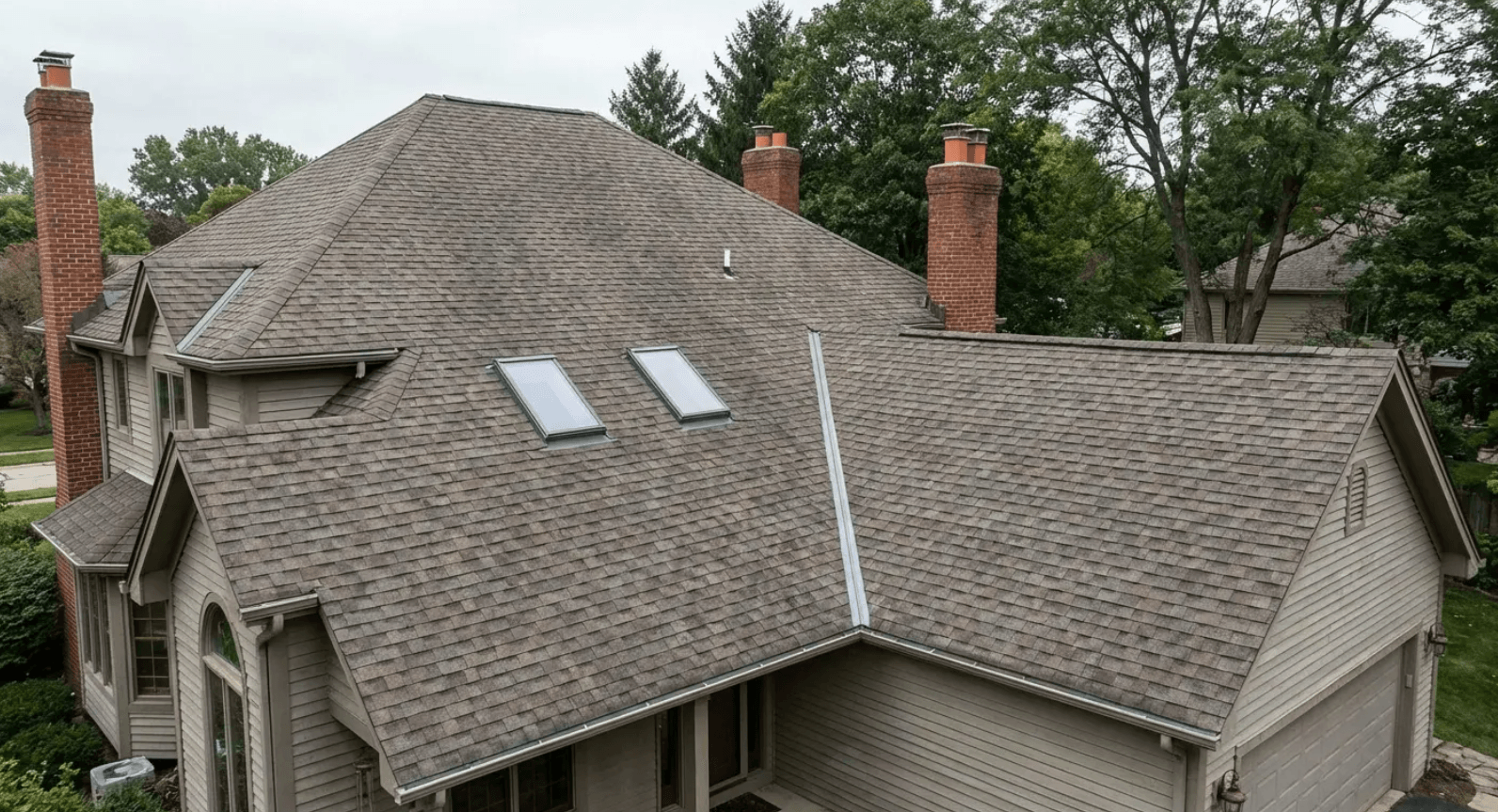
Last month I looked at this colonial in the Heights. Nice house, 2,400 square feet, but a nightmare roof: three chimneys, two skylights, and this weird valley where the garage meets the main house.
The homeowner showed me her instant quote: $12,000.
I walked on the roof and found exactly what I expected. Every chimney needed custom flashing ($800 each). Both skylights were leaking and needed to be reflashed ($600 each). That valley? Total mess. We'd need to fabricate custom metal for it ($1,200), plus the decking underneath was rotted from years of water pooling there ($2,400).
My estimate: $18,600.
She thought I was ripping her off. I showed her the rot. She got two more estimates. Both came back around $17,500-$18,000.
The algorithm had no idea.
Why Your Roof's Real Story Doesn't Fit Into an Algorithm
Every roof has a story. Yours might have been installed during a boom period when contractors cut corners. Maybe the previous owner added a room addition without properly integrating the new roof section. Perhaps decades of patch jobs have created a patchwork of different materials and installation methods.
Instant roof estimate systems start from zero history. They assume a standard installation on a standard home with standard conditions.
Your home isn't standard, and pretending it is costs money.
The Age Factor Nobody Discusses
Older homes present challenges that don't scale linearly with square footage. We're not just talking about removing additional layers of old shingles (though that's part of it). Building codes have evolved significantly over the past 30-40 years. Bringing an older roof up to current code often requires structural modifications that instant quotes never anticipate.
Rafter spacing, decking thickness, and attachment methods that were acceptable in 1985 don't meet 2024 wind resistance requirements in many jurisdictions. Upgrading these elements isn't optional. It's legally required, and it's expensive.
Modern instant quote tools have gotten better at estimating removal costs for multiple shingle layers. They still can't tell you whether your roof deck will pass inspection once those layers come off.
Regional Complications That Break the Model
You live somewhere specific, with specific weather patterns, specific code requirements, and specific material availability. Instant quotes apply regional averages that smooth over crucial local variations.
Coastal homes face salt air exposure that requires upgraded fasteners and underlayment. Mountain properties deal with snow load requirements that affect both structure and material selection. Desert roofs need UV-resistant materials and ventilation systems designed for extreme heat.
The algorithm knows your zip code. What it doesn't know is which microclimate zone you occupy within that zip code or how your specific lot conditions (elevation, exposure, surrounding structures) affect material performance and installation requirements.
I've inspected homes three blocks apart where one needed minimal work and the other required extensive structural upgrades, despite identical square footage and similar age. The difference? One sat in a wind tunnel created by surrounding buildings. The other enjoyed protection from mature trees. Satellite imagery caught neither factor.
The Three Questions No Instant Quote Can Answer Without Seeing Your Home
We've established what instant quotes miss. Here's what you actually need to know before signing a contract, and why remote tools can't provide these answers.
First Thing: What's Actually Broken?
Instant roof quotes assume you need a full replacement. Maybe you do. Maybe you need targeted repairs that cost 15% of a full replacement. Maybe you need a full replacement plus structural repairs that cost 40% more than a standard reroof.
You can't determine scope without actually looking at the roof. That leak in your bedroom might stem from failed flashing around your chimney, compromised pipe boots, or damaged shingles in a specific section. Replacing your entire roof fixes the problem but potentially wastes tens of thousands of dollars.
On the flip side, that small leak might indicate widespread decking damage that isn't visible from the surface. You won't know until someone walks your roof and checks attic conditions.
Last spring, this guy calls me up, says he got a quote for $9,500 online, wants to know when we can start. I get out there and the "roof replacement" he needed was a $350 vent boot. But (and here's the thing) while I'm up there I find this Frankenstein repair job from the previous owner that's failing across 200 square feet. Final bill: $2,800. Less than the full replacement, more than he thought he needed. The algorithm had no way to know any of that.
Second: What's the Right Solution for Your Situation?
Material selection involves tradeoffs between cost, longevity, aesthetics, and performance. Instant quotes typically price out architectural shingles because they're the most common residential roofing material. Your home might benefit from metal roofing, tile, or premium synthetic products depending on your priorities and budget.
These aren't just aesthetic choices. They're functional decisions that affect your home's energy efficiency, resale value, and long-term maintenance costs. A qualified contractor can explain these tradeoffs based on your specific roof design and local climate. An algorithm can't.
Before accepting any roofing quote, think about: How long are you staying in this house? Because if you're selling in 5 years, don't pay for a 50-year roof. Does this material actually work in your climate, or are you buying something that looks good but won't last? What's it going to do to your cooling bills? And for God's sake, check with your HOA before you fall in love with metal roofing. I've seen that fight too many times.
I've had homeowners initially request the cheapest shingle option based on their instant roof estimate budget, only to realize after discussion that spending 20% more on metal roofing would pay for itself in energy savings and longevity within their ownership timeline. That conversation doesn't happen with a free roofing quote algorithm.
Third: Who's Actually Doing the Work?
This matters more than you think. Instant quote platforms often connect you with contractor networks rather than specific companies. The crew that shows up might be a top-tier local company or a volume-focused operation that prioritizes speed over quality.
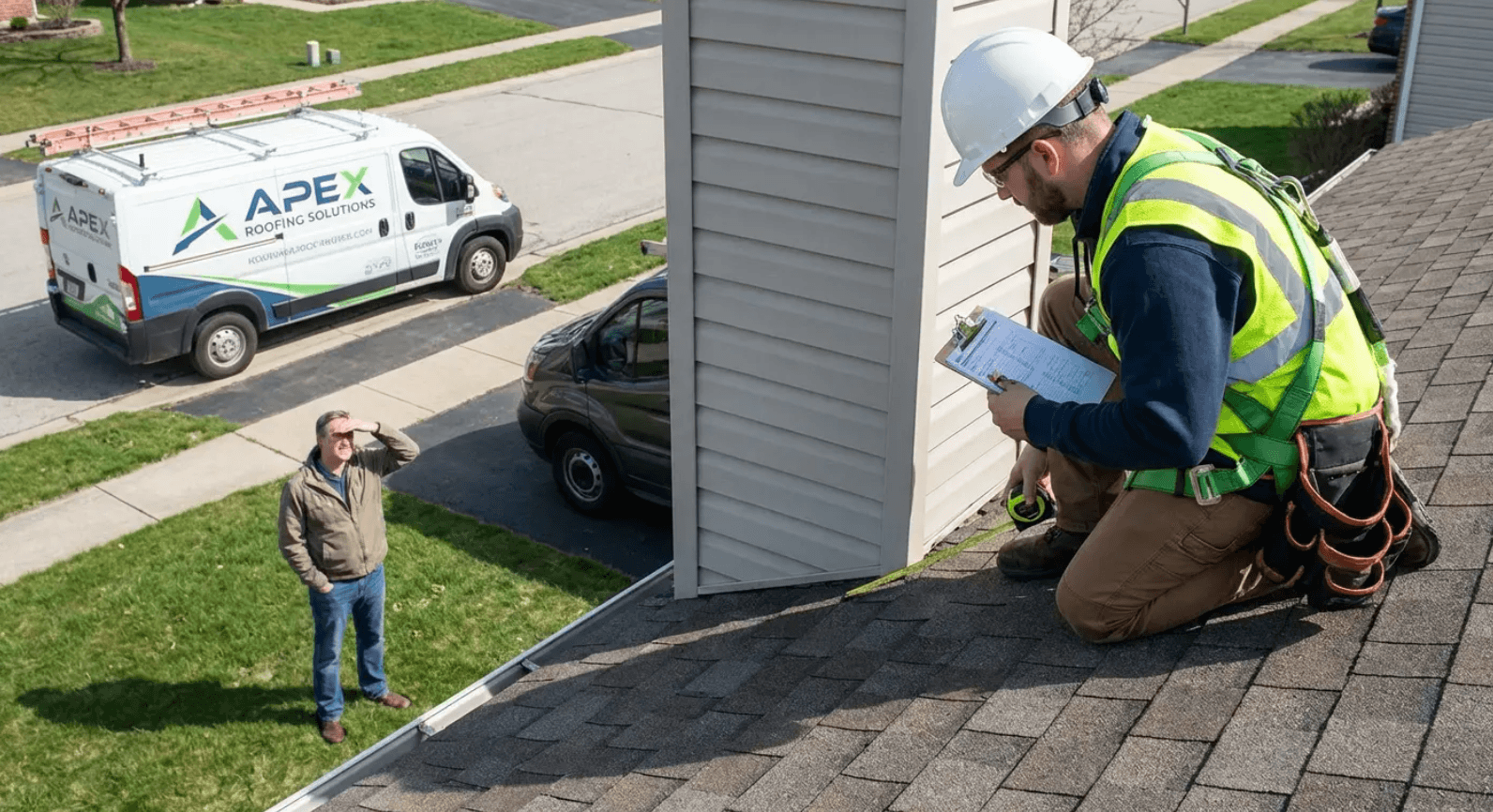
You can't evaluate workmanship quality, warranty reliability, or installation standards through an instant quote form. You need to meet the contractor, check references, verify licensing and insurance, and assess whether their communication style and business practices align with your expectations.
When Digital Estimates Create More Problems
Instant quotes aren't neutral tools. They shape expectations and influence decisions in ways that can hurt you as a homeowner.
Here's where instant quotes actually screw you. You get five of them, and obviously you're going to lean toward the cheapest one. That's not stupid: that's human. But that cheap quote? It's cheap because it's making the most optimistic assumptions about your roof.
Now you've anchored your brain to that number. When a good contractor comes out and gives you an honest estimate that's 30% higher, it feels like they're ripping you off. They're not. They're just accounting for reality.
And some contractors (not all, but enough that I have to mention it) they'll lowball the instant quote on purpose. Get you hooked on that number, start the job, then hit you with change orders. "Oh, your decking needs work. That's extra. Oh, your ventilation doesn't meet code. That's extra." Each charge sounds reasonable, but you're paying more than the honest guys quoted in the first place. And you're stuck because stopping mid-project means your house is open to the weather.
You can collect seventeen instant quotes if you want. You'll have seventeen slightly different wrong numbers. Congratulations.
You end up spending hours comparing quotes that aren't comparable, delaying the decision while your roof continues deteriorating. One system prices premium underlayment as standard. Another assumes basic synthetic underlayment. A third includes ventilation upgrades while the fourth doesn't. The price variations don't reflect competitive differences. They reflect different scope assumptions you can't see.
How to Use Instant Quotes Without Getting Burned
Instant quotes aren't evil. They're just incomplete. Here's how to use them strategically without falling into the traps we've discussed.
Think of Them as Ranges, Not Prices
When you receive an instant roof quote of $12,000, mentally convert that to a range: $10,000-$16,000. This keeps you from anchoring to a specific number that was never meant to be precise.
The actual price will fall somewhere in that range depending on factors the algorithm couldn't measure. If the final estimate comes in at $15,500, you're not being over
The actual price will fall somewhere in that range depending on factors the algorithm couldn't measure. If the final estimate comes in at $15,500, you're not being overcharged. You're seeing the impact of real-world complexity that the instant system couldn't account for.
Use Them to Identify Outliers
If you get three instant quotes around $12,000-$14,000 and one at $7,500, that outlier deserves scrutiny. Either that system is using fundamentally different assumptions (measuring only the main roof section and excluding the garage, for example), or it's a lowball designed to get you in the door.
Similarly, if one quote comes in at $22,000 while others cluster around $13,000, investigate why. Maybe that system is pricing premium materials while others assume standard products. Understanding these variations helps you ask better questions during in-person consultations.
Ask About the Assumptions
When contractors provide estimates, ask what assumptions they're making. Specifically:
- What condition are you assuming my roof deck is in?
- Does this include bringing ventilation up to current code?
- What material grade and brand are you pricing?
- How many layers of old roofing are you assuming need removal?
- What complexity factors might increase this price once work begins?
Contractors who provide detailed answers to these questions are showing transparency. Those who get defensive or vague are revealing how they operate.
I've found that homeowners who document their comparison process make better decisions and feel more confident about their choice. Compare contractors on multiple dimensions rather than price alone; that protects you from the race-to-the-bottom trap that instant quotes often create.
Why Waiting for a Real Estimate Actually Helps
I know, waiting sucks. You want to know what this is going to cost, you want to know now, and some algorithm promising you an answer in 90 seconds sounds perfect.
But here's what happens in that waiting period while you're scheduling appointments: you actually research the people who might be climbing on your roof. You check their license, read reviews, ask your neighbors. With instant quotes, you skip all that because you've got a number in your head and you're ready to move. That's how people end up hiring contractors they know nothing about.

The push toward instant digital solutions continues to reshape the roofing industry. In July 2025, Jensen Exteriors launched their "Instant Roof Replacement Quote" feature on their website, allowing homeowners to receive accurate roof replacement estimates instantly by simply entering their street address. While this innovation addresses the legitimate desire for quick information, it also compresses the traditional vetting timeline that protects homeowners from making rushed decisions about five-figure investments.
Space to Ask Better Questions
The delay between requesting and receiving an estimate gives you time to educate yourself about roofing systems, material options, and common problems. You arrive at the in-person consultation prepared to ask informed questions rather than passively receiving information.
This preparation shifts the power dynamic. You're not a confused homeowner at the mercy of expert advice. You're an informed consumer evaluating whether this contractor's recommendations align with your research and priorities.
Opportunity to Get Multiple Perspectives
In-person estimates take time to schedule and conduct. This naturally limits you to three or four detailed consultations rather than dozens of instant quotes.
That limitation helps you. You're getting deep, nuanced assessments from a few qualified contractors rather than superficial numbers from many unknown sources. You can compare their diagnostic assessments, recommended solutions, and communication styles. This qualitative information matters more than price variations.
Finding the Balance Between Speed and Certainty
Look, I'm not saying instant quotes are useless. Use them to figure out if you're looking at a $10,000 project or a $30,000 project. That's helpful for budgeting. Just don't use them to pick a contractor or lock in your expectations.
Start with an instant roof quote to establish baseline expectations and budget parameters. Use that information to determine whether a roofing project fits your current financial situation. If the instant quote suggests your roof replacement will cost $20,000 and you have $8,000 available, now you know you need to either adjust your timeline or explore financing options before investing time in detailed consultations.
Once you've confirmed the project is financially feasible, request in-person estimates from three qualified contractors. Use the instant quote as a reference point for evaluating their assessments, but don't anchor to it rigidly.
During in-person consultations, share your instant quote results and ask contractors to explain any significant variations. Reputable contractors will appreciate your research and use it as a starting point for education rather than feeling threatened by it.
If you're dealing with an urgent situation (active leaks, storm damage, insurance deadlines) instant quotes help you quickly identify whether you're facing a $5,000 problem or a $25,000 problem. That information guides your immediate next steps even though you'll need detailed assessments before proceeding with repairs.

When Joyland Roofing Enters the Conversation
Yeah, we have an instant quote tool on our website too. I'm not going to pretend we don't. But I'll tell you the same thing I tell everyone who calls after using it: that number is a starting point. It's not a promise, and it's not a bid.
Here's what I've found after years in this business: homeowners who start with our in-person assessment process are consistently happier with their final results than those who shop primarily on instant pricing. Not because our prices are lower (they're competitive but not the cheapest), but because they understand exactly what they're getting and why it costs what it costs.
When I come out to look at your roof, you'll get a written estimate that shows you exactly what we found and what it costs to fix it. Line by line. If you want to know why we're recommending certain materials or why the price is what it is, I'll explain it. No games.
Call us, we'll come look at your roof for free, and you'll know what you're actually dealing with. That's it.
Final Thoughts
So are instant quotes evil? No. Are they accurate? Also no. They're a rough starting point that works if you treat them like a rough starting point.
The number you get in three minutes reflects educated guesses about your roof's square footage and regional pricing averages. It doesn't reflect your roof's condition, your home's specific complications, or the quality of work you'll receive. Treating it as a final answer sets you up for budget shock, contractor conflicts, and decision paralysis.
Use instant quotes for what they do well: establishing rough budget parameters and identifying pricing outliers. Then invest time in the assessment process that matters. Walk your roof with qualified contractors who can see what algorithms can't. Ask questions about their assumptions, their material recommendations, and their installation processes.
The gap between your instant quote and your final invoice tells you how much complexity your roof contains. A small gap suggests your roof is relatively straightforward. A large gap reveals problems that needed professional diagnosis to uncover. Either way, you're better off knowing the truth before work begins than discovering it mid-project.
Your roof protects everything else you own. It's worth having someone actually look at it before you spend five figures on it. The algorithm can't see what's broken. I can. That's the difference.