March 30, 2026
Patio Roof Ideas That Actually Solve Problems (Not Just Look Pretty)
Author
Let’s get something straight before you scroll any further: most patio roof ideas look great in photos - but fall apart in real life.
Because this isn’t just about picking a design that “fits your vibe.” It’s about choosing a structure that actually works with your climate, your home, and how you use your outdoor space. And that’s where most homeowners get it wrong. They start with aesthetics… and end up paying for it later in repairs, upgrades, or a space they barely use.
The truth? A patio roof isn’t just an add-on - it’s a performance decision. The right choice can extend your living space, protect your investment, and even lower energy costs. The wrong one? It becomes an expensive lesson in why function should’ve come first.
That’s exactly what this guide is here to fix. No recycled inspiration boards. No vague recommendations. Just real-world insight into Patio Roof Ideas that actually solve problems - so you don’t end up redesigning the same space twice.
If you want to understand how roofing really works (and why most installations fail long-term), start here - it’ll completely change how you approach this project.
Table of Contents
- TL;DR
- Why Most Patio Roof Decisions Start With the Wrong Question
- The Hidden Cost of Choosing Style Over Function
- Material Choices That Won't Make You Regret Your Budget
- How Climate Dictates Everything (And Why You're Probably Ignoring It)
- The Maintenance Reality Nobody Talks About Until Year Three
- Permit Nightmares and How to Avoid Becoming a Cautionary Tale
- Integration Points That Make or Break Your Investment
- When to Walk Away From a Patio Roof Project Entirely
TL;DR
- Stop choosing patio roof ideas based on what looks good on Instagram—what works in photos often fails in real life.
- Your climate should dictate every material choice before you even think about aesthetics.
- That “cheap” installation? It’ll cost you significantly more over five years than doing it right the first time.
- Permits aren’t optional - no matter what your contractor buddy says.
- Skipping permits can turn into a serious resale nightmare down the line.
- Sometimes the smartest decision isn’t choosing between patio roof ideas - it’s realizing a patio roof doesn’t make sense for your situation at all.
Why Most Patio Roof Decisions Start With the Wrong Question
You've been down a Pinterest rabbit hole for three weeks now. I know this because you're here, reading a 5,000-word article about patio roofs instead of just calling a contractor and getting it done.
Good.
That means you're smarter than most people who call me.
Here's what usually happens: Someone sees a gorgeous cedar pergola on Instagram, all moody lighting and expensive outdoor furniture, and they call me up asking if I can build "exactly that." And I have to be the one to explain that what works in Santa Barbara is going to be a rotted-out disaster in Houston.
Fun conversation.
So before you fall in love with another picture that has nothing to do with your actual climate, your actual budget, or your actual problems, let's talk about what you're really trying to accomplish here.
The impulse to prioritize appearance makes sense when you consider how outdoor design experts frame the conversation. According to Annie Thornton, outdoor design expert at Houzz, "shade covers can provide protection from the hot afternoon sun or visually divide a patio into 'rooms,' but keep in mind that they may affect how you plan for patio size." Even the design people admit these things mess with your space planning. But most homeowners don't think about that until they've already ordered furniture that doesn't fit.
Here's what happens when you start with the wrong question: You fall in love with a design that solves problems you don't have while ignoring the problems you do. That gorgeous lattice pergola you saw? Beautiful filtered light in dry climates. Zero protection from rain. The solid metal roof that looks so contemporary? Might turn your kitchen into a cave by blocking all natural light from south-facing windows.
I've seen this play out a hundred times.
Before you browse another patio roof idea, answer these questions:
What weather am I actually dealing with? Rain, UV, snow, wind. Be honest, not what you wish your climate was. You can't solve all of them with one structure, and trying to means solving none of them well.
When will I use this space? Summer evening dinners are different from year-round weather protection. If the answer is "summer evenings," you're designing for like 60 days a year.
What's happening out here? Dining needs different coverage than outdoor cooking. Lounging has different requirements than hosting large gatherings.
What rooms might lose light? This matters more than you think until you're living with a dark kitchen at noon.
Is this for resale value or personal use? The answer changes everything from materials to budget.
What's my realistic budget for installation AND the next 10 years? Notice I said realistic. The installation cost is only part of your true investment.
Can I maintain this, or do I need something that takes care of itself? Be honest. Your answer should eliminate entire categories of materials right now.
The Real Problems Patio Roofs Solve (When Done Right)
UV protection sounds straightforward until you realize what it actually means for your situation. Protecting expensive outdoor furniture from sun damage? You need high-opacity materials with heat-reflective surfaces. Clear polycarbonate panels might look sleek, but they'll let UV rays destroy your cushions within two seasons.
Rain shelter seems obvious until you realize that "keeping things dry" requires proper pitch, integrated gutters, and solid coverage. Those beautiful open-lattice designs you’ve been admiring in popular patio roof ideas? They're decorative structures, not functional rain protection. I've seen countless people discover this distinction after their first major storm.
Temperature control demands more than just shade. Want to reduce heat on your patio during summer afternoons? You need materials that reflect rather than absorb heat. Dark metal roofs might look stunning, but they can increase ambient temperature by 15-20 degrees compared to reflective alternatives.
The benefits extend beyond the obvious. A well-designed patio roof can reduce cooling costs for adjacent interior rooms by shading walls and windows during peak sun hours. It can create defined outdoor zones that increase perceived home value during resale. It can protect grills and outdoor kitchens from weather damage, extending their lifespan by years.
But here's what most people miss: each benefit requires specific design features that may conflict with other goals.
You need to prioritize.
| Primary Problem | Required Design Features | Materials to Consider | Materials to Avoid |
|---|---|---|---|
| UV Protection | High opacity, heat-reflective surface | Metal with reflective coating, solid wood, composite | Clear polycarbonate, glass, open lattice |
| Rain Shelter | Solid coverage, proper pitch (min 1/4" per foot), integrated gutters | Metal roofing, sealed wood, solid polycarbonate | Shade sails, pergolas without roofing, fabric canopies |
| Temperature Control | Insulated panels, air gap design, light-colored surfaces | Insulated aluminum, composite with thermal breaks | Dark metal, solid glass, heat-absorbing materials |
| Light Filtering | Partial transparency, adjustable louvers | Louvered systems, translucent panels, retractable fabric | Solid opaque materials, completely open structures |
| Wind Protection | Low profile, secure anchoring, enclosed sides option | Reinforced metal framing, engineered wood, tempered glass panels | Lightweight fabric, unsecured umbrellas, tall freestanding structures |
What Happens When You Skip This Step
The Mitchells, a nice couple in Portland, retired, way too trusting. They spent $8,000 on a cedar lattice pergola after seeing similar designs in coastal magazines and trending patio roof ideas online. The structure looked stunning and provided dappled shade on sunny afternoons. I tried to warn them. Portland gets 43 inches of rain. That open lattice design? Zero protection.
They didn't listen.
The patio remained unusable during the times they would've valued it most. Rainy spring and fall evenings when temperatures were perfect but precipitation made outdoor time impossible. Within two years, they spent another $4,200 installing polycarbonate roof panels over the pergola.
Essentially paying twice for a solution that could've been designed correctly from the start.
The husband just kept saying "We should've listened to you."
Yeah, buddy. You should've.
Beautiful lattice works for sun control in dry climates. It fails completely as rain protection in wet regions.
I've also worked with homeowners who installed solid roofs for complete weather protection, then realized they'd turned their covered patio into a dark, uninviting space that felt more like a basement than an outdoor room. The adjacent kitchen lost all natural light from its patio-facing windows, requiring artificial lighting even during midday hours.
This happens all the time.
The frustration compounds when you realize you've spent thousands on a structure that doesn't extend your outdoor season as intended. You imagined cozy fall evenings under your new roof, but instead you have a space that works for three months of the year and sits unused the rest of the time.
The Hidden Cost of Choosing Style Over Function
That $5,000 patio roof installation seems reasonable until you're writing checks for repairs and maintenance every six months. I'm going to walk through the math that most contractors won't show you. The five-year total ownership cost that reveals whether you're making a smart investment or setting money on fire.
Certain beautiful materials—often featured in budget-friendly patio roof ideas - require replacement or extensive repairs within five years, turning what seemed like a smart choice into a compounding expense nightmare.
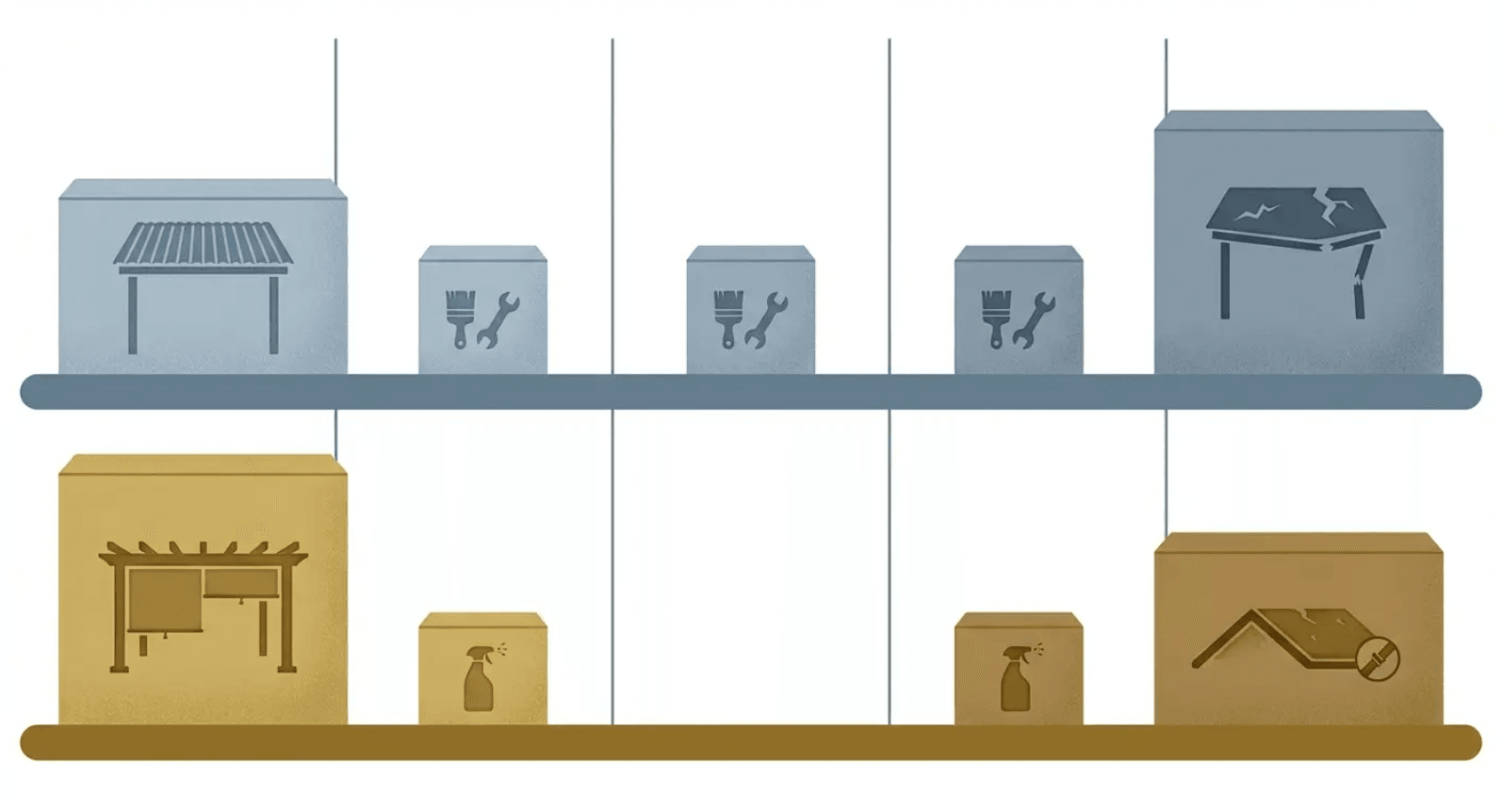
I've tracked the actual costs homeowners face across different installation tiers. The numbers don't lie.
The Five-Year Total Ownership Calculator
Installation price represents only the beginning of your financial commitment. Annual maintenance requirements, expected repair frequency, cleaning costs (whether you do it yourself or hire professionals), energy impact on adjacent rooms, and depreciation versus appreciation effects on home value all factor into your true investment.
A $3,000 installation might cost $8,000 over five years when you factor in bi-annual sealing at $200 per application, gutter cleaning, structural adjustments to correct settling issues, and fastener replacement as screws work loose under thermal expansion and contraction cycles.
Actually, let me back up. That sounds worse than I meant it. What I'm saying is this: cheap installations require constant babysitting.
Conversely, a $7,000 installation with durable materials might cost only $7,500 total over the same period. The upfront premium pays for itself through reduced maintenance demands and eliminated repair costs.
Here's the breakdown:
| Cost Category | Budget Installation ($3,000-$5,000) | Mid-Range Installation ($6,000-$9,000) | Premium Installation ($10,000+) |
|---|---|---|---|
| Year 1 | Installation + $200 sealing | Installation + $100 inspection | Installation (warranty period) |
| Year 2 | $300 repairs + $200 sealing | $150 cleaning | $100 cleaning |
| Year 3 | $500 structural adjustment + $200 sealing | $200 sealing + $150 cleaning | $150 cleaning |
| Year 4 | $400 fastener replacement + $200 sealing | $250 minor repairs + $200 sealing | $200 sealing |
| Year 5 | $800 partial replacement + $200 sealing | $150 cleaning | $150 cleaning |
| 5-Year Total | $8,000+ | $7,200 | $10,600 |
| Cost Per Year | $1,600 | $1,440 | $2,120 |
| Resale Value Added | $0-$2,000 (buyers see through cheap work) | $4,000-$6,000 | $7,000-$10,000 |
Notice how the budget installation becomes the most expensive option when you account for ongoing costs and the lack of resale value. Buyers recognize cheap installations. They either demand price reductions or mentally write off the structure entirely during valuations.
Request maintenance schedules from contractors before committing to any installation. If they can't provide specific timelines for sealing, inspection, cleaning, and expected repair intervals, you're dealing with someone who either doesn't know or doesn't care about long-term performance.
Both scenarios should send you looking for different contractors.
The energy impact deserves special attention. Poorly designed patio roofs can increase interior cooling costs by trapping heat against your home or blocking natural ventilation patterns. I've measured temperature increases of 8-12 degrees in adjacent rooms after solid roof installations that blocked windows and disrupted airflow. That translates to $40-80 monthly increases in summer cooling costs. Another hidden expense that compounds over time.
When "Low Maintenance" Actually Means "Frequent Replacement"
Marketing language around maintenance-free materials deserves serious skepticism. Some products marketed as low-maintenance simply fail quickly rather than requiring upkeep, forcing replacement instead of repair. You're not avoiding maintenance. You're just deferring all costs to a single catastrophic replacement event.
A guy in Phoenix installed a composite pergola system marketed as "maintenance-free" and "perfect for all climates." For the first 18 months, the structure performed beautifully with zero upkeep required. Phoenix gets over 4,000 hours of bright sunshine annually, though, and that intense UV exposure started breaking down the composite material's binding agents.
By month 24, the pergola beams showed visible warping and surface cracking. By year three, the structural integrity was compromised enough that the entire system required replacement. The manufacturer's warranty excluded "environmental degradation," leaving him with a $6,800 replacement cost.
A powder-coated aluminum system would've cost $2,000 more initially but would've lasted 20+ years in the same conditions without degradation. The "maintenance-free" composite became the most expensive option when the replacement cycle was factored in.
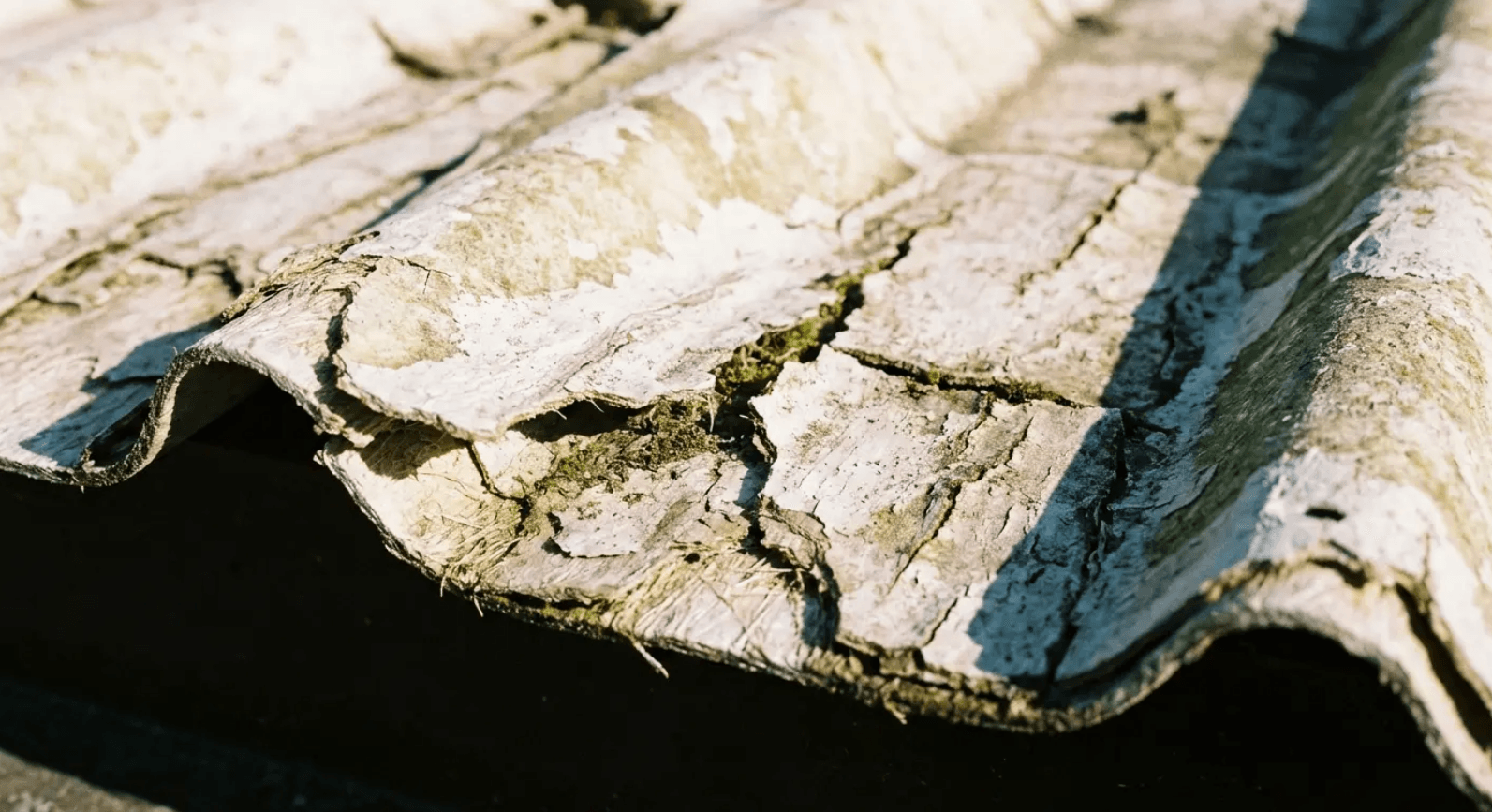
Certain composite materials degrade in specific climates despite being sold as universal solutions. High-humidity environments break down binding resins. Extreme temperature swings cause expansion and contraction that loosens fasteners and creates gaps. Coastal salt air corrodes embedded metal components even when the surface material appears intact.
Installation quality affects maintenance requirements more than most homeowners realize. Even premium materials fail when improperly installed. I've seen thousand-dollar roofing panels destroyed by incorrect fastener spacing that allowed wind to get underneath and peel sections away. I've watched beautiful wood structures rot from the inside because installers didn't create proper drainage paths for trapped water.
Ask contractors about their installation standards, not just their material choices. How do they account for thermal expansion? What fastener spacing do they use? How do they seal penetrations? How do they integrate with existing structures to prevent water intrusion?
Vague answers or dismissive responses indicate you're dealing with someone who will create maintenance problems you'll discover years after they've cashed your check.
Material Choices That Won't Make You Regret Your Budget
I'm not going to give you another generic list of material pros and cons. You've already read those articles - and probably seen dozens of conflicting patio roof ideas that all claim to be “the best.”
Instead, let's talk about why the "best" material for Phoenix differs drastically from the best choice for Seattle, and why your neighbor's successful patio roof might fail spectacularly on your property.
Material selection should follow climate analysis and purpose definition, not precede it. You can't choose materials before you understand what problems you're solving and what environmental conditions those materials will face.
Climate-Specific Material Performance
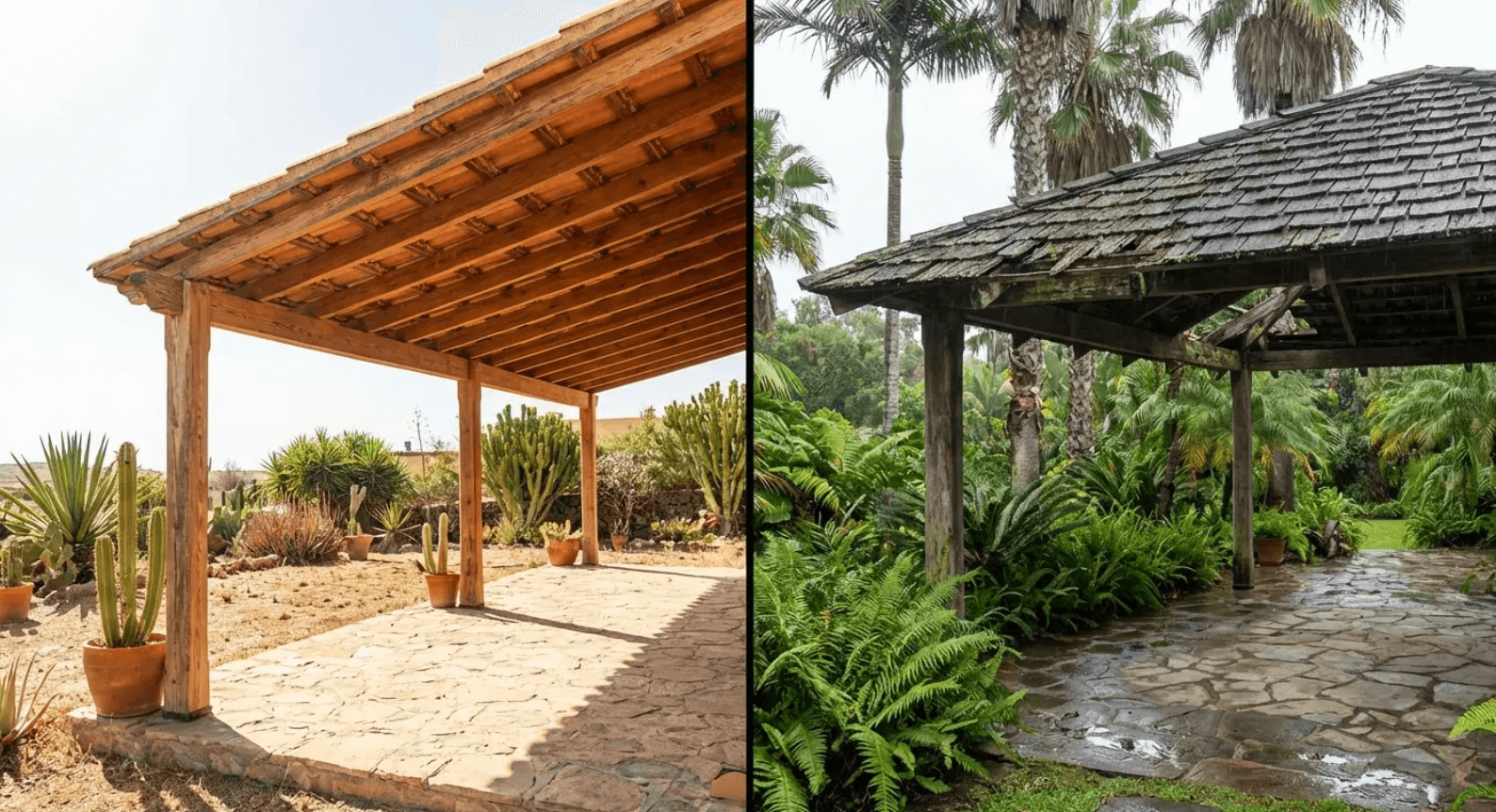
High-humidity environments accelerate wood deterioration regardless of treatment quality. I've watched pressure-treated cedar rated for ground contact fail within four years in coastal regions where humidity regularly exceeds 70%. The treatment protects against insects and initial moisture exposure, but it can't prevent the gradual saturation and rot that occurs when wood never fully dries between weather events.
Extreme temperature swings cause expansion and contraction issues with certain metals and composites. Materials that perform flawlessly in moderate climates develop gaps, loose fasteners, and structural stress in regions where daily temperature variations exceed 40 degrees. The materials aren't defective. They're just inappropriate for the application.
UV exposure in southern climates degrades polycarbonate panels faster than manufacturers typically disclose. Those 20-year warranties? They're often prorated and exclude "normal weathering," which conveniently includes the yellowing, brittleness, and reduced light transmission that occurs after 5-7 years of intense sun exposure.
Snow load requirements in northern regions eliminate certain lightweight options entirely. Building codes specify minimum load-bearing capacities based on historical snowfall data, and those requirements often rule out fabric systems, lightweight aluminum frames, and thin polycarbonate panels. You can't install materials that won't support your region's snow loads, regardless of how much you prefer their appearance.
Wind resistance matters in coastal and plains regions where sustained winds and gusts create forces that lightweight structures can't withstand. I've seen beautiful shade sails torn apart in their first windstorm. I've watched unsecured pergolas tip over and damage homes. I've documented metal roofing panels peeling away because fastener spacing didn't account for wind uplift.
A coastal New Jersey homeowner installed a beautiful wood-framed patio roof with cedar posts and beams, inspired by designs they'd seen in Colorado mountain homes. The structure looked magnificent initially, and the pressure-treated cedar was rated for outdoor use.
The coastal environment presented challenges that inland installations never face. Salt air accelerated corrosion of all metal fasteners and brackets within 18 months. The constant humidity, often above 70% even on "dry" days, created perfect conditions for wood rot despite bi-annual sealing treatments.
Within four years, three of the six support posts showed structural compromise from interior rot that wasn't visible externally. The replacement cost exceeded $8,500. An aluminum or vinyl-clad structure would've performed flawlessly in the same location for decades.
Materials that work beautifully in dry mountain climates often fail rapidly in humid coastal environments, regardless of treatment quality.
The Transparency Factor Nobody Considers Until It's Too Late
Material transparency affects both function and livability in ways most homeowners don't anticipate until they're living with the consequences.
Solid roofs provide complete weather protection but can turn covered patios into dark, cave-like spaces that nobody wants to use. I've worked with homeowners who chose opaque materials for maximum rain and UV protection, then realized their beautiful new outdoor room felt claustrophobic and unwelcoming. The lack of natural light made the space feel disconnected from the outdoors, defeating the entire purpose of a patio.
Translucent materials provide light but can create greenhouse effects that make spaces unusable during peak hours. Clear or lightly tinted polycarbonate panels look great in photos, but they trap heat underneath and create temperatures 15-20 degrees hotter than ambient conditions. Your shaded patio becomes an oven from noon to 4 PM, precisely when you'd want to use it most.
The impact on adjacent interior rooms deserves serious consideration. Installing a solid patio cover attached to house walls often blocks windows that previously provided natural light to kitchens, dining rooms, or living spaces. You gain outdoor coverage but lose interior livability, forcing you to run lights during daytime hours and fundamentally changing how those rooms feel.
Some transparent materials create glare problems that make interior spaces uncomfortable. Certain polycarbonate panels and glass roofs reflect and refract light in ways that create bright spots on walls, ceilings, and floors inside your home. You might not notice this during your initial planning, but you'll definitely notice it when you're trying to watch TV or work on a computer in a room bombarded by reflected light.
Privacy concerns with certain transparent materials often get overlooked during planning. If you have neighbors with second-story windows overlooking your patio, a clear roof provides zero visual privacy from above. You might feel exposed during activities that you assumed would be private in your own backyard.
Answer these questions to determine your ideal transparency level:
What rooms are adjacent to the proposed patio roof? Do those rooms rely on natural light from windows the roof might block? What time of day do you use those interior rooms most? Would losing natural light require adding artificial lighting during daytime hours?
Does your patio receive direct afternoon sun? What are typical summer temperatures in your area? Will you use the space during the hottest parts of the day? Do you plan to add ceiling fans or other cooling elements?
Do you have neighbors with second-story windows overlooking your patio? Will you use the space for activities requiring visual privacy? Does your local code require privacy screening for outdoor living spaces?
Recommended transparency levels based on your answers:
If you answered mostly "yes" to questions about adjacent room lighting, choose 40-60% translucent materials that provide weather protection while allowing light transmission.
If you answered mostly "yes" to questions about heat and temperature, choose opaque or highly reflective materials that block heat rather than trapping it.
If you answered mostly "yes" to privacy questions, choose opaque materials or plan to add privacy screening regardless of roof transparency.
How Climate Dictates Everything (And Why You're Probably Ignoring It)
Your climate should determine structure type, pitch, orientation, and integration points before you consider any other factors. I'm not talking about general regional assumptions. I'm talking about your actual climate data, your specific microclimate, and your worst-case weather scenarios.
Rainfall patterns dictate drainage requirements more than any other single factor. If you receive 40+ inches of annual precipitation, your patio roof will concentrate massive water volumes that your existing landscape drainage probably can't handle. That water has to go somewhere, and if you haven't planned for it, "somewhere" usually means foundation damage, landscape erosion, or flooded basements.
Sun angles affect shade coverage throughout the year in ways that fixed structures can't adapt to. A roof that provides perfect shade in July when the sun is at 70 degrees elevation might offer zero protection in October when the sun drops to 45 degrees and shines directly under your coverage area. You designed for summer sun and ended up with a structure that's useless during the shoulder seasons when you'd use it most.
Wind patterns influence structural reinforcement needs that go far beyond minimum code requirements. Building codes specify baseline standards, but they don't account for your property's specific exposure. If you're on a hilltop, in a wind corridor, or near large open areas, you need engineering beyond code minimums or you'll watch your investment blow apart in the first major storm.
The Drainage Design You're Definitely Overlooking
Drainage. Nobody thinks about it until they have problems, then they're shocked by the damage and repair costs.
Patio roofs concentrate water flow in ways that exceed original landscape design capacity. A 12x16 foot roof collects 120 gallons of water during a one-inch rain event. During a typical storm that drops 2-3 inches, you're channeling 240-360 gallons through gutters and downspouts. Where does that water go? If you haven't planned discharge points, it pools against your foundation, saturates your landscape, or floods adjacent areas.
Inadequate gutter systems create consequences from foundation damage to landscape erosion. I've documented foundation cracks from water saturation, basement flooding from improper discharge, and landscape destruction from concentrated water flow. These aren't minor cosmetic issues. They're structural problems that cost thousands to repair and can affect your home's entire drainage system.
Roof pitch affects drainage requirements in ways most homeowners don't understand. Flat or low-slope designs often create standing water problems because water doesn't flow quickly enough to gutters. That standing water finds every seam, every fastener hole, and every slight imperfection, then leaks through and damages the structure and everything underneath.
The importance of proper drainage planning has gained renewed attention as extreme weather events become more common. A recent HGTV feature on rooftop deck designs (updated March 12, 2026) highlights how professional designers are now prioritizing water management systems in outdoor spaces. The article notes that successful rooftop installations in cities like Chicago and New York require sophisticated drainage integration with existing building systems, a principle that applies equally to ground-level patio roof ideas attached to house structures.
As climate patterns shift and precipitation events intensify, the drainage systems that seemed adequate five years ago may no longer handle the concentrated water flow from patio roof installations.
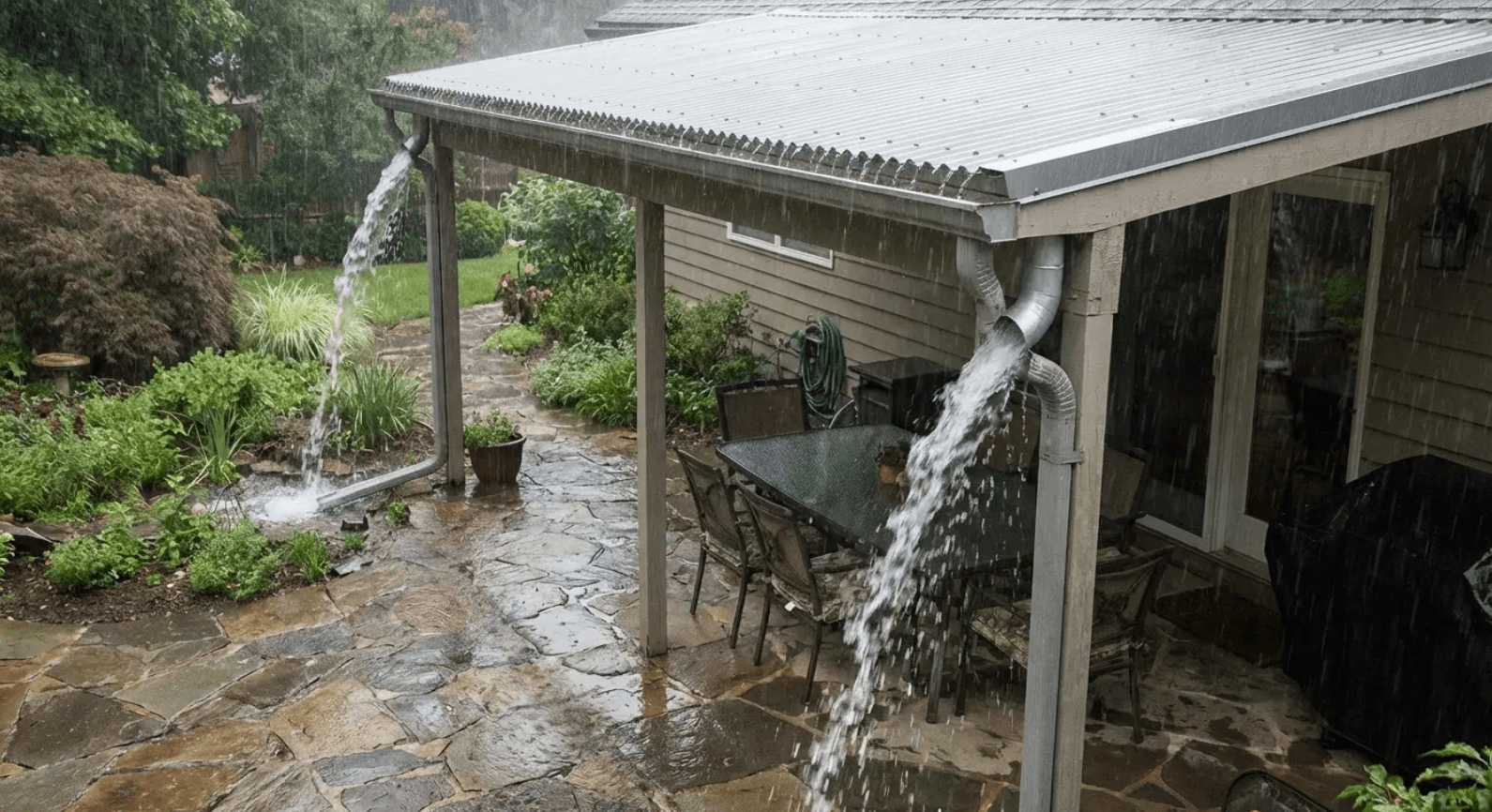
Drainage integration with existing systems requires planning, not afterthought solutions. You need to know where your current gutters discharge, what capacity your drainage systems can handle, and how adding concentrated flow from a patio roof affects the entire system. Bolting gutters onto a finished structure and hoping water finds its way to appropriate discharge points is a recipe for expensive problems.
Ask contractors specific questions about drainage during planning: Where will gutters discharge? How does that integrate with existing drainage? What's the calculated water volume during typical and extreme rain events? How will discharge points be protected from erosion?
Vague answers indicate insufficient planning.
Sun Angle Math That Changes Throughout the Year
Solar positioning affects shade coverage across seasons in ways that dramatically impact usability. A roof designed to provide shade during summer months might offer zero protection during spring and fall when sun angles are lower and you're still using outdoor space regularly.
Fixed structures can't adapt to changing sun angles, making design orientation critical from the start. You get one chance to position your roof correctly, and that positioning needs to account for the sun's path throughout the entire year, not just peak summer.
Understanding seasonal sun angles becomes even more critical when you consider how outdoor spaces get used throughout the year. According to Los Angeles-based landscape designer Andrea Scharff, patio covers serve dual purposes: "they allow for shade during the day and provide structure for gas or electric heaters to be affixed to in order to keep cool evenings toasty."
This means your patio roof needs to account for both summer sun protection and shoulder-season usability when temperatures drop but the space remains valuable. A roof designed only for peak summer shade will fail to provide the year-round functionality that justifies the investment.
Tools exist for calculating sun angles specific to your location. Sun path diagrams, solar angle calculators, and even smartphone apps can show you exactly where the sun will be at different times of day throughout the year. Use this data for positioning decisions before you commit to a design.
The common mistake of designing based on summer sun only leads to discovering the patio is unusable during shoulder seasons when you'd benefit from it most. I've worked with homeowners who realized their roof provided perfect July shade but left them completely exposed during pleasant April and September afternoons when they wanted outdoor time.
The Maintenance Reality Nobody Talks About Until Year Three
Initial enthusiasm for a new patio space often masks the reality of ongoing upkeep requirements. You're excited about your beautiful new outdoor room, and contractors are happy to let you believe it will stay beautiful with minimal effort.
Then year three arrives.
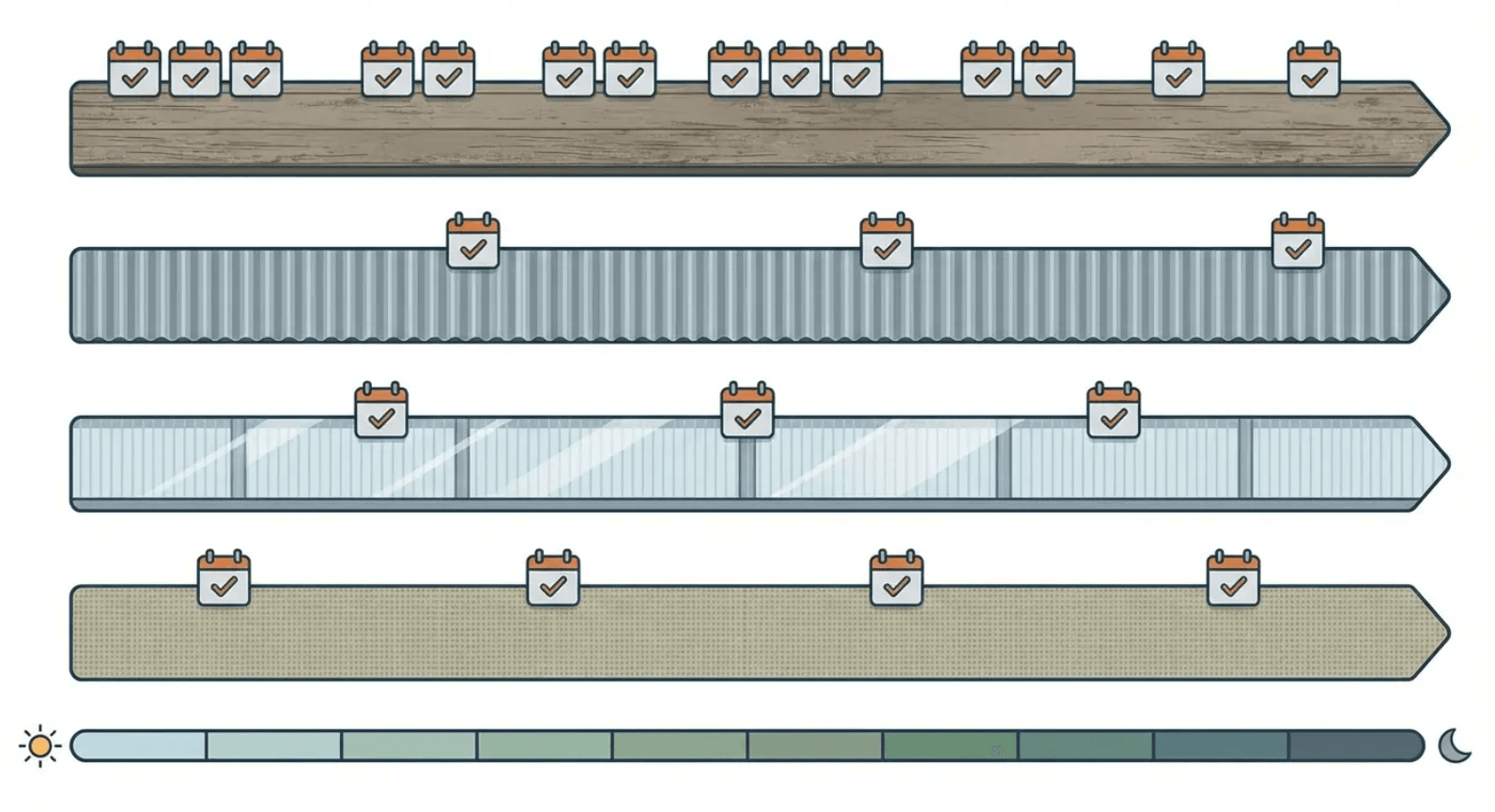
Different roof types demand specific maintenance tasks, from annual sealing to gutter cleaning to fastener inspection to structural adjustments. Wood structures need sealing every 1-2 years to prevent moisture damage. Metal roofs need fastener checks because thermal expansion and contraction gradually loosen screws. Polycarbonate panels need cleaning to remove debris that blocks light and creates staining.
Maintenance neglect compounds into structural problems faster than most homeowners expect. Skipping one sealing treatment might seem harmless, but it allows moisture penetration that starts rot you won't see until the damage is severe. Ignoring loose fasteners for a season allows movement that creates larger gaps and accelerates deterioration.
The First Three Years vs. The Next Ten
textMany materials perform beautifully for the first few years, then begin demanding increasing attention as protective coatings wear, fasteners loosen, and structural settling occurs.
The maintenance curve differs dramatically across material types. Wood requires consistent annual effort: sealing, inspection, fastener tightening, and rot checks. Metal roofs need little initially but demand significant intervention at specific intervals when coatings fail or fasteners require wholesale replacement. Composite materials often need nothing for years, then fail catastrophically when binding agents degrade beyond recovery.
Installation quality affects long-term maintenance burden more than material choice in many cases. Poor installations require constant adjustment while quality work remains stable. I've seen budget installations that need quarterly attention to remain functional, while properly executed premium installations go years between maintenance events.
Evaluate whether a contractor's work will age well by examining warranty terms that indicate confidence in longevity.
Contractors who offer 10+ year warranties on their installation work (not just material warranties) are betting their reputation on quality execution. Contractors who offer 1-2 year warranties or only pass through manufacturer warranties aren't confident their work will last.
What Professional Maintenance Actually Costs
Annual inspections typically run $150-300 depending on your region and structure complexity. Inspectors check fasteners, examine seals, assess structural integrity, and identify problems before they become expensive repairs.
Cleaning services cost $200-400 annually for most residential patio roofs. This includes gutter cleaning, debris removal, panel washing, and drainage system checks.
Sealing applications run $300-600 depending on structure size and material type. Wood structures need this every 1-2 years. Some composite materials need it every 3-5 years.
Minor repairs, fastener replacement, small seal repairs, gutter adjustments, typically cost $150-400 per incident. Budget installations might need these repairs 2-3 times annually. Quality installations might go years between repair needs.
Regional cost variations affect these numbers significantly. Urban areas with higher labor costs might see 30-50% premiums over rural regions. Areas with extreme weather that accelerates deterioration might need more frequent service.
Deferred maintenance creates exponentially higher costs over time. Skipping a $200 annual sealing can lead to $3,000 in wood replacement within five years. Ignoring a $150 g utter cleaning can cause $5,000+ in foundation damage when water backs up and saturates soil against your home.
Finding qualified maintenance providers presents challenges since many installers don't offer ongoing service. They're focused on new installations, not maintaining work they completed years ago. You need to identify local contractors who specialize in outdoor structure maintenance, or budget for DIY time and materials.
Permit Nightmares and How to Avoid Becoming a Cautionary Tale
Permits exist for structural safety, property line compliance, and building code adherence, not to generate revenue or annoy homeowners. When you build without permits, you're gambling that nothing will go wrong and you'll never need to prove your structure was built correctly.
That gamble fails more often than you'd think.
Unpermitted work creates consequences from forced removal to insurance claim denials to title issues during home sales. These aren't theoretical risks. They're documented outcomes that happen to real homeowners who thought they could skip the permit process.
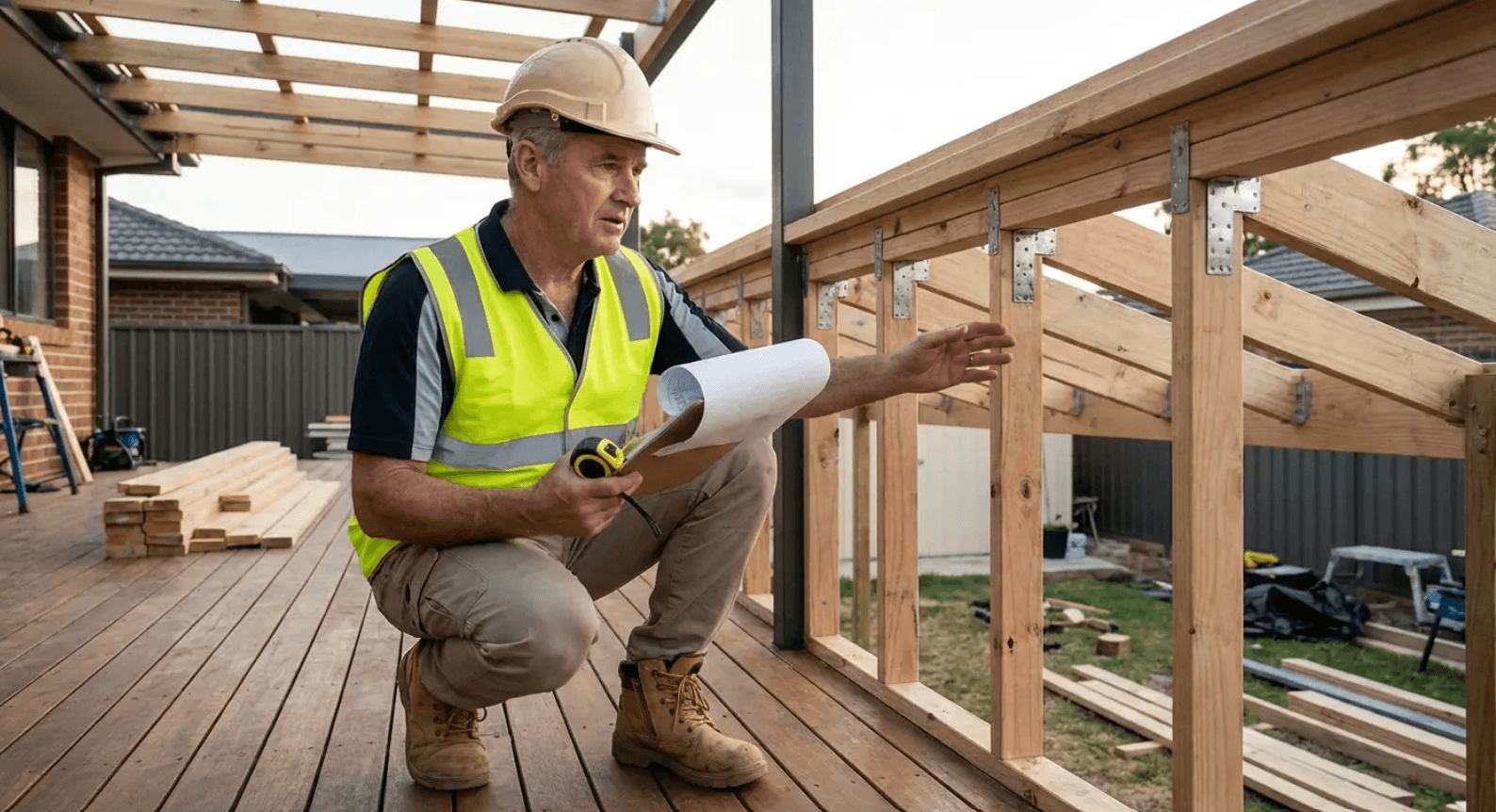
Permit requirements vary by structure type, size, and location in ways that make blanket advice impossible. What's permit-exempt in one jurisdiction requires full structural review in another. A 10x12 attached patio roof might need permits in your city but not in the next town over. You need to check your specific requirements, not rely on what worked for your neighbor or what some contractor claims.
Working with contractors who encourage permit avoidance should immediately disqualify them from consideration, regardless of cost savings promises. Contractors who suggest "we can skip permits and save you money" are telling you they cut corners everywhere, not just on paperwork. They're also setting you up to take full responsibility when problems arise, since they'll be long gone with your money.
The Resale Complications You Won't Discover for Years
Title companies discover unpermitted work during closing processes through property records, aerial imagery comparisons, and buyer inspection reports. They're specifically trained to identify structures that don't match permitted records because unpermitted work creates liability they won't accept.
Buyers can demand removal or price reductions when unpermitted structures are discovered. I've seen $15,000 patio roofs result in $25,000 price reductions because buyers assumed the worst about overall home maintenance and quality. I've watched sales fall through entirely when buyers walked away over permit issues that sellers couldn't resolve quickly.
Retroactive permitting requires partial demolition for inspections in most jurisdictions. Inspectors need to verify that structural elements, fasteners, and integration points meet code requirements. If they can't see those elements, you need to expose them, which often means removing sections of your completed structure.
The cost and complexity of retroactive permitting typically exceeds what you would've paid for permits during original construction. You're paying permit fees plus inspection fees plus the cost of demolition and reconstruction for inspection access plus the cost of bringing any non-compliant elements up to code.
Unpermitted work affects home valuations because appraisers often assign zero value to structures without proper permits. That $10,000 patio roof you installed might add nothing to your home's appraised value, eliminating any return on investment and potentially affecting your ability to refinance.
The money saved by skipping permits almost always gets lost (and then some) during resale negotiations. You might save $800 in permit fees, then lose $8,000 in sale price negotiations when the issue surfaces.
Insurance Claim Denials Nobody Expects
Many homeowners don't realize their patio roof isn't covered until they file a claim after storm damage. Insurance companies investigate claims and often discover permit status during that process. When they find unpermitted structures, they deny coverage for damage to the structure itself.
Unpermitted structures can void coverage for adjacent damage in some policies. A falling patio roof might not be covered, and the house damage it causes might not be covered either because the damage resulted from an unpermitted structure. You end up paying for everything out of pocket.
Insurance companies have become increasingly sophisticated at identifying unpermitted work through aerial imagery, property record databases, and inspection reports. They're not relying on your honesty. They're actively investigating.
Honest disclosure to insurance companies about unpermitted structures can lead to coverage denials or policy cancellations. If you tell them you have an unpermitted patio roof, they might exclude it from coverage or decline to renew your policy. If you don't tell them and they discover it during a claim, they might deny the claim for misrepresentation.
Permit shortcuts create risk far beyond just the structure itself, potentially affecting entire home insurance coverage. This isn't worth the few hundred dollars you might save on permit fees.
Integration Points That Make or Break Your Investment
Patio roofs interact with existing home systems in ways that most homeowners completely ignore until problems become obvious. Electrical integration for lighting and fans, drainage connections to existing gutter systems, structural attachment to home framing, and thermal effects on HVAC efficiency in adjacent rooms all require planning during design, not problem-solving during installation.
Treating a patio roof as a standalone project rather than a home system integration leads to problems ranging from water intrusion to electrical hazards to structural failures. Your patio roof doesn't exist in isolation. It affects and is affected by multiple home systems.
Electrical Planning Beyond "We'll Add Lights Later"
Installing electrical during construction costs one-third what retrofitting later will cost. Running conduit, placing junction boxes, and installing circuits while the structure is being built allows access that won't exist once everything is finished. Retrofitting means fishing wires through completed structures, cutting access holes, and working around obstacles that didn't exist during construction.
Code requirements for outdoor electrical include GFCI protection and proper conduit installation, non-negotiable safety standards that exist because outdoor electrical presents shock and fire hazards. You can't use interior-rated materials or installation methods outside, regardless of what some handyman tells you.
Electrical planning affects structural design because conduit paths and junction box locations need accommodation in framing. You can't just decide where you want outlets and switches after the structure is built. Those decisions need to happen during design so framing can incorporate necessary pathways and support.
Common electrical mistakes include undersizing circuits for future fan and heater additions. You might only want lights initially, but if you add a ceiling fan next year and a patio heater the year after, your 15-amp circuit won't handle the load. Plan for future additions now, or plan to run new circuits later at triple the cost.
Placing switches in inconvenient locations creates daily frustration that you'll live with for years. I've seen switches placed inside the house for lights that illuminate outdoor spaces, requiring you to go inside to turn on lights when you're already outside. I've seen switches placed on opposite sides of patios from the doors people actually use.
The trend toward fully-equipped outdoor living spaces has made electrical planning more complex than ever. A recent showcase of luxury rooftop decks featured by HGTV demonstrates how modern outdoor spaces now regularly incorporate ceiling fans, ambient lighting, task lighting, televisions, outdoor speakers, and even heating elements.
Designer Vanessa Slivinski of Chicago Roof Deck and Garden notes that successful installations feature "a TV centered on the wall" along with "self-serve beverage centers" and full kitchen appliances, all requiring substantial electrical infrastructure. What once required a single outdoor outlet now demands dedicated circuits, proper load calculations, and sophisticated switching systems.
Planning for these electrical needs during initial design prevents the expensive retrofitting that plagues homeowners who treat electrical as an afterthought.
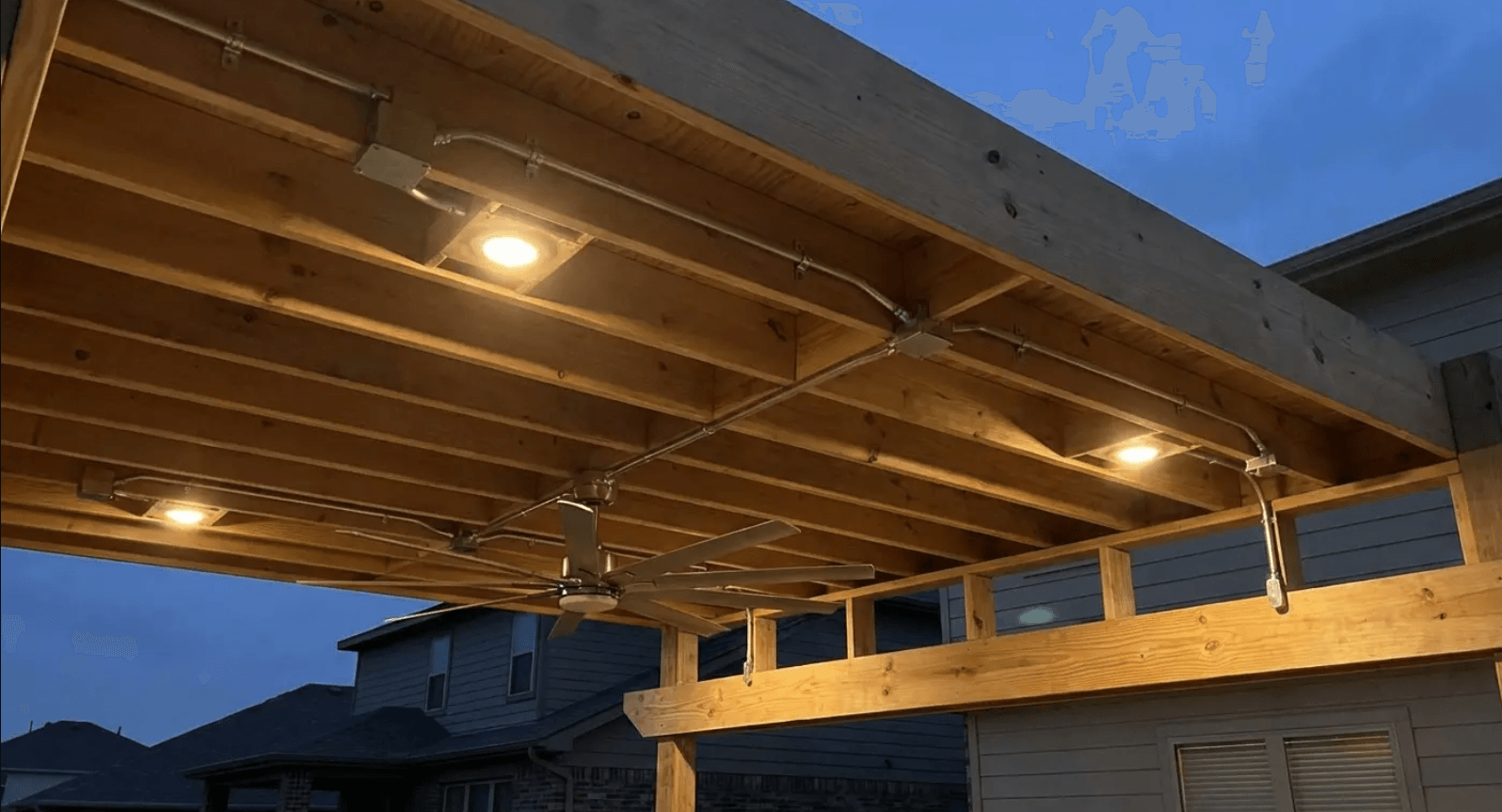
Ask electricians specific questions during planning: What's the total load calculation including future additions? How many circuits are you running? Where exactly will junction boxes be located? How will conduit be protected from physical damage? What switching arrangement makes sense for actual usage patterns?
Vague "we'll figure it out" responses indicate insufficient integration thinking. Professional electricians can answer these questions during planning because they've thought through the entire system, not just the immediate installation.
How Your New Roof Affects Indoor Climate Control
Patio roofs attached to house walls often block windows that previously provided natural light to kitchens, dining rooms, or living spaces. I've worked with homeowners who gained outdoor coverage but lost interior livability, transforming bright, pleasant rooms into dark spaces that require artificial lighting even at midday.
Poorly designed roofs can trap heat against the house, increasing cooling costs despite providing outdoor shade. Solid roofs placed too close to walls create dead air spaces that absorb and hold heat. That heat radiates into your home through walls and windows, forcing your HVAC system to work harder.
Proper roof design can reduce interior cooling costs by shading walls and windows during peak sun hours. The impact of patio covers on adjacent interior spaces extends beyond just blocking light. They fundamentally alter how homeowners use their entire property.
According to David Charette, cofounder of Britto Charette in Miami, when choosing patio cover ideas, homeowners should "really think about the location, how the sun hits the patio and at what time, and the optimum use times."
This consideration becomes critical when you realize that a poorly positioned solid roof can block morning sunlight that previously illuminated your kitchen, forcing you to use artificial lighting during breakfast hours. Conversely, a well-designed roof that shades south-facing windows during peak afternoon hours can reduce interior cooling costs by 15-25% during summer months, offsetting the installation cost over time through energy savings.
Material choices affect heat reflection and absorption in ways that impact both outdoor comfort and indoor temperature. Dark metal roofs absorb heat and radiate it downward and into adjacent walls. Light-colored, reflective materials deflect heat away from both the patio and the house.
I've measured temperature differences of 8-12 degrees in adjacent rooms after solid roof installations that blocked windows and disrupted airflow patterns. That translates to real money, $40-80 monthly increases in summer cooling costs that compound year after year.
Think about your patio roof as part of your home's thermal envelope, not just an outdoor feature. How will it affect sun exposure on walls and windows? Will it improve or worsen your home's energy efficiency? Does the design allow for natural ventilation, or will it trap heat against your house?
When to Walk Away From a Patio Roof Project Entirely
Sometimes the smartest decision is recognizing when a patio roof doesn't make sense for your specific situation.
Look, not every property needs a patio roof. Not every budget supports one. And not every homeowner should take on the maintenance commitment.
This isn't about discouraging worthwhile projects. It's about protecting you from expensive mistakes that won't deliver value regardless of how much you want the outcome.
Site Conditions That Doom Projects Before They Start
Properties with high water tables make foundation work prohibitively expensive. If groundwater sits 2-3 feet below the surface, you're looking at extensive drainage systems, specialized footings, and engineering costs that can double or triple your project budget. The patio roof itself might cost $8,000, but the foundation work required to support it could run $15,000.
Mature trees create both installation challenges and ongoing maintenance burdens that can undermine the structure's value. Large trees drop leaves, sap, and branches that clog gutters and damage roofing materials. Root systems interfere with footing placement. Branches require clearance that limits roof positioning and size.
I've worked with homeowners who spent $12,000 on beautiful patio roofs, then spent $800 annually on gutter cleaning and $300 annually on debris removal because of overhanging trees. The ongoing costs and constant maintenance turned their dream outdoor space into a burden they resented.
Sloped lots make patio roof installation exponentially more complex and expensive. Level pads require retaining walls, extensive grading, and drainage systems to prevent erosion. Support posts need varying heights to compensate for slope, increasing material costs and structural complexity. What might be a straightforward $6,000 installation on a level lot becomes a $15,000+ project on a slope.
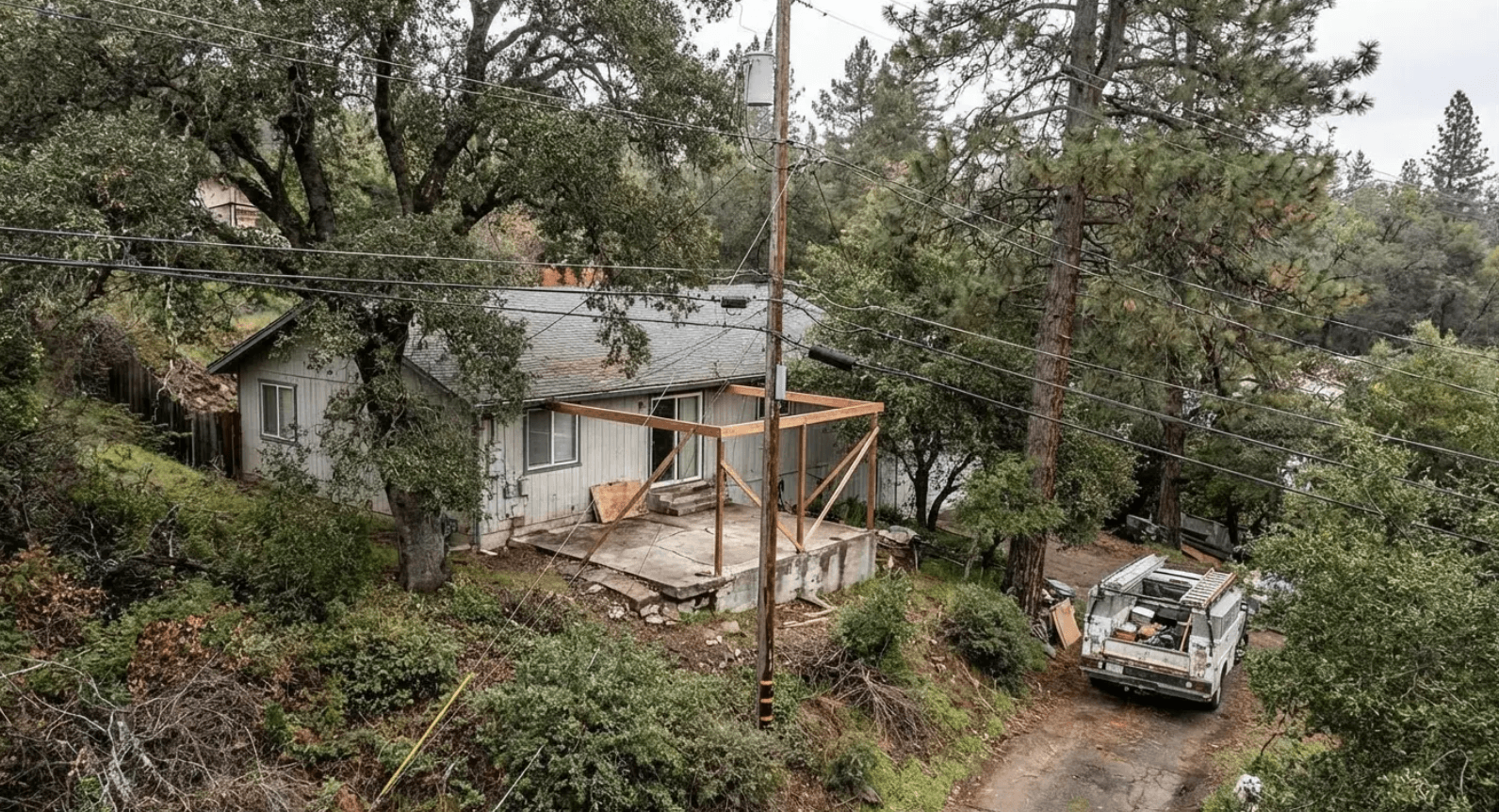
Properties where utility lines, easements, or setback requirements leave no viable installation locations present insurmountable obstacles. You can't build over utility easements. You can't place structures within setback zones. You can't obstruct access easements that provide utility companies or neighbors with legal access rights.
Check these restrictions before investing in design work. Your property survey shows easements and setbacks. Your local zoning office can clarify what's permitted within those areas. Discovering these limitations after you've spent money on design and planning wastes resources on projects that can't proceed.
Seek professional site assessments before investing in design work if you have any concerns about site suitability. A structural engineer or experienced contractor can evaluate your property and identify deal-breaking conditions before you've invested significant money.
The Budget Threshold Where Quality Becomes Impossible
Below certain budget levels, you can't build a patio roof that will perform adequately or last reasonably.
Here's uncomfortable truth: ultra-budget installations often fail within 2-3 years, making them more expensive than waiting and saving for proper construction.
Minimum budget thresholds vary by region and material costs, but general guidelines exist. For a basic 12x16 shed roof patio cover ideas implementation in most markets, you're looking at $4,500-6,000 minimum for quality construction. Below that threshold, contractors are cutting corners on materials, installation quality, or both.
For more complex designs, freestanding structures, integrated electrical, premium materials, minimum budgets start at $8,000-10,000. Anything less means compromises that will create problems.
Cost-cutting measures that are reasonable include simplifying design complexity, choosing mid-grade materials over premium options, and handling some finish work yourself. Cost-cutting measures that guarantee failure include using undersized framing, skipping proper footings, eliminating drainage systems, and using residential-grade materials in commercial applications.
I've watched homeowners spend $3,000 on patio roofs that collapsed under snow loads, blew apart in windstorms, or rotted out within three years. They then spent $7,000-10,000 replacing them with proper construction. The budget-friendly approach cost them more than doing it right initially.
If your budget doesn't support quality construction, consider alternatives. A high-quality retractable awning might cost $2,500-3,500 and provide functional shade while you save for a permanent structure. A well-designed pergola without roofing might cost $3,000-4,000 and provide partial shade and architectural interest until you can afford to add roofing.
Financing options exist for home improvement projects, but weigh the interest costs against the benefits. Paying 8-12% interest on a patio roof installation needs to make financial sense based on the value you'll receive. For some homeowners, the extended outdoor season and increased home value justify financing. For others, saving for 12-18 months makes more sense than paying thousands in interest.
You're probably feeling overwhelmed right now.
Good. That means you're taking this decision seriously instead of rushing into something you'll regret.
Final Thoughts
Alright, I'm done. That's everything I wish someone had told me before I made my own expensive mistakes (yeah, I've screwed this up too, different story).
Patio roof ideas represent significant investments that should solve specific problems, not just check aesthetic boxes. The beautiful images you've been browsing don't show the maintenance requirements, the drainage failures, the permit complications, or the resale issues that result from poor planning.
The most successful patio roof projects start with honest assessment of needs, climate conditions, and budget constraints, then work toward solutions that address those factors. You need to know what problem you're solving before you can choose materials, designs, or contractors.
Taking time to plan properly, ask difficult questions, and even walk away from ill-conceived projects demonstrates wisdom, not indecision. I've seen too many homeowners rush into installations based on Pinterest inspiration, then spend years dealing with functional failures they didn't anticipate.
Ask yourself: What specific weather conditions am I protecting against? What activities will happen in this space? How will this structure affect my home's existing systems? Can I maintain this properly, or do I need low-intervention solutions? Does my budget support quality construction, or am I setting myself up for expensive failures?
Well-planned patio roofs genuinely enhance properties and lifestyles. They extend outdoor seasons, protect valuable furniture and equipment, reduce cooling costs, and create defined spaces that increase home value. But these benefits only materialize when function drives form rather than the reverse.
Most people will skim this, look at pretty pictures anyway, and call the cheapest contractor. But you read this far, so maybe you're different.
Just... please, PLEASE get the drainage right. Everything else you can fix later. Drainage problems only get worse.
Good luck.