March 31, 2026
Flat Roof Replacement Cost: What Happens When You Wait Too Long to Pull the Trigger
Author
Most property owners think flat roof replacement cost is just a number on a quote. Something you compare, negotiate, and move on from. But that number? It’s only part of the story.
A flat roof doesn’t fail all at once. It quietly stacks problems underneath the surface—trapped moisture, weakened insulation, slow structural damage—until one day you’re no longer choosing between repair and replacement. The decision’s already been made for you. And it’s usually more expensive than it needed to be.
That’s the real selling point of this guide. It’s not just about what a flat roof replacement costs. It’s about understanding the timing, the hidden variables, and the mistakes that turn a manageable project into a budget-breaking one.
If you want a clearer picture of how roof systems actually fail (and why waiting changes the math), take a few minutes to read this breakdown.
Because once you understand what’s happening up there, you stop reacting—and start making decisions that actually save you money.
Table of Contents
- TL;DR
- The Real Price You're Not Calculating
- How Flat Roofs Age Differently (And Why That Changes Everything)
- Material Choices That Actually Move the Cost Needle
- The Hidden Labor Variables No One Talks About
- When "Just a Repair" Becomes a Full Replacement
- Size, Access, and Other Cost Multipliers You Can't Control
- The Timing Strategy That Could Save You Thousands
- What Happens If You Keep Postponing
- Working With Joyland Roofing
- Final Thoughts
TL;DR
Waiting to replace your flat roof doesn't save money. It multiplies costs. Your roof fails differently than pitched roofs (water pools, membranes crack, damage hides until it's catastrophic). Material choice matters, but timing matters more. And that quote you got? It doesn't include what's hiding under your current roof. The gap between "we can patch this" and "you need full replacement" is shorter than you think. Strategic timing can shift your total investment by 15-30%. Postponement costs include interior damage, HVAC efficiency loss, and structural problems that aren't visible until you're already past the point of simple fixes.
The Real Price You're Not Calculating
Your contractor hands you a quote: $18,000 to replace your flat roof. You think that's the number you're working with. It's not even close. That's maybe 60% of what you'll actually spend.
The rest is hiding in places you haven't looked yet.
Your flat roof isn't just deteriorating. It's creating compounding problems that increase exponentially, not linearly. Every month you postpone a needed replacement, you're not just adding one month's worth of wear. You're potentially adding water infiltration that's rotting your decking, killing your insulation's R-value (which hits your energy bills), and creating conditions for mold that'll require remediation before any roofer can even start work.
If you’ve ever wondered whether you can delay repairs, this breakdown on whether your roof leak repair can wait shows exactly how quickly small issues spiral.
I've seen property owners save $8,000 by waiting another year to replace their roof, only to spend $23,000 more because that year of delay allowed water to get into everything. The math works backwards from what you'd expect.
Here's a real example. Commercial property owner in Virginia postponed a $35,000 flat roof replacement for 18 months to preserve cash flow. During that delay, persistent leaks saturated the insulation, which then compressed under its own weight and created additional ponding areas. When replacement finally became unavoidable, the project cost $52,000 because it required complete insulation replacement, substrate repairs in three locations, and remediation of mold that had developed in the ceiling cavity. The "savings" from waiting cost an additional $17,000 plus two weeks of business disruption.
Understanding how much does flat roof replacement cost in your specific situation requires looking beyond the initial quote to the total financial exposure. The cost conversation needs to start with understanding your roof's current condition trajectory. Is it declining slowly or accelerating toward failure? Most flat roofs don't give you much warning before they cross from "manageable" to "crisis," and that crossing point is where your costs explode. When evaluating the cost of replacing a flat roof, you must factor in not just the immediate installation expense but the long-term implications of your timing decision.
How Flat Roofs Age Differently (And Why That Changes Everything)
Pitched roofs are honest. Shingles curl, blow off, show their age. You can spot the problems from your driveway.
Flat roofs lie. They look fine until the day they're catastrophically not fine.
I've walked roofs that looked solid and had my boot punch through rotten decking. The membrane looked perfect from above. Underneath? Disaster waiting to happen.
The aging process centers on membrane integrity and water management. Your flat roof (which isn't actually flat, but has minimal slope, usually about 1/4 inch per foot, but that's a whole other conversation) relies entirely on its waterproof membrane and drainage system. When that membrane develops even microscopic failures, water doesn't run off. It sits. It pools. It finds every weakness and exploits it with patient, relentless pressure.
Ponding water is your primary cost accelerator. Any area where water stands for more than 48 hours after rainfall is actively destroying your roof. If you’re already seeing buildup issues, it’s worth understanding how drainage systems and gutters impact roof performance.
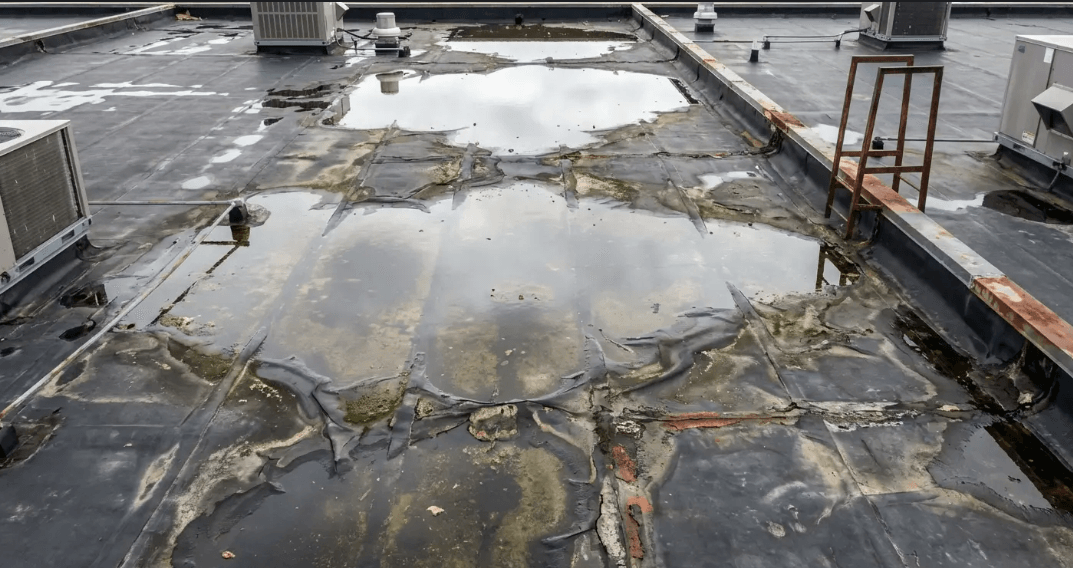
Temperature cycling hits flat roofs harder than pitched systems. Your membrane expands and contracts with every temperature swing. Over years, this creates stress cracks, especially at penetrations, edges, and seams. By the time you notice a leak inside your building, the membrane has been failing for months or even years.
The urgency of addressing aging flat roofs before they reach critical failure has become increasingly apparent across the country. In March 2026, Hamden High School in Connecticut began planning a $7.7 million roof replacement after years of persistent leaks caused substantial water damage, promoted mold and mildew growth, and compromised indoor air quality. The school's flat roof sections were more than 25 years old, demonstrating how postponing replacement beyond a roof's service life creates compounding damage that affects not just the roof structure but the entire building's safety and habitability.
Substrate condition matters more on flat roofs because the membrane is only as good as what's supporting it. If your decking is shot, your insulation is saturated, or your structural supports are sagging, no amount of new membrane will solve your problem. You're looking at a tear-off that goes deeper than the surface, and that's where flat roof replacement cost calculations become more complex.
The replacement decision isn't about the membrane you can see. It's about everything underneath that you can't see until you start the tear-off process. This uncertainty is why flat roof replacement cost varies so dramatically from initial estimate to final invoice.
Material Choices That Actually Move the Cost Needle
Four materials dominate flat roofing: TPO, EPDM, PVC, and modified bitumen. Price spread is huge, from $3.50 to $13 per square foot. But here's what matters more than upfront cost: total cost over the roof's life. Cheap installation that fails in 12 years costs more than expensive installation that lasts 30.
| Material | Cost Per Sq. Ft. | Expected Lifespan | Key Advantages | Primary Drawbacks |
|---|---|---|---|---|
| TPO | $4 - $8 | 15-20 years | Heat-welded seams, energy efficient, UV resistant | Installation quality critical, seam failures if poorly welded |
| EPDM | $3.50 - $7 | 25-50 years | Proven durability, flexible, temperature tolerant | Glued/taped seams, absorbs heat, more failure points |
| PVC | $6 - $13 | 25-35 years | Superior chemical resistance, excellent fire rating, longest lifespan | Highest upfront cost, damaged by petroleum products |
| Modified Bitumen | $4 - $9 | 15-30 years | Multi-layer redundancy, forgiving of substrate issues | Heat application complexity, code restrictions in some areas |
Let me break down what you need to know about materials, minus the sales pitch.
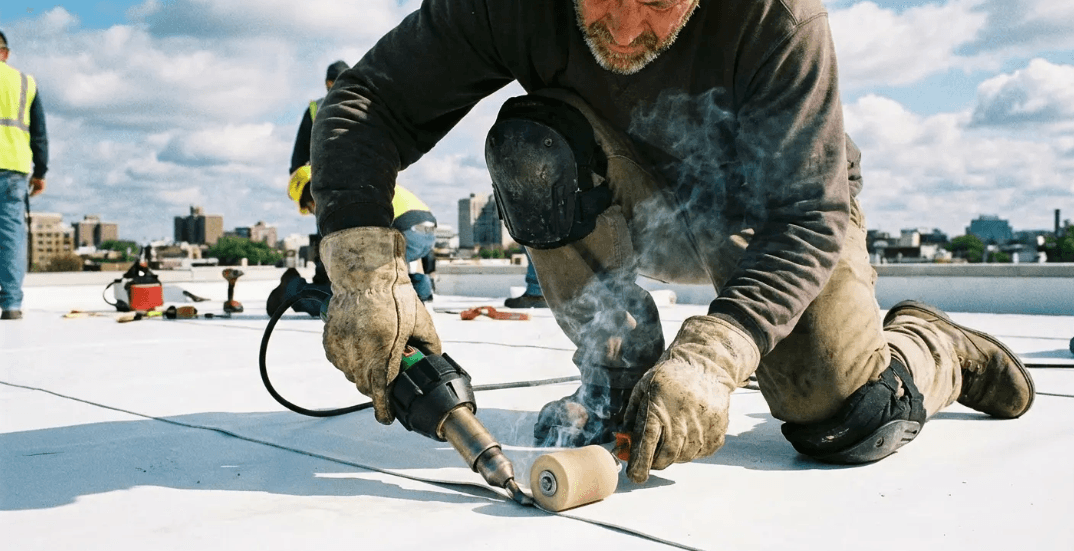
TPO (thermoplastic polyolefin) runs $4 to $8 per square foot installed. This is what most commercial buildings get now, and for good reason. The heat-welded seams create a monolithic membrane that's genuinely waterproof. TPO reflects heat well, which matters for your cooling costs. Resists UV breakdown. Lasts 15 to 20 years if installed correctly.
The catch? Installation quality matters enormously. Bad welding technique creates failure points that won't show up for years. If your contractor is new to TPO, pass.
EPDM (rubber roofing) costs slightly less, around $3.50 to $7 per square foot. Been around for decades, which means every contractor knows how to install it and you're not betting on unproven technology. EPDM is forgiving during installation and performs reliably in temperature extremes. The downside is that seams are glued or taped rather than welded, creating more potential failure points over time. It also absorbs heat rather than reflecting it, which can hammer your summer cooling costs.
PVC sits at the premium end. You're paying for durability, chemical resistance, and longevity. If you’re comparing long-term material value, it helps to understand why roofing materials shift in popularity—this breakdown on why metal roofing is becoming more popular gives a good perspective on how performance drives cost decisions.
Look, if you're planning to own this building for 15+ years, PVC is worth the premium. If you're flipping in 5 years, TPO makes more sense. Don't let a contractor talk you into EPDM just because they're comfortable with it.
Modified bitumen falls in the middle range at $4 to $9 per square foot. It's essentially a modern evolution of traditional built-up roofing, with better performance and easier installation. The multi-layer approach provides redundancy. One layer can fail without the whole system failing. It's more forgiving of substrate imperfections than single-ply membranes. Installation requires heat (torch-down application), which some building codes restrict and which adds complexity in occupied buildings.
A roof that lasts 25 years instead of 15 years doesn't just save you one replacement cycle. It saves you the inflation-adjusted cost of that future replacement, plus the business disruption of having contractors on your roof again.
Here's something that surprises people: a more expensive roof can lower your insurance premiums enough to pay for the upgrade. PVC and TPO roofs with good fire ratings can cut your commercial property insurance by 8-12%. Over 20 years, that's real money. But nobody thinks to call their insurance agent before choosing materials.
Warranty coverage varies dramatically by material and manufacturer. You might pay $2 per square foot more for a material that comes with a 30-year warranty instead of a 15-year warranty. Is that worth it? Depends on whether you trust the manufacturer to still exist in 30 years and whether the warranty covers labor (most don't) or just materials (which is often the cheapest part of a future repair).
The Hidden Labor Variables No One Talks About
Material costs are predictable. Labor costs are where your estimate meets reality, and reality usually wins.
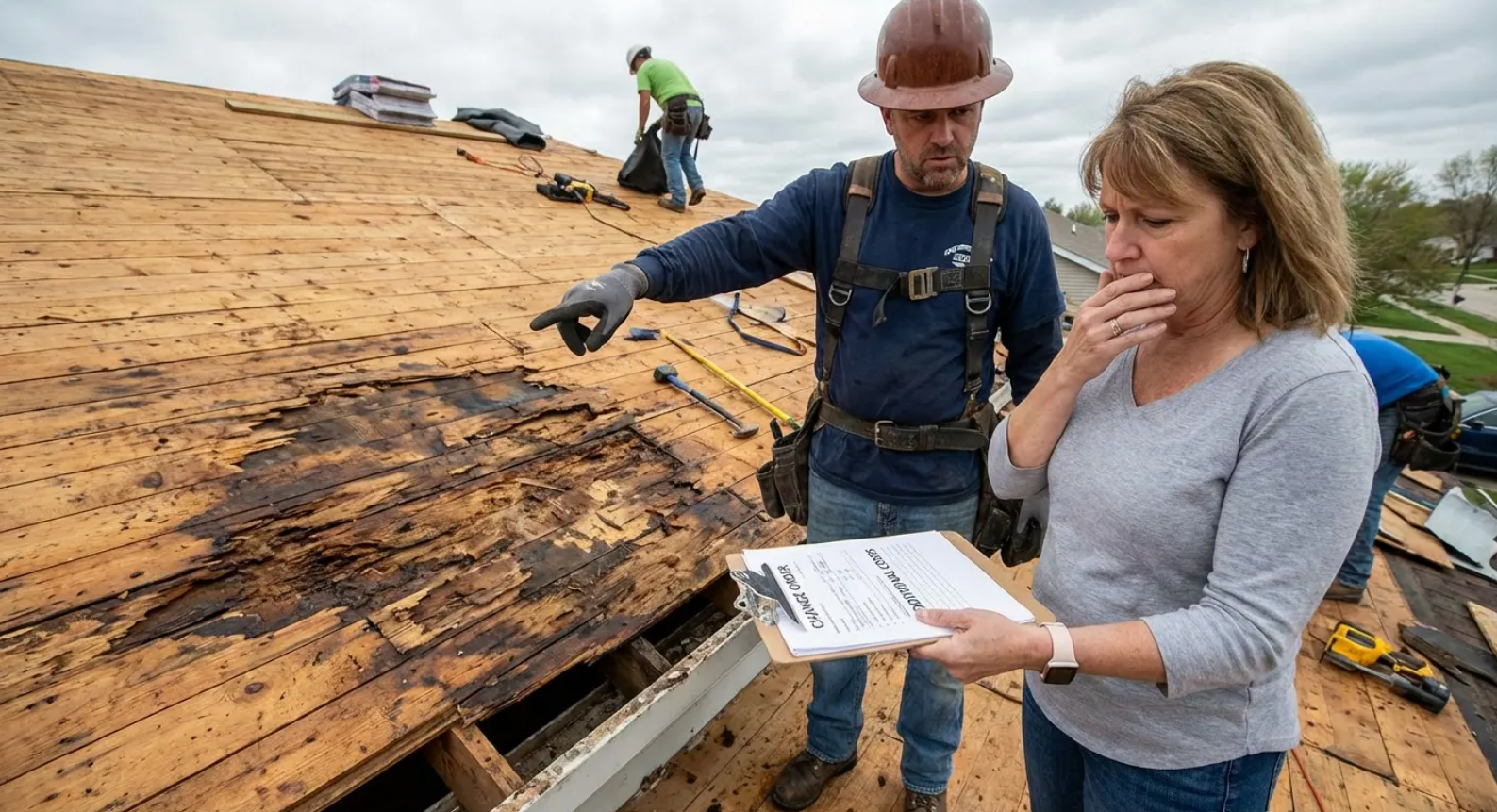
Substrate repair is the cost wildcard that can blow up your budget. You won't know the extent of needed repairs until the old membrane is off. Wet insulation needs replacement. Damaged decking requires new material and structural work. Compromised support beams need engineering and reinforcement. These repairs can add 30% to 100% to your initial flat roof replacement cost estimate.
Will your substrate need repair? I can't tell you for certain until we pull up the membrane. Anyone who promises otherwise is lying.
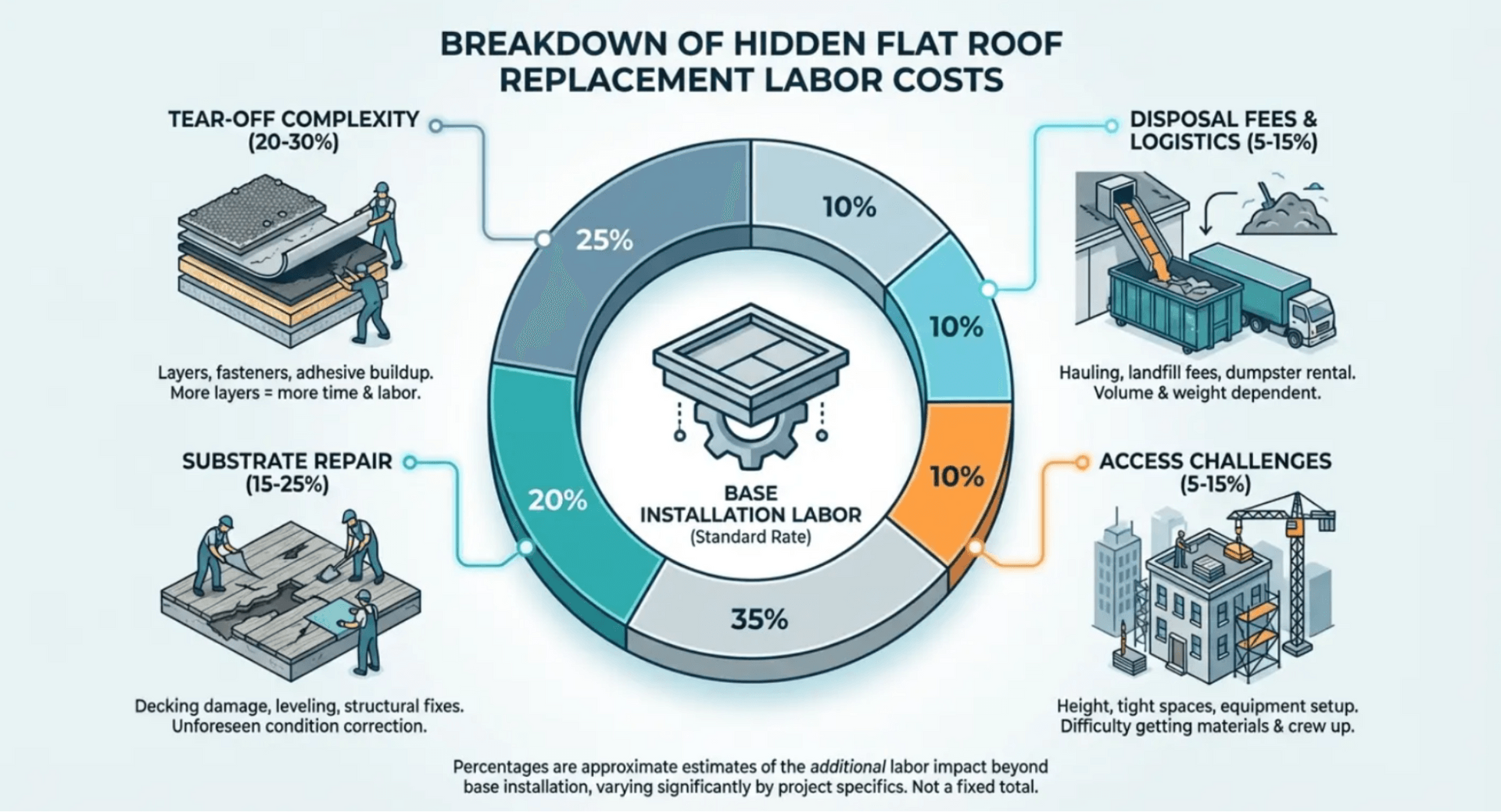
Roof access determines how efficiently crews can work. Can they use a crane to lift materials? Is there a freight elevator? Are they hand-carrying everything up stairs?
Your building's access limitations directly translate to labor hours. A roof that requires manual material transport can cost 20% more in labor than an identical roof with crane access.
A retail building owner in Massachusetts discovered this access premium firsthand when replacing a 3,200 square foot flat roof. The building sat in a dense downtown area with no crane access and limited street parking. Contractors had to hand-carry all materials up three flights of stairs and coordinate debris removal during restricted hours to avoid disrupting neighboring businesses. What would have been a $19,000 project with normal access became a $24,500 project, a 29% increase driven entirely by access constraints. The project also took eight days instead of the typical four, extending the weather exposure window and adding risk.
Existing penetrations and rooftop equipment create labor multipliers. Every HVAC unit, vent pipe, skylight, and drain adds complexity. If your system includes multiple penetrations or drainage concerns, understanding the parts of a roof can help you see where these costs come from.
Parapet walls and roof edges add complexity and cost. Proper edge flashing and parapet cap installation is time-consuming detail work that can't be rushed. Tall parapets require more material and more labor. Damaged parapet walls might need repair before roofing work can even start.
Working height and safety requirements impact labor costs in ways that aren't obvious. A single-story building allows faster work with simpler safety setups. A five-story building requires more extensive fall protection, slower material handling, and higher insurance costs for the contractor. You're paying for that added risk and complexity.
Weather windows constrain scheduling, especially in northern climates. Many flat roofing materials can't be installed below certain temperatures. If you're replacing your roof in a region with short construction seasons, contractors charge premium rates because they're trying to fit limited annual revenue into a compressed timeframe. The same job might cost 15% less if you can schedule it during the contractor's slow season, assuming your roof can wait that long.
When "Just a Repair" Becomes a Full Replacement
There's a moment in every aging flat roof's life when the math flips. Repairs that made financial sense last year suddenly don't make sense this year.
You've crossed an invisible threshold, and most property owners don't realize it until they've wasted money on repairs that bought them nothing.
Patch repairs work when you're dealing with isolated damage. A puncture from a fallen branch. A seam failure at one location. Damage from a specific event. You're looking at $300 to $1,200 per repair, depending on size and complexity. The repair buys you years of additional life if the rest of the membrane is sound.
But flat roofs rarely fail in isolation. They fail systemically. The conditions that caused one seam to fail are affecting other seams. The UV exposure that broke down one section is breaking down adjacent sections. Ponding water that created one leak is stressing the entire ponding area.
I had a customer argue with me for 20 minutes that his roof "just needed a patch." Took him up there, showed him the membrane cracking under our feet, showed him three different ponding areas. He still wanted a patch. I walked away from the job. Six months later, different contractor, full replacement, $15K more than I quoted because water had gotten into the decking. Sometimes you can't save people from themselves.
You're past the repair stage when:
- You're dropping $4K+ per year on patches and the problems keep coming back
- The membrane cracks when you walk on it (that's the whole system telling you it's done)
- Water's pooling in three or more spots (that's substrate failure, not a membrane issue)
- You've got actual leaks inside the building (by then, you've got months of hidden damage)
- Your roof has hit the maximum allowable layers, usually 2-3 per building code
- The membrane has outlived its expected lifespan by 5+ years and you're on borrowed time
- You're calling for repairs more than twice per year
- Energy bills have jumped because your insulation is compromised
- Previous repairs failed within 12-18 months
If you're constantly patching leaks, you're likely past the point of cost-effective repair. And if you're still unsure, this guide on emergency leaking roof repair shows what happens when problems are pushed too far.
You hit the replacement threshold when your annual flat roof repair cost starts approaching 10% to 15% of the full replacement cost. If you're spending $4,000 per year on repairs and full replacement would cost $30,000, you're in the danger zone. You're paying for temporary fixes on a roof that's telling you it's done. Understanding flat roof repair cost patterns helps you identify when you've crossed from cost-effective maintenance into throwing money away.
Membrane brittleness is your signal that repairs are becoming pointless. When your roof membrane has lost its flexibility and cracks when you walk on it, you're not repairing your way out of that condition. The entire membrane has reached the end of its service life. Patching one crack doesn't address the thousand other cracks waiting to develop.
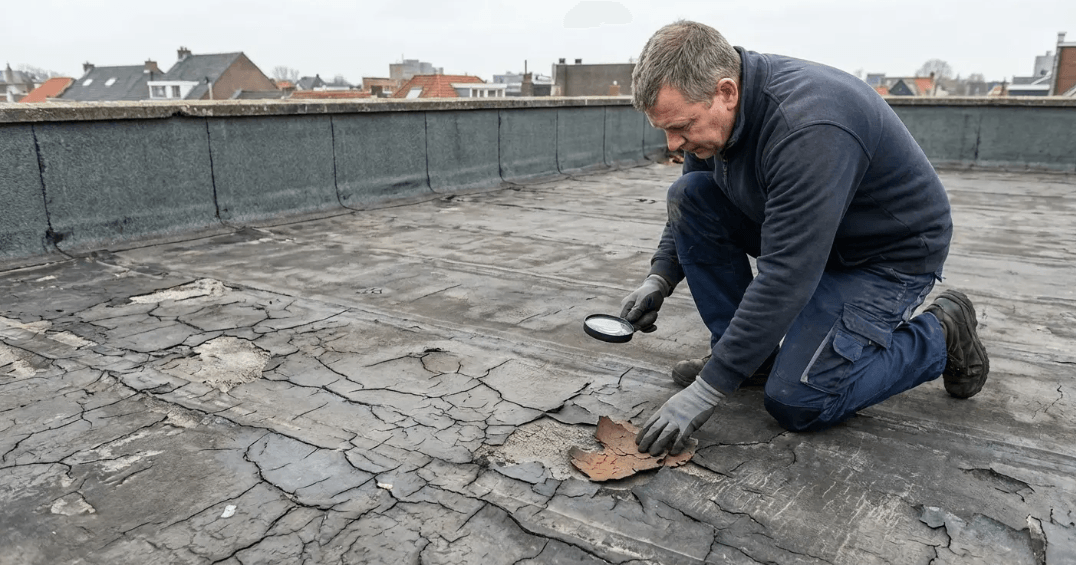
Widespread ponding indicates substrate failure that repairs can't fix. If water is pooling in multiple locations, your roof's drainage slope has failed. The substrate is sagging. Insulation is compressed. You need structural correction, new insulation, and new membrane. Trying to patch your way through this is throwing money away.
Interior water damage is your roof screaming at you. Once water is making it through your membrane, through your substrate, and into your building, you've got active failure. The visible leak inside represents months or years of hidden damage within the roof assembly. You're not looking at a repair anymore. You're looking at replacement plus remediation of the damage that's already occurred.
Multiple roof layers signal that you're out of repair options. Building codes limit flat roofs to two or three layers maximum. If you're already at that limit, your next intervention has to be a tear-off and replacement. There's no "repair" option that doesn't involve removing existing layers first.
The brutal truth about flat roof repair cost is that repairs are often false economy. You feel like you're being financially responsible by choosing the cheaper option, but you're extending the timeline on a roof that's going to fail anyway. Every dollar you spend on repairs is a dollar that doesn't contribute to the replacement you were always going to need. You're paying twice: once for repairs that buy you a little time, and again for the cost of replacing a flat roof you were always going to need.
Size, Access, and Other Cost Multipliers You Can't Control
Some cost factors are fixed by your building's characteristics. You can't negotiate them away or value-engineer around them. You can only understand them and plan accordingly.
Roof size obviously drives total cost, but the relationship isn't linear. Small roofs, under 1,500 square feet, often cost more per square foot because contractors have mobilization costs that don't scale down. I'm bringing the same truck, same crew, same equipment whether I'm doing 800 square feet or 8,000 square feet. Those fixed costs don't disappear just because your roof is small. You might pay $10 per square foot while the warehouse down the street pays $6 for the same material and quality.
Very large roofs, over 20,000 square feet, can see per-square-foot costs drop as low as $3.50 to $4 for basic systems. You're achieving economy of scale. But you're also dealing with longer project timelines, more complex logistics, and greater weather exposure during installation.
Building height multiplies costs through safety requirements and material handling. A ground-level roof might cost $5 per square foot while an identical roof on a 10-story building costs $7 per square foot, purely due to access challenges and safety setup.
Roof shape and complexity matter more than you'd expect. A simple rectangular roof is straightforward to measure, straightforward to install, and straightforward to waterproof. An irregular roof with multiple levels, valleys, and direction changes requires more material (to handle the transitions), more labor (to execute the details properly), and more skill (to ensure everything is waterproof). Complex roofs can cost 30% to 50% more per square foot than simple rectangular roofs of the same size.
| Cost Multiplier | Impact on Total Cost | Why It Matters |
|---|---|---|
| Small roof size (<1,500 sq ft) | +25-40% per sq ft | Fixed mobilization costs don't scale down |
| Building height (3+ stories) | +15-30% | Safety equipment, slower material handling, insurance |
| Complex roof shape | +30-50% per sq ft | More transitions, custom flashing, precision work |
| Limited access | +20-35% | Manual material transport, restricted work hours |
| Multiple drain relocations | +$1,500-$4,000 each | Structural work, plumbing, waterproofing complexity |
| Code-required upgrades | +15-40% | Insulation, fire rating, drainage improvements |
| Multiple existing layers | +30% removal cost | Additional labor, disposal weight, complexity |
Existing drainage systems impact your flat roof replacement cost. If your drains are properly located and functioning, great. If they're in the wrong places, creating ponding areas, or if they're failing, you're looking at drain relocation or replacement. Moving a roof drain isn't a simple task. It involves cutting through your roof assembly, potentially rerouting interior plumbing, and waterproofing the new and old penetrations. Each drain relocation can add $1,500 to $4,000 to your project.
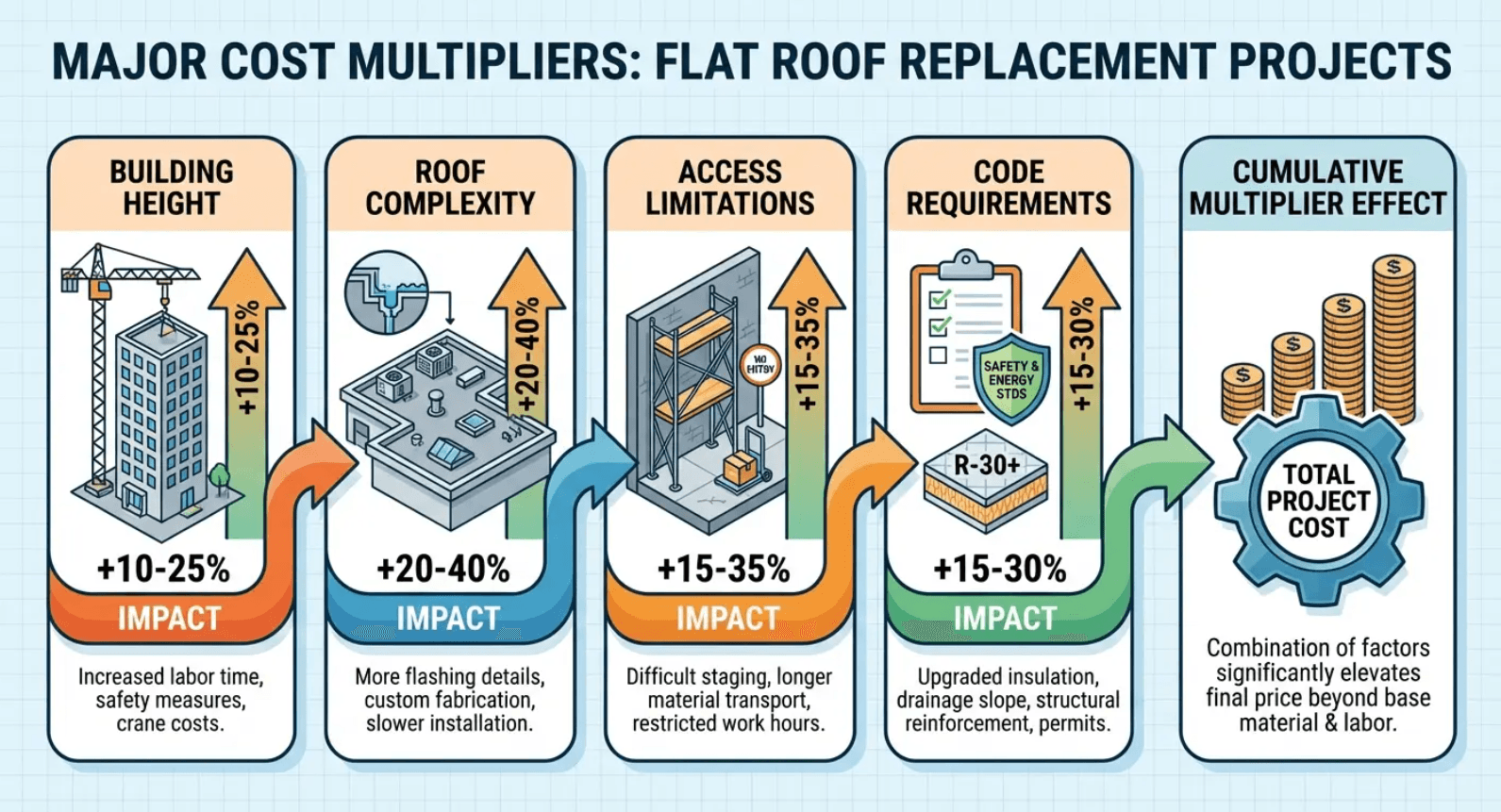
Local code requirements create cost variations by region. Some jurisdictions require specific membrane types, minimum insulation R-values, or particular fire ratings. You might be required to bring your entire roof up to current code even if you're just replacing the membrane. Code-required upgrades can add 15% to 40% to your base replacement cost.
Permit costs and inspection requirements vary wildly by location. Some municipalities charge a few hundred dollars for a roof replacement permit. Others charge a percentage of project cost, potentially adding thousands to your expense. Required inspections add time to your project, which can mean weather risk, and potentially require corrections if the inspector finds issues. Understanding the cost to install a flat roof in your specific jurisdiction requires accounting for these local variables.
Want to know if a contractor knows flat roofs? Ask them about crickets, the small ridges that divert water from HVAC units. If they look confused, keep calling.
The Timing Strategy That Could Save You Thousands
When you replace your flat roof matters almost as much as how you replace it. Strategic timing can shift your total investment by thousands of dollars without changing a single specification.
Seasonal pricing varies significantly in most markets. Roofing contractors are busiest in late spring through early fall. Demand is high, schedules are full, and pricing reflects that demand. The same contractor who quotes you $45,000 in June might quote $38,000 in November if they're trying to keep crews busy during the slow season.
But seasonal savings come with tradeoffs. Many flat roofing materials have temperature limitations for installation. TPO and PVC can be installed in cooler weather than EPDM or modified bitumen. If you're chasing off-season pricing, you need to ensure your chosen material can be installed properly in those conditions. A cheaper quote doesn't help if the installation fails prematurely because adhesives didn't cure properly or membranes couldn't be welded correctly.
Weather windows require careful calculation. You need enough consecutive dry days to complete tear-off and installation without exposing your building's interior to rain. A 5,000 square foot roof might need three to five days of dry weather. Gambling on weather in shoulder seasons, early spring or late fall, can backfire spectacularly. Rain delays mean paying crews to stand around, extended equipment rental, and potential water damage to your building's interior.
Here's how I tell customers to think about timing:
Schedule off-season if your roof can wait 3-6 months without catastrophic failure and you want to save 15-30%. Just make sure your material can be installed in cold weather. Not all can.
Pay the peak-season premium if your roof is already failing, you need a guaranteed completion date, or you can't risk weather delays.
None of this matters if you've got active leaks, structural problems, or your insurance company breathing down your neck. Then you replace it now, whatever it costs.
Emergency replacement costs 40% to 60% more than planned replacement. When your roof fails catastrophically and you need immediate action, you've lost all negotiating leverage. You're calling contractors who know you're desperate. You're accepting whatever schedule opening they have. You're paying premium rates for rush service. Worse, you're probably also paying for emergency water remediation, temporary weather protection, and business interruption costs that dwarf the roofing premium.
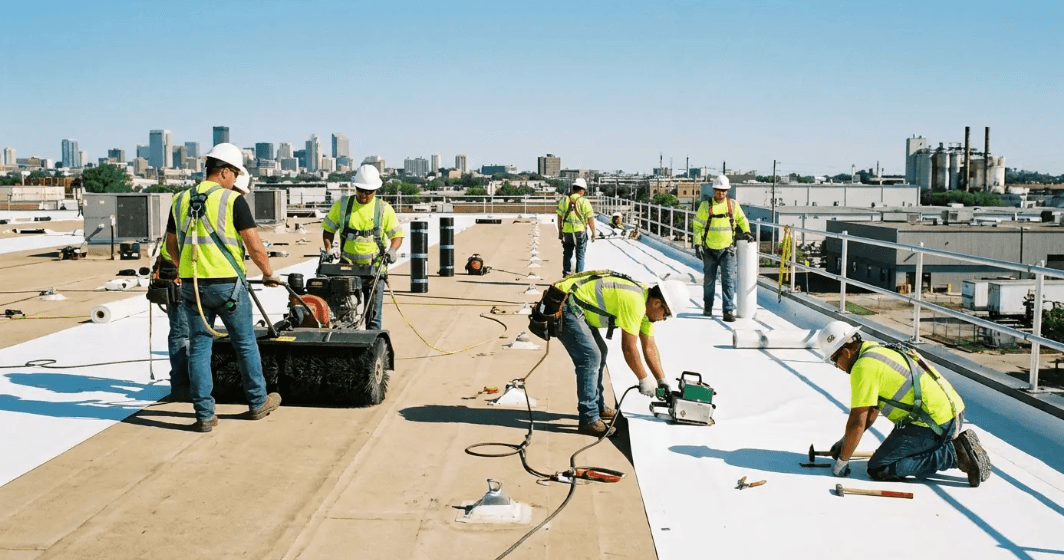
The financial case for proactive replacement is compelling. Replacing your roof when it's at 80% of its service life, before failure, costs substantially less than waiting until it fails. You control the timing, you can get competitive bids, you can schedule during favorable pricing periods, and you avoid the cascade of damage costs that come with roof failure. While a flat roof replacement cost calculator can provide baseline estimates, the real savings come from strategic timing decisions.
Counterintuitive truth: the best time to replace your flat roof is before you think you need to. Sounds like contractor self-interest, but the math proves it. Waiting until you "need" replacement means you're already into damage territory. The roof that looks 80% fine costs half what the roof that's "definitely failing" costs.
Market conditions affect contractor pricing beyond just seasonality. During construction booms, contractors are selective about which jobs they take. Your small or medium-sized flat roof might not interest them, or they'll price it high because they'd rather be doing larger, more profitable work. During construction slumps, that same contractor is hungry for work and will sharpen their pencil considerably.
Material costs fluctuate with oil prices (most roofing membranes are petroleum-based) and supply chain conditions. We saw dramatic material cost increases in 2021-2022 that added 25% to 40% to flat roof cost. Those costs have moderated but remain elevated. Trying to time the material cost market is difficult, but being aware of trends helps you understand whether current pricing represents good value or whether waiting a few months might yield better numbers.
Contractor availability matters more than most property owners realize. The best contractors stay busy. If you want a specific company because they have the best reputation, the most experience with your building type, or the strongest warranty support, you might need to book them months in advance. Waiting until your roof is in crisis means you'll get whoever is available, not necessarily who you want.
What Happens If You Keep Postponing
Delaying needed flat roof replacement feels financially responsible in the moment. You're conserving capital, avoiding a major expense, keeping cash available for other needs. But postponement has costs that aren't visible until they've already compounded into something much worse.
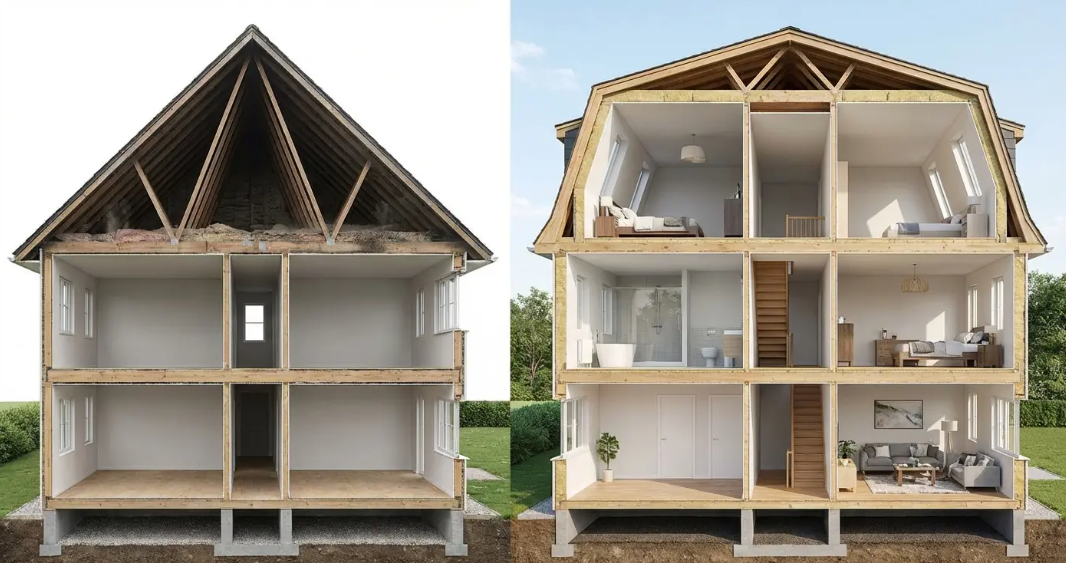
Water infiltration accelerates from minor to catastrophic faster than you expect. What starts as a small leak that shows up as a ceiling stain becomes saturated insulation, which loses its thermal performance and adds weight load to your structure. Then it becomes compromised decking. Then it becomes structural damage to supports and beams. Each stage multiplies your eventual repair cost.
The real-world consequences of postponing flat roof replacement extend beyond financial costs to safety and quality of life. In March 2026, Gray Line Roofing completed a no-cost roof replacement for a disabled veteran in Norfolk whose roof was over 25 years old and had caused widespread interior damage and electrical issues due to multiple leaks. The veteran had experienced difficult living conditions and financial hardship that prevented timely replacement, demonstrating how postponement creates cascading problems that affect not just the structure but the inhabitants' daily lives and safety.
Saturated insulation is expensive to replace and expensive to ignore. Wet insulation can weigh 10 to 20 times more than dry insulation, creating load stress your structure wasn't designed to handle. It loses virtually all its insulating value, which means you're heating and cooling the outdoors. Your energy bills climb while your roof slowly collapses under the added weight. Insulation replacement can add $2 to $4 per square foot to your roofing project, costs you wouldn't have incurred if you'd replaced the roof before water infiltration began.
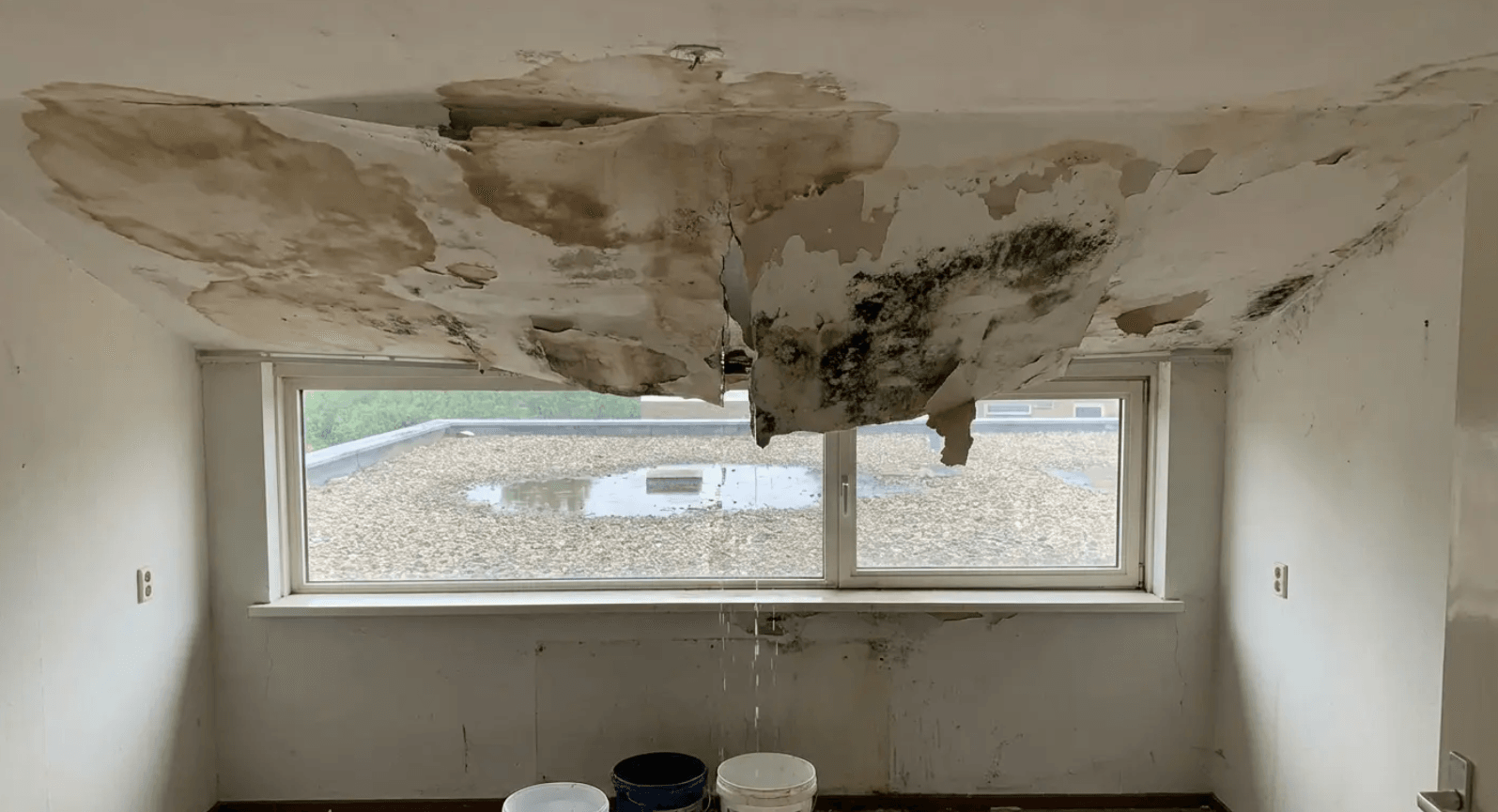
Structural damage transforms a roofing project into a construction project. Once your support beams are compromised by water or rot, you need structural engineering, permits, potentially temporary building supports during repair, and skilled carpentry work before any roofer can start. I've seen postponement turn a $40,000 roof replacement into a $95,000 structural repair and roof replacement because the owner waited two years too long.
Guy in Virginia Beach, owned a three-story office building off Independence Boulevard. Put off a $35K roof for 18 months because, I get it, $35K hurts. When I came back, we were looking at $52K. The ponding water had turned his insulation into a sponge. Weighed probably three times what it should. Had mold in the ceiling cavity. He saved $35K for 18 months and it cost him an extra $17K plus he had to close the second floor for two weeks while we worked. His tenants weren't thrilled.
Mold and indoor air quality issues create health risks and remediation costs. Water that makes it into your building creates conditions for mold growth. Remediation requires specialized contractors, containment procedures, air quality testing, and potentially temporary relocation of occupants. Mold remediation can easily cost $10,000 to $50,000 depending on extent, and it has to be completed before roof replacement can begin.
You can smell a failing flat roof before you see it. That musty, organic smell when you walk into the top floor? That's saturated insulation. Smells like wet cardboard mixed with basement.
Interior damage to finishes, equipment, and inventory represents costs beyond the roof itself. Water destroys ceiling tiles, damages walls, ruins flooring, and can destroy equipment or inventory. Your business interruption costs might exceed your roofing costs. Insurance might cover some of this damage, but you'll pay through increased premiums and deductibles. Plus, insurance doesn't cover damage from long-term neglect or failure to maintain your roof properly.
Energy efficiency losses hit your operating costs every single month. A failing flat roof with compromised insulation can increase your heating and cooling costs by 20% to 40%. On a building with $1,500 monthly HVAC costs, that's $300 to $600 per month in waste. Over two years of postponement, you've paid $7,200 to $14,400 in excess energy costs. That money could have funded a significant portion of your flat roof replacement cost.
Property value and marketability suffer from deferred maintenance. If you're planning to sell or refinance, a roof that's visibly at end-of-life or that has known issues will crater your property value. Buyers will either walk away or demand price concessions that far exceed the actual flat roof replacement cost because they're assuming worst-case scenarios about hidden damage. You'll pay for the deferred maintenance one way or another.
Code compliance issues accumulate over time. Older roofs were installed to older codes. When you finally do replace your roof, you'll need to bring everything up to current code. The longer you wait, the more codes change, and the more expensive compliance becomes. Requirements for insulation R-values, fire resistance, and drainage have all become more stringent over the past decade.
If you want to avoid getting to that point, proactive care matters. This guide on maintaining your flat roof shows how early action can extend lifespan—but only up to a point.
The math of postponement never works in your favor on flat roofs. Unlike pitched roofs, which can sometimes limp along for years past their prime, flat roofs create compounding damage that multiplies costs exponentially. Every month you wait past the optimal replacement point costs you money, either in repairs, in damage, or in the eventual replacement project that's grown more complex and expensive.
Working With Joyland Roofing
You're probably sitting on a roof decision right now, weighing costs against risks, trying to figure out if you can squeeze another year out of what you've got. That calculation is exactly where most property owners get stuck, and it's where honest guidance makes the biggest difference.
I started Joyland Roofing because I got tired of watching contractors sell roofs people didn't need yet, or worse, tell people their roof was fine when it wasn't. You need someone to tell you the truth about your timeline. That's what we do.
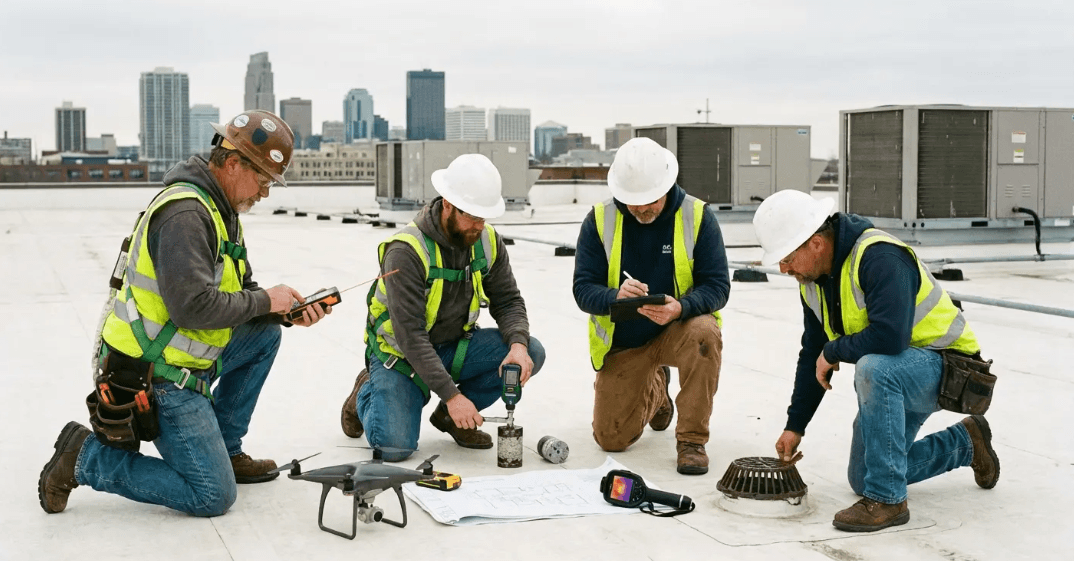
The cost conversation we have with property owners starts with understanding what's driving your specific numbers. Your roof isn't a generic square footage calculation. It's a unique combination of substrate condition, drainage issues, access challenges, and timing pressures. We price projects based on what your roof needs, not what a formula says it should cost.
We're not interested in selling you a roof replacement you don't need yet, but we're also not going to tell you it's fine when it's not. You'll get a clear picture of your roof's condition, a realistic timeline for replacement, and transparent pricing that accounts for the variables specific to your building.
I know $40,000 is a lot of money. I know you're hoping I'll tell you that you can patch it and get another five years. I wish I could tell you that. But I can't, because it's not true, and you deserve better than being sold a solution that won't work.
You can reach us for a thorough roof assessment that gives you the information you need to plan properly.
Final Thoughts
Flat roof replacement cost figures are frustrating because they resist simple answers. You want a number, and what you get instead is a range that depends on factors you can't fully control or predict until the work begins.
But here's what you can control: timing. The single biggest variable in your total cost isn't material choice or contractor selection. It's whether you replace your roof proactively or reactively. Proactive replacement, when your roof is clearly declining but hasn't failed yet, costs 40% to 60% less than emergency replacement after failure. That difference alone dwarfs any savings you might achieve through aggressive bid shopping or material downgrading.
You can also control how you think about flat roof cost. The cheapest installation price rarely represents the best value. Your roof is a 15 to 30 year investment. The total cost of ownership, installation plus maintenance plus energy impact plus eventual replacement, matters more than the initial check you write. A roof that costs $8,000 more upfront but lasts 10 years longer and requires less maintenance is cheaper in every way that matters.
And don't get me started on customers who get five bids and pick the lowest one. You know what the lowest bid means? Either the contractor missed something, or they're planning to cut corners, or they're desperate for work because they're not good at this. I've never, not once in 20 years, seen the lowest bid turn out to be the best value.
When we do a roof right, proper drainage, clean seams, good flashing details, that roof will outlast the building's next two owners. That matters to me. I've got roofs I installed 15 years ago that still look good. That's the point of doing this work.
The overlooked angle in flat roof replacement cost isn't about finding cheaper materials or getting better bids. It's about understanding that postponement is the most expensive decision you can make. Every property owner I've worked with who waited too long has regretted it. Every property owner who replaced their roof proactively has been glad they did, even though it hurt to write that check.
Your flat roof is trying to tell you something right now. Ponding water, visible membrane damage, increasing leak frequency, or repair costs that keep climbing. Those aren't problems to manage. They're signals that your window for cost-effective replacement is closing. The question isn't whether you'll replace your roof. It's whether you'll replace it on your terms or on the roof's terms.
Here's what it comes down to: You're going to replace this roof. The only question is whether you do it on your schedule or the roof's schedule. On your schedule, you control costs, timing, contractor selection. On the roof's schedule, you're scrambling, paying premiums, and dealing with water damage while you wait for an available crew.
I can't make the decision for you. But I can tell you that in 20 years of this work, I've never had someone regret replacing their roof proactively. I've had plenty regret waiting too long.
Your call.