March 31, 2026
Roof Overhang Ideas That Look Good - but Cost You More Than You Think
Author
Most homeowners start looking at overhang roof ideas the same way they pick finishes—scrolling, saving, and chasing whatever looks good. That’s exactly how you end up with a roof that works…until it doesn’t.
Because here’s the part nobody tells you: your overhang isn’t just design—it’s performance. It decides how water moves, how your siding holds up, how your foundation survives, and whether your “outdoor space” is actually usable or just a damp, high-maintenance afterthought. And if you get it wrong, you won’t notice right away—but you will pay for it later.
The problem is, most advice out there treats overhangs like a one-size-fits-all detail. It ignores pitch, climate, drainage, and how your house actually behaves in real conditions. That’s how people end up copying “standard” dimensions that quietly create bigger issues over time .
If you want a deeper understanding of how roofs actually function (not just how they look), it’s worth taking a few minutes to read this complete roofing guide before you commit to a design.
Because the right overhang isn’t about following a trend—it’s about building something that works year-round, not just the four months you’re outside enjoying it.
Table of Contents
- TL;DR
- The Problem Nobody Wants to Talk About
- Roof Pitch Changes Everything (But Everyone Ignores It)
- Your Climate Matters More Than You Think
- Material Choices: Where Most People Screw Up
- Drainage Integration Is Half the Battle
- When Bigger Isn't Better
- Fighting Your Home's Architecture
- What This Actually Costs
- The Maintenance Problem You're Creating
- How We Actually Approach This
TL;DR
Quick version: Most overhang advice is garbage because it ignores your specific roof pitch, climate, and sun angles. The "18-24 inch standard" is lazy thinking that needs to die. Your drainage system matters as much as the overhang itself. Sometimes shorter is actually better. And if you can't reach your gutters with a normal ladder, you've designed yourself a permanent maintenance problem. Oh, and material choice will either save you or bankrupt you over 20 years.
The Problem Nobody Wants to Talk About
Three houses on my street have gorgeous deep overhangs (the kind that make you slow down and stare). Two of them have foundation cracks from water damage. The third owner pays $400 twice a year for gutter cleaning because he can't reach them with a ladder.
Pretty expensive curb appeal.
I see this constantly. Homeowners come in excited about a specific overhang style they saw online and different overhang roof ideas, and I have to walk them through why that 36-inch projection might damage their foundation or why their roof pitch makes that design physically impossible. The disconnect happens because everyone treats overhangs like they're crown molding (pretty trim that finishes off the roofline).
They're not. They're your home's umbrella—and your overhang roof design determines how well it actually works.
Your overhang has one job: keep water away from your foundation. Everything else (the shade, the siding protection, even the curb appeal) is a bonus.
When you prioritize appearance over engineering, you're building an expensive problem that photographs well.
Roof Pitch Changes Everything (But Everyone Ignores It)
Roof pitch changes everything about how your overhang performs, yet most discussions treat all overhangs like they exist in a geometric vacuum.
A 24-inch overhang on a 4:12 pitch roof provides completely different protection than the same projection on an 8:12 pitch. Steeper roofs throw water farther from your foundation.
You need to think about your overhang's protection zone in three dimensions—and this is where most overhang roof ideas fail.
If you’re not sure how everything connects, this breakdown of the
parts of a roof helps put your
roof overhang design into the bigger system.
| Roof Pitch | Recommended Minimum Overhang | Effective Wall Coverage | Structural Considerations |
|---|---|---|---|
| 3:12 to 4:12 | 24-30 inches | Moderate (water dumps close to foundation) | Standard rafter tails usually sufficient |
| 5:12 to 6:12 | 20-26 inches | Good (balanced protection) | May require lookouts beyond 24" |
| 7:12 to 8:12 | 18-24 inches | Very good (steep angle throws water far) | Enhanced uplift concerns in wind zones |
| 9:12 to 12:12 | 16-22 inches | Excellent (maximum throw distance) | Requires engineered connections |
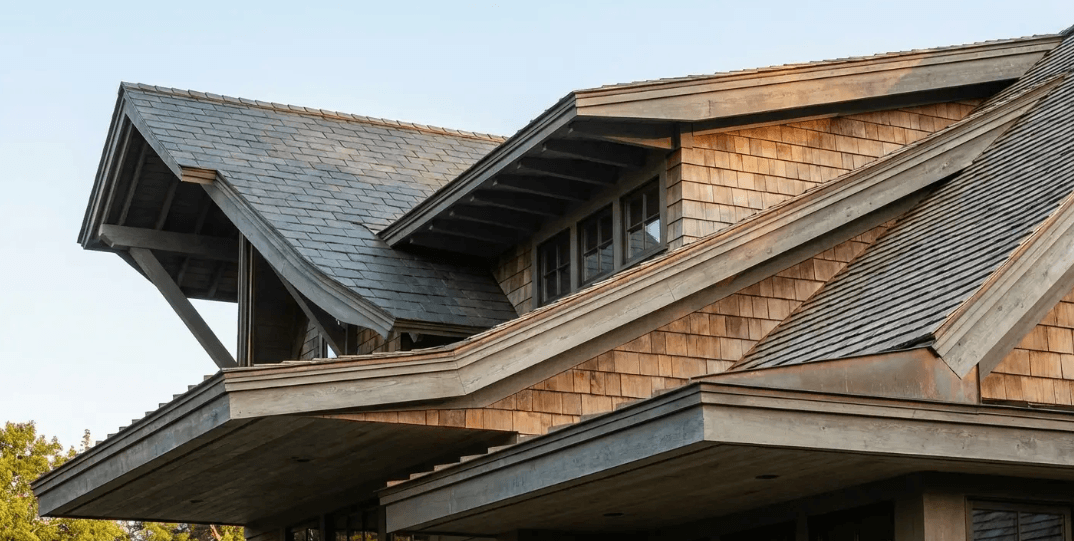
I use a simple rule of thumb that accounts for pitch: divide your roof's rise by its run, then multiply your desired wall protection distance by that ratio. This gives you a starting point for minimum projection that considers your roof's geometry instead of applying a one-size-fits-all number.
Structural capacity is the other half of this equation that gets glossed over. You can't just decide you want a 36-inch overhang and assume your current framing will support it. Extending your overhang beyond your existing rafter tails requires additional support, and that support needs to be engineered based on your snow load, wind exposure, and roofing material weight.
LSU AgCenter's building standards found that roof overhangs larger than 2 feet wide have to withstand very high uplift forces, so they should be engineered rather than built using standard construction methods alone. Confirms what I've known from experience.
The sweet spot exists where adequate protection meets structural feasibility and cost-effectiveness. For most homes, that's going to fall somewhere between 16 and 30 inches, but your specific number depends entirely on the variables I've just outlined. Anyone who gives you a definitive answer without measuring your roof pitch and assessing your framing is guessing.
Your Climate Matters More Than You Think
Your climate zone isn't just a detail on a building permit. It's the primary factor that should determine your overhang strategy.
Sun angle varies dramatically based on latitude. Rainfall intensity, snow load, and wind exposure all play a role in how your overhang roof design performs.
I've worked with homeowners who copied overhang roof ideas from homes in different climate zones and ended up with either inadequate shade or excessive weather exposure.
If you're already dealing with moisture issues, it’s worth understanding whether your roof leak repair can wait—because poor roof overhang design is often part of the problem.
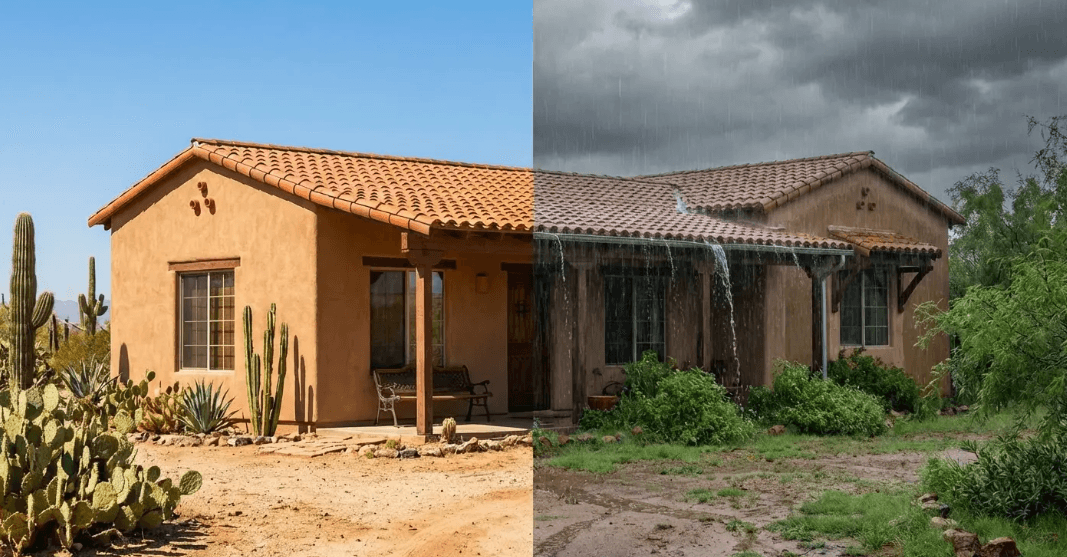
Rainfall intensity matters more than annual rainfall totals. A region that gets 40 inches of rain spread evenly across the year has different overhang needs than an area that gets the same 40 inches concentrated in monsoon-style downpours. High-intensity rainfall overwhelms gutters and creates more splash-back, requiring deeper overhangs or more sophisticated drainage integration.
Coastal regions face wind-driven rain that approaches walls at steep angles, sometimes nearly horizontal during severe storms. Standard overhangs provide almost no protection in these conditions. You need rain screen wall systems and other water management strategies that work with your overhang, not rely on the overhang alone.
Snow loading creates its own set of challenges. Deep overhangs in heavy snow regions become collection points for massive snow accumulation, creating structural stress and ice dam conditions. Sometimes a shorter overhang with a steeper pitch performs better because it sheds snow more effectively rather than holding it at the roof edge.
What I Actually Check (When I Remember):
- ☐ Determine your latitude and calculate summer/winter sun angles
- ☐ Research your region's average rainfall intensity (inches per hour during storms, not just annual totals)
- ☐ Identify your snow load zone and evaluate ice dam risk
- ☐ Assess prevailing wind direction and wind-driven rain exposure
- ☐ Calculate cooling degree days vs. heating degree days for your location
- ☐ Measure existing sun penetration at different times of year before finalizing overhang depth
- ☐ Consider microclimate factors (nearby buildings, trees, elevation changes)
- ☐ Review local building code requirements Actually, do this first or you'll waste everyone's time
Climate change is shifting these calculations in real time. Rainfall intensity is increasing in many regions even as total annual precipitation stays relatively stable. More extreme temperature swings are accelerating freeze-thaw damage.
Your overhang design needs to account for the climate you're going to experience over the next 20-30 years, not just historical averages.
Material Choices: Where Most People Screw Up
Your overhang isn't just a geometric projection. It's a system of materials that work together (or against each other) to provide protection and performance.
Let me be blunt: don't use wood unless you hate money. Everything else is details.
Okay, that's not entirely fair. Wood (especially cedar or redwood) looks incredible. For about five years. Then it starts rotting from the back side where you can't see it until the damage is extensive.
Soffit material affects your attic ventilation strategy. Solid wood soffits look beautiful but provide zero ventilation unless you add separate vents. Perforated vinyl or aluminum soffits integrate ventilation but can look cheap if not detailed properly. Fiber cement offers a middle ground with good durability and the ability to add ventilation where needed, but it's heavier and requires more robust support.
| Material | Durability (Years) | Maintenance Frequency | Ventilation Capability | Cost (per linear foot) | Best Application |
|---|---|---|---|---|---|
| Wood (Cedar/Redwood) | 15-25 | Every 5-7 years (painting) | Poor (requires separate vents) | $8-15 | Traditional/craftsman styles with maintenance commitment |
| Vinyl | 20-30 | Minimal (washing only) | Excellent (perforated options) | $3-6 | Budget-conscious projects, humid climates |
| Aluminum | 30-40 | Every 10-15 years (repainting) | Excellent (perforated options) | $5-10 | Coastal areas, low-maintenance priorities |
| Fiber Cement | 40-50 | Every 15-20 years (painting) | Good (requires vent installation) | $10-18 | High-wind zones, fire-prone areas |
| PVC/Composite | 30-50 | Minimal (washing only) | Good (perforated options) | $7-14 | Modern designs, extreme weather exposure |
If your contractor quotes you these exact prices, they're guessing. Markets vary.
Fascia takes the most weather exposure (and the most abuse from ladder-wielding homeowners who don't know what they're doing) of any trim element on your home. That beautiful wood fascia will look great for about five years, then it'll start to rot. Aluminum wrapping protects wood but can trap moisture if not installed with proper drainage details. PVC and composite materials offer durability but expand and contract with temperature changes (sometimes a quarter-inch over 16 feet, I've measured it) requiring careful installation to prevent buckling or gaps.
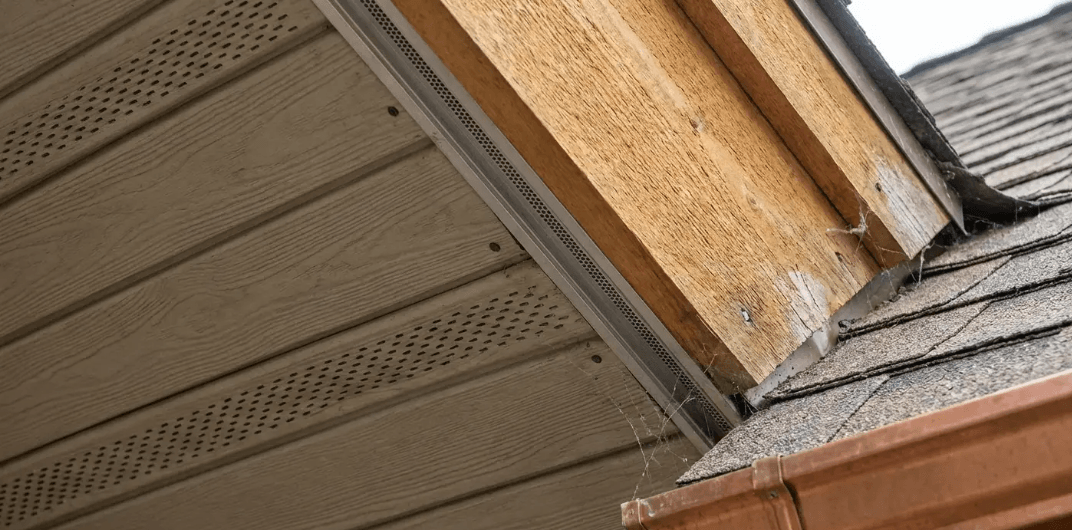
The roofing material at your overhang edge creates or prevents ice dams, depending on how it's detailed. Architectural shingles without proper underlayment at the eaves will leak when ice backs up under them. Metal roofing needs specific edge flashing to prevent wind-driven water infiltration. Tile roofing requires bird stops and specialized edge treatments that affect how water sheds off the roof edge.
Guy named Mike in Beaufort called me after his three-year-old cedar fascia started rotting. Beautiful house (historic district, perfectly matched the neighboring properties). But cedar and salt air? That's a five-year lifespan at best, and he was already seeing damage. The homeowner was pissed, and I don't blame him. He'd paid extra for cedar to match the historic character, done everything "right" according to his architect, and three years later he's looking at rot. The conversation I had to have (explaining that sometimes the historically accurate choice is the wrong choice) was not fun.
Switching to aluminum-wrapped fascia and fiber cement soffits with integrated ventilation solved the durability problem while maintaining the visual appearance from ground level. Climate exposure intensity should drive material selection as much as aesthetic preference.
Material weight matters more as overhangs get deeper. Heavy materials like fiber cement soffit and thick fascia boards add serious load to your overhang framing. You might need to upgrade structural support even if your projection stays within typical dimensions, simply because your material choices are heavier than standard.
Drainage Integration Is Half the Battle
Can we talk about how every big-box store employee confidently tells homeowners that gutters solve all drainage problems? They don't. They help. They're part of a system. But I've seen $30,000 foundation repairs on houses with perfectly functioning gutters because nobody thought about where the downspout water was going. The gutters worked great (they collected the water and dumped it right against the foundation). Brilliant.
You can have the perfectly sized overhang and still end up with foundation damage if your drainage system isn't designed to work with it. These aren't separate systems.
Gutter sizing needs to account for your roof's square footage, your overhang projection, and your region's rainfall intensity. A deeper overhang can sometimes allow you to use smaller gutters because the overhang itself provides additional protection during moderate rainfall. But in high-intensity downpours, that same deep overhang can shoot water past undersized gutters, making the problem worse.
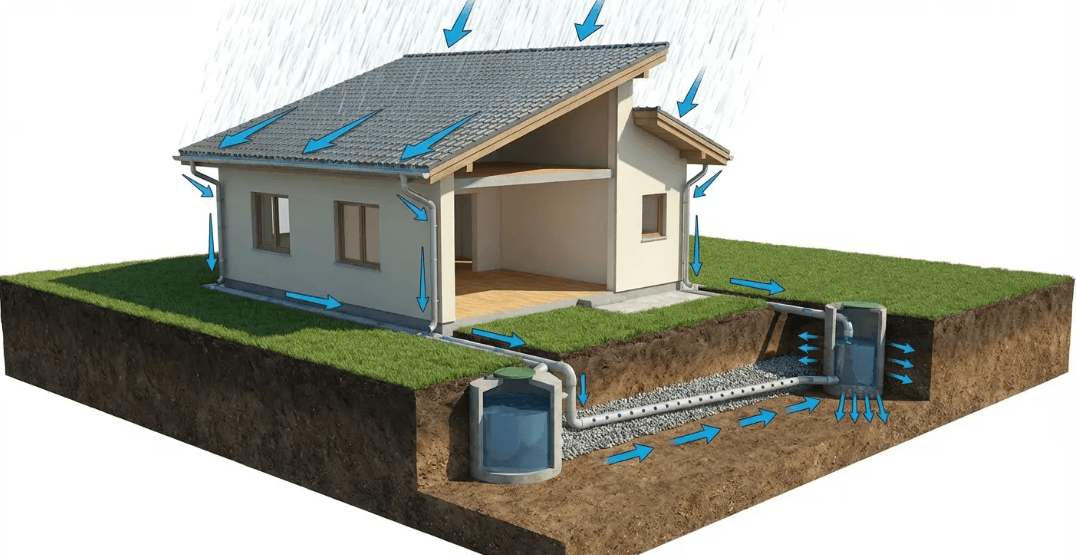
Downspout placement should be planned simultaneously with overhang design. Your roof valleys and the natural drainage patterns of your roof surface determine where water concentrates. Your downspouts need to be positioned at these concentration points, and your overhang needs to be detailed to direct water into the gutters at these locations rather than allowing it to overflow.
Splash blocks and drainage extensions are the unglamorous components that complete your water management system. Your overhang and gutters move water to ground level, but something needs to move it away from there. Too many homeowners stop at the downspout and wonder why they still have foundation moisture issues or basement leaks.
Some architectural styles and roof configurations make traditional gutters impractical or visually inappropriate. In these cases, your overhang needs to be deeper (often 36 inches or more) and you need a robust ground-level drainage strategy using French drains, channel drains, or graded swales. The overhang alone isn't enough.
Ice and snow add another layer of complexity. Gutters can become useless or even counterproductive in regions with winter precipitation because they collect ice and create dams. Your overhang design needs to account for this by either incorporating heat cable systems, using specialized gutter guards, or relying more heavily on overhang projection and less on gutter collection.
You can hear when a gutter's overflowing (that specific waterfall sound during a heavy rain). If you hear that, your overhang is undersized, your gutter's too small, or both.
The integration of overhang and drainage systems is becoming increasingly critical as weather patterns intensify. The Williams College Museum of Art under construction in Williamstown features a dramatic wave-like timber roof designed to emulate the surrounding Berkshire landscape, with carefully engineered drainage systems integrated into the mass timber structure to handle the building's complex roofline and significant overhang projections. Demonstrates how modern construction must balance aesthetic ambition with functional water management from the design phase forward.
When Bigger Isn't Better
Bigger isn't always better, despite what most overhang advice suggests. There are specific situations where a shorter overhang delivers better overall performance and lower lifecycle costs.
Modern wall systems with integrated rain screens, proper flashing, and water-resistant barriers can handle weather exposure that would've destroyed walls built with older methods. When you pair these advanced wall assemblies with appropriate (not excessive) overhangs, you get excellent protection without the structural complexity and cost of deep overhangs.
Deep overhangs create shadow lines that some homeowners love and others find oppressive. They reduce natural light penetration, which can be a serious quality-of-life issue in northern climates or on north-facing walls. A 16-inch overhang might provide 90% of the protection of a 30-inch overhang while allowing substantially more natural light into your home.
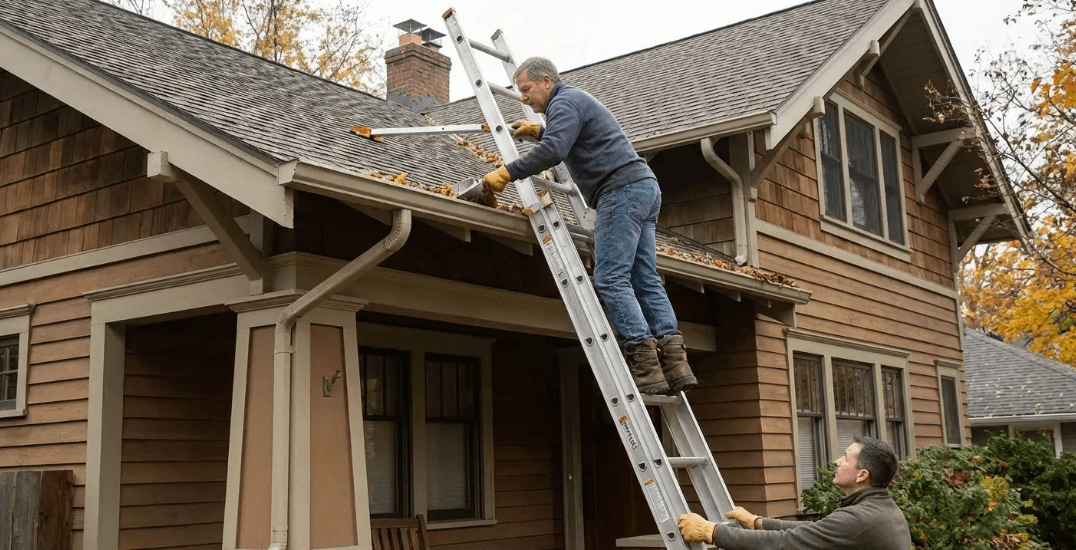
Maintenance accessibility becomes a nightmare with very deep overhangs. You can't easily reach the fascia, soffit, or gutter from a ladder when the overhang extends three feet past the wall. You end up needing scaffolding or specialized equipment for routine maintenance tasks. Over the life of your home, this added maintenance complexity costs more than the incremental protection benefit of the extra depth.
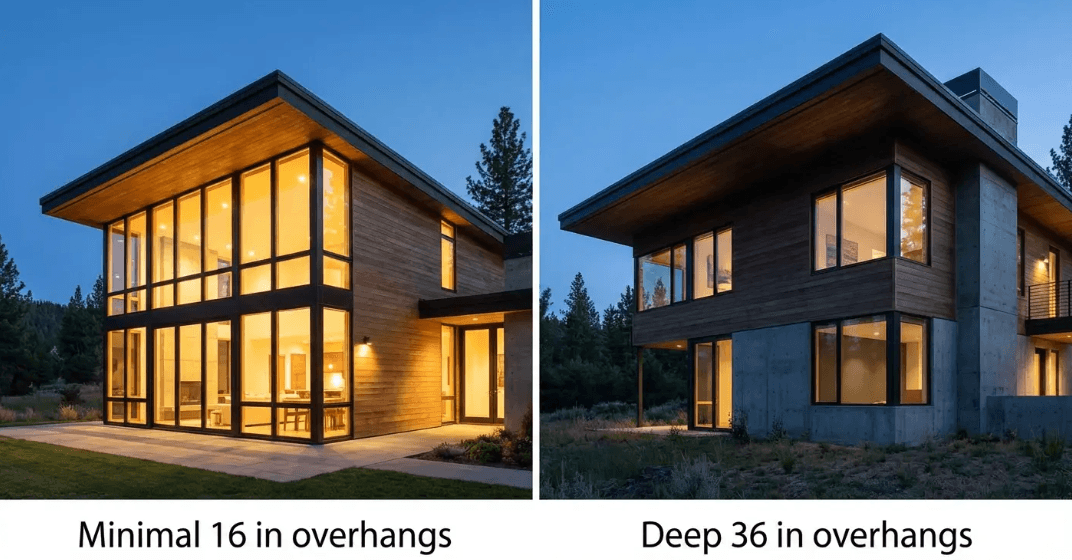
Some architectural styles actively fight against deep overhangs. Contemporary designs with clean lines and minimal trim details look awkward with traditional overhang proportions. Trying to force a deep overhang onto a style that doesn't accommodate it results in a home that looks confused rather than cohesive.
A homeowner in Denver built a modern minimalist home with 14-inch overhangs paired with a rainscreen wall system and high-performance windows. Their neighbor built a traditional home with 32-inch overhangs using standard wall construction. After five years, both homes showed excellent weather protection, but the modern home had 40% lower maintenance costs (no scaffolding needed for gutter cleaning, less fascia to paint) and significantly better interior daylighting. The neighbor's deep overhangs created perpetually dim rooms on the north side that required artificial lighting even during daytime. Shorter overhangs plus advanced building science can outperform longer overhangs with conventional construction.
The cost-per-inch of overhang protection isn't linear. The first 12 inches of overhang provides massive protective value. The next 12 inches provides significant but diminishing returns. Beyond 24 inches, you're paying exponentially more for incrementally smaller benefits. I help homeowners understand where their specific cost-benefit curve crosses the optimization point. If you’re trying to understand how roofing decisions impact long-term performance and cost, this complete roofing guide breaks it down in a way most advice doesn’t.
Wind exposure can make deep overhangs a liability. High-wind regions create uplift forces on overhangs that increase dramatically with projection distance. A deep overhang in a hurricane-prone area needs substantial engineering and bracing, adding cost and complexity. Sometimes a shorter, better-braced overhang performs more reliably in extreme wind events.
Fighting Your Home's Architecture
Your home's architectural style comes with expectations about overhang proportions, and sometimes those expectations directly contradict what your climate and orientation require. This tension creates real design challenges.
The challenge of balancing architectural style with functional overhang design continues to spark debate in residential communities. In Park City, Utah, a contentious appeal over a contemporary home design on King Road highlights how overhang design intersects with historic preservation guidelines. The project's appeal specifically challenges conditions requiring reduction in roof overhang to align with historic structures, with the homeowner arguing that reducing the overhang would significantly burden the proposed home as "the overhang provides shade for the terrace." This real-world case demonstrates how overhang design becomes a flashpoint when contemporary functional needs clash with traditional architectural expectations.
Prairie-style and Craftsman homes practically demand deep, dramatic overhangs. These styles were developed partly as responses to climate (Frank Lloyd Wright's prairie homes used those broad eaves for sun control), so the aesthetic and functional elements align naturally. You're working with the style, not against it, when you extend those rooflines generously.
Contemporary and modern farmhouse styles trend toward minimal overhangs or even flush eaves in some applications. This creates problems in climates that need substantial weather protection. You can't just slap a 30-inch overhang on a modern box-style home without destroying the clean lines that define the aesthetic. You need to solve the protection problem through wall assembly performance and strategic overhang placement rather than uniform depth.
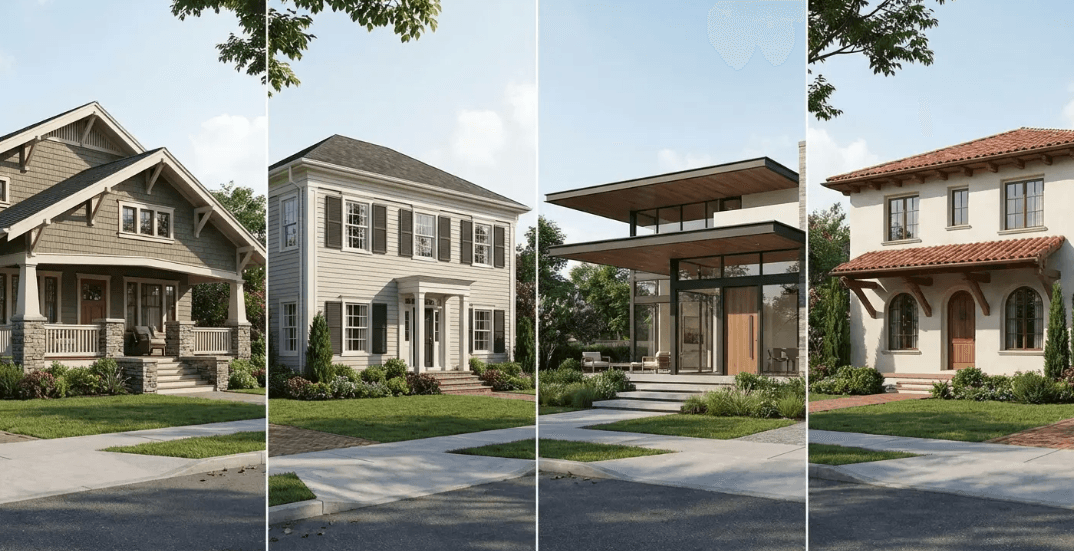
Colonial and Georgian styles traditionally feature moderate overhangs with specific cornice details. Going too deep looks wrong and violates the proportional relationships that make these styles work. Going too shallow leaves your walls vulnerable. The solution involves returning to historical precedent from your specific region (Southern colonials have different overhang traditions than New England colonials for climate-driven reasons).
Ranch homes present a different challenge because their low-slung profiles and broad footprints create large roof areas that collect substantial water. The style accommodates various overhang depths reasonably well, giving you flexibility to optimize for function. But you need to maintain consistent proportions across all elevations, which can be tricky when different sides of your home face different exposure conditions.
When Your Style Conflicts with Function:
- Identify non-negotiable style elements (the features that define the style's character)
- Identify non-negotiable functional requirements (minimum protection based on climate data)
- Find regional precedents (how did this style adapt in similar climates historically?)
- Consider hybrid solutions:
- Vary overhang depth by elevation (deeper on weather-exposed sides)
- Use advanced wall systems to reduce overhang dependency
- Incorporate style-appropriate details that add depth (brackets, exposed rafters)
- Adjust roof pitch to change effective coverage without changing projection
- Test visual impact (render or mock up proposed solutions before building)
I work through these style-versus-function conflicts regularly. The solution is almost never "ignore the style" or "ignore the climate." It's finding the adaptation strategies that respect both constraints. Sometimes that means using regional variations of a style that already solved this problem. Sometimes it means hybrid approaches that borrow solutions from multiple traditions.
What This Actually Costs
Nobody wants to talk about what overhangs cost because the numbers vary wildly based on your home's specifics. But you need some framework for understanding how costs scale so you can make informed decisions.
The first 16-18 inches of overhang comes "free" in the sense that it's accommodated by standard rafter tails or truss overhangs without additional structural support. You're paying for materials (soffit, fascia, roofing) but not for engineering or special framing. This is your baseline cost zone.
Extending from 18 to 24 inches requires lookouts or ladder framing to support the additional projection. You're adding labor and materials for this support structure, plus the incremental soffit, fascia, and roofing. Costs might increase 40-60% compared to the baseline zone, but you're getting significant additional protection value.
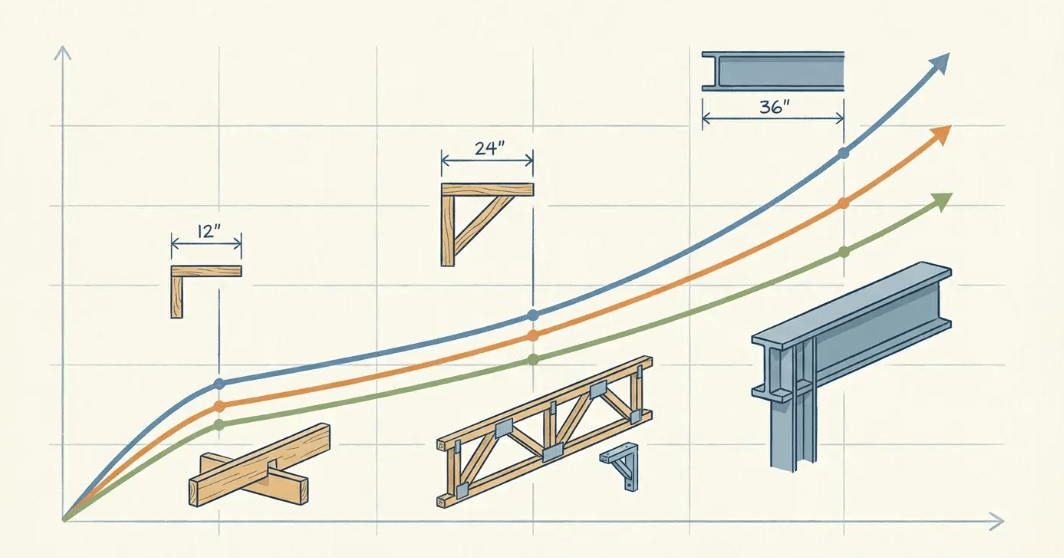
Pushing beyond 24 inches requires engineered solutions. You might need posts, brackets, or exposed rafter tails designed to carry the load. Your cost-per-inch starts climbing steeply here because you're not just extending existing structure, you're building new structural systems. I've seen costs double or triple compared to standard overhangs once you cross into this territory.
Last quote I saw: $12 per linear foot for standard overhang, $28 per linear foot for extended. That's not double (that's 2.3x the cost for maybe 1.3x the protection). Sometimes worth it, often not. But contractors won't tell you this because the bigger number makes them more money.
Material costs scale linearly (twice the projection requires roughly twice the materials), but labor and structural costs scale exponentially. That's the relationship most homeowners don't anticipate. They assume adding another foot of overhang will cost proportionally more, but it costs disproportionally more once you exceed standard framing capabilities.
You need to factor in your planned ownership duration. If you're building your forever home, optimizing overhang depth for long-term performance makes financial sense even if the upfront premium is substantial. If you're building for resale within five years, you need to balance functional optimization with market expectations and cost recovery through home value.
Regional construction costs affect these calculations dramatically. Labor-intensive overhang solutions cost relatively more in high-wage markets. Material-intensive solutions (using premium fascia and soffit products) cost relatively more in remote areas with limited supplier competition.
The Maintenance Problem You're Creating
Every overhang will need maintenance eventually. Gutters clog, fascia needs repainting, soffit vents need cleaning, and structural components require periodic inspection. Your overhang design either accommodates this reality or ignores it.
Standard ladder access works fine for overhangs up to about 20 inches. You can position a ladder against the fascia, reach the gutter, and perform routine maintenance safely. Beyond 20 inches, you start needing longer ladders positioned farther from the house, creating stability and safety issues. By the time you reach 30-inch overhangs, ladder-based maintenance becomes genuinely dangerous.
I've worked with homeowners who designed gorgeous deep overhangs and then discovered they couldn't safely clean their own gutters. They're now paying for professional service twice a year (at $200–400 per visit) for a task they used to handle themselves. Nobody mentioned this during design, and now they're stuck with the consequence. If you're not sure how often this upkeep should actually happen, this guide on how often to clean gutters lays out what most homeowners underestimate.
Gutter guards reduce but don't eliminate maintenance needs. They prevent large debris from entering gutters but still require periodic cleaning and can create their own maintenance issues if not properly installed. The value proposition depends on your tree coverage and local debris load. Don't assume gutter guards solve the access problem entirely.
Some overhang designs benefit from permanent access solutions. Roof hatches, built-in ladders, or catwalk systems might seem excessive during construction, but they become invaluable over decades of ownership. The incremental cost during construction is minimal compared to the accumulated cost of difficult access over 30 years.
Material selection directly impacts maintenance frequency. Wood fascia needs repainting every 5-7 years. Aluminum-wrapped wood extends that to 15-20 years. PVC or composite materials might never need painting. If your overhang design makes access difficult, you need to compensate with low-maintenance materials.
Rotted fascia has a distinctive smell (sweet and musty). If you smell it when you're on a ladder, the damage is already extensive.
Inspection access matters beyond routine maintenance. Your overhang structure can develop problems (rot, pest damage, connection failures) that aren't visible from the ground. If your design makes it impossible to inspect these areas without scaffolding, small problems become major failures because they go undetected for years.
Think about aging in place. The ladder work you can handle easily at 40 becomes risky at 60 and impossible at 75. Your home's maintenance requirements should decrease as you age, not increase. Design your overhangs with this trajectory in mind, especially if you're planning long-term ownership.
How We Actually Approach This
You've probably noticed a pattern: almost every overhang decision depends on variables specific to your home, your climate, and your priorities. That's why generic advice falls short.
I start every overh ang conversation by understanding what you're trying to achieve beyond "I need a roof." Are you fighting foundation moisture issues? Trying to reduce cooling costs? Protecting expensive siding materials? Matching a specific architectural vision? Your goals determine which overhang strategies make sense and which ones waste money solving problems you don't have.
The evaluation process looks at your roof pitch, your home's orientation, your regional climate data, your existing drainage systems, and your structural capacity. I'm measuring and calculating, not guessing. You'll understand exactly why I'm recommending specific dimensions and how they relate to your home's protection needs.
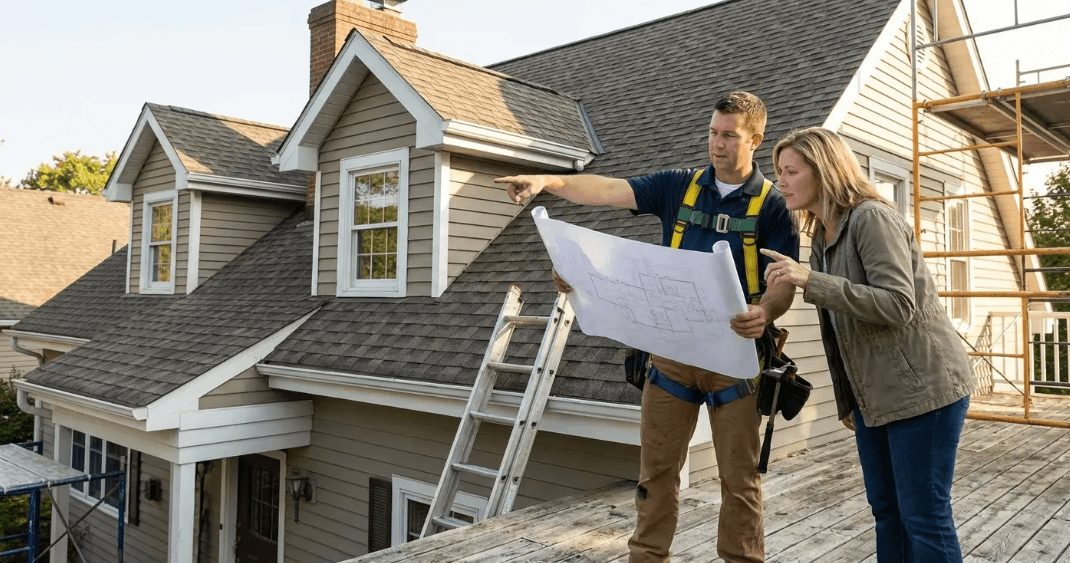
Most homeowners I work with have received conflicting advice from different sources. One contractor says you need 24-inch overhangs, another says 18 inches is plenty, a third suggests going to 30 inches on the south side. Nobody's explaining the reasoning, so you're left trying to choose between equally confident but contradictory recommendations.
Most architects hate when I say this, but a lot of them design overhangs to look good in renderings, not to work in real weather. I've had arguments with architects who wanted flush eaves on a house in a rainforest climate. Literal rainforest. I'm not naming names, but if you're reading this, you know who you are.
The integration piece matters too. Your overhang doesn't exist in isolation from your roofing material choice, your ventilation strategy, your gutter system, and your wall assembly. I'm designing these elements to work together, creating a comprehensive water management and thermal control system rather than a collection of independent components.
Building code in my area says 16 inches minimum. I ignore that and go 20 inches minimum on every house I design. Why? Because code is the bare minimum to not have your house fall down, not the standard for good design. I've never had a client complain their overhangs were too protective.
If you're struggling with overhang decisions or dealing with problems caused by inadequate overhangs on your existing home, I can help you develop a solution that addresses your specific situation. You can reach us to schedule an evaluation. I'll give you the analysis you need to move forward confidently, whether that's new construction, a renovation, or solving existing weather protection issues.
Final Thoughts
I learned this the hard way on my own house, actually. Went with 16-inch overhangs because I liked the clean modern look. First summer, my AC bills were $80 higher than my neighbor's identical floor plan with 24-inch overhangs. Took me two years to admit I'd prioritized aesthetics over function and add extended overhangs over the south-facing windows. My wife still brings it up.
Overhang design isn't complicated once you understand what you're trying to accomplish. You're managing water, controlling solar heat gain, and protecting your home's exterior materials from accelerated weathering. Everything else flows from these core functions.
The "right" overhang for your home depends on factors that generic advice can't account for. Your roof pitch changes the geometry. Your climate determines the threats you're protecting against. Your architectural style sets aesthetic boundaries. Your budget defines what's practically achievable. Your maintenance capabilities influence material and depth choices.
I've seen too many homeowners make overhang decisions based on incomplete information and then deal with the consequences for decades. Foundation moisture issues that could've been prevented with an extra six inches of projection. Cooling costs that are permanently elevated because inadequate overhangs allow excessive solar gain. Siding that needs premature replacement because weather exposure was underestimated. In a lot of cases, those same issues show up alongside leaks—if that’s something you’re dealing with, this guide on whether roof leak repair can wait
These aren't inevitable problems.
Start with your home's specific conditions. Measure your roof pitch. Understand your sun angles and prevailing weather patterns. Evaluate your existing drainage. Assess your structural capacity. Then make overhang decisions based on this foundation of data rather than generic recommendations.
You don't need the deepest possible overhang. You need the right overhang for your situation, designed to work with your drainage system, built with appropriate materials, and detailed for long-term performance.
One last thing: take a walk around your neighborhood this weekend and look at everyone's overhangs. Once you start seeing this stuff, you can't unsee it. You'll be that person at parties talking about roof pitch.
Sorry in advance.