January 2, 2026
Different Types of Houses: What Your Roof Says About How You'll Actually Live There
Author
Walk through any neighborhood and you’ll see a mix of styles - ranches, colonials, craftsman homes - all competing for attention. But here’s the truth most buyers (and even homeowners) miss: the different types of houses you’re drawn to aren’t just aesthetic choices. They quietly dictate how much you’ll spend, how often you’ll deal with repairs, and how your home actually performs over time.
That’s where this guide flips the script. Instead of focusing on curb appeal or square footage, we’re breaking down what really matters - the roof. Because no matter how beautiful a home looks from the street, it’s the roofing system that determines whether you’re dealing with minor upkeep… or a major, unexpected expense.
If you’ve ever wondered why some homes seem to “age well” while others turn into constant maintenance projects, it all comes back to design - and how that design handles water, heat, and time. Before you fall in love with a house style, it’s worth understanding what’s happening above your head.
Want to go deeper into how roofing systems actually work (and fail)? Check out this breakdown of the parts of a roof to see what you’re really investing in.
Because once you understand how different house styles affect your roof, you stop guessing - and start making smarter decisions that can save you thousands.
Table of Contents
- TL;DR
- Why We're Starting With the Roof (And Why That Changes Everything)
- The Ranch: Built for Simplicity, Vulnerable in Ways You Haven't Considered
- The Colonial: Symmetry That Hides Complexity
- The Cape Cod: Charm That Comes With Trade-Offs
- The Split-Level: The Misunderstood Middle Child of American Housing
- The Craftsman: Character Built Into Every Angle
- The Contemporary: Where Design Meets Real-World Maintenance
- The Tudor: Statement Architecture With Hidden Costs
- The Mediterranean: Climate-Specific Design That Travels Poorly
- What Most People Miss When Choosing a House Style
- Final Thoughts
TL;DR
- Every house style creates roofing challenges that'll hit your wallet in ways you didn't see coming. Maintenance costs, insurance rates, how long before you're replacing the whole thing again.
- Ranch homes? Easy roof access, sure. But that low pitch makes them sitting ducks for wind damage.
- Colonial and Cape Cod styles hide ventilation nightmares that can shave years off your roof's life if you don't catch them.
- Split-levels create multiple roof planes that turn water management into a puzzle. Every transition point is a leak waiting to happen.
- Craftsman homes look gorgeous with all those decorative elements. They also create dozens of spots where water can sneak in.
- Contemporary designs often look amazing but forget about basic drainage. You'll end up with pooling water and early failure.
- Tudor and Mediterranean styles use materials that most roofers don't actually know how to install right.
- Understanding what breaks on your specific house type means you'll ask better questions during inspections and dodge expensive surprises.
Why We're Starting With the Roof (And Why That Changes Everything)
Walk through any open house and you'll hear the same conversations. Granite countertops. Hardwood floors. Whether the kitchen is big enough for that island you've been dreaming about.
Nobody stands in the driveway examining the roof pitch or counting dormer valleys.
That oversight? It costs them thousands of dollars they never saw coming.
I've been inspecting roofs for fifteen years now, and I'm tired of watching people buy houses without understanding what they're getting into. You focus on what you see from the curb or how the kitchen makes you feel, while the roof system quietly determines whether you'll be writing a $15,000 check five years after closing. Understanding how your house style affects your roof isn't about becoming an expert. It's about recognizing that the architectural choices someone made decades ago create problems you'll inherit the moment you sign the deed.
Here's what nobody talks about: your house type isn't just about aesthetics or square footage. It's a maintenance contract you're signing for decades, and the roof is where that contract shows its terms most clearly.
After fifteen years of crawling around on roofs in hundred-degree heat and twenty-degree cold, you start seeing patterns. Some house styles just cost more to own. Period. Each architectural style creates its own set of vulnerabilities, maintenance demands, and cost implications that directly affect how you'll experience homeownership.
The Ranch: Built for Simplicity, Vulnerable in Ways You Haven't Considered
Ranch homes. Everyone loves them. Single story, easy living, no stairs to worry about when you're 70. They dominate American suburbs because they're affordable to build and actually work for families at every stage.
But that roof? That's where things get interesting.
That long, low-pitched roof creates problems most buyers never anticipate. The shallow pitch makes them accessible for maintenance, which sounds great until you realize that same low angle is terrible at shedding water quickly. During storms, water sits on the shingles for 30 to 45 seconds longer than it would on a steeper Colonial roof. That extended exposure gives water more time to find gaps in the seal around nail heads or worn spots in the shingle granules.
After fifteen years of this extended exposure, you might notice ceiling stains in the hallway. The roof wasn't installed poorly. The shallow pitch just let normal wear become a leak pathway faster than it would have on a steeper design.
The wide, open attic spaces in ranch homes can turn into ovens in summer if ventilation isn't perfect. Heat builds up and bakes your shingles from underneath, cutting their lifespan significantly. Many ranch roofs were built with minimal overhang, leaving fascia boards exposed to weather damage that accelerates rot and requires expensive repairs.
Wind poses another threat. That low-pitched roof acts like an airplane wing during high winds, creating uplift forces that can tear shingles loose. In cold climates, the shallow angle promotes ice dam formation because snow doesn't slide off naturally and meltwater refreezes at the eaves.
What Makes Ranch Roofs Fail Faster Than Others
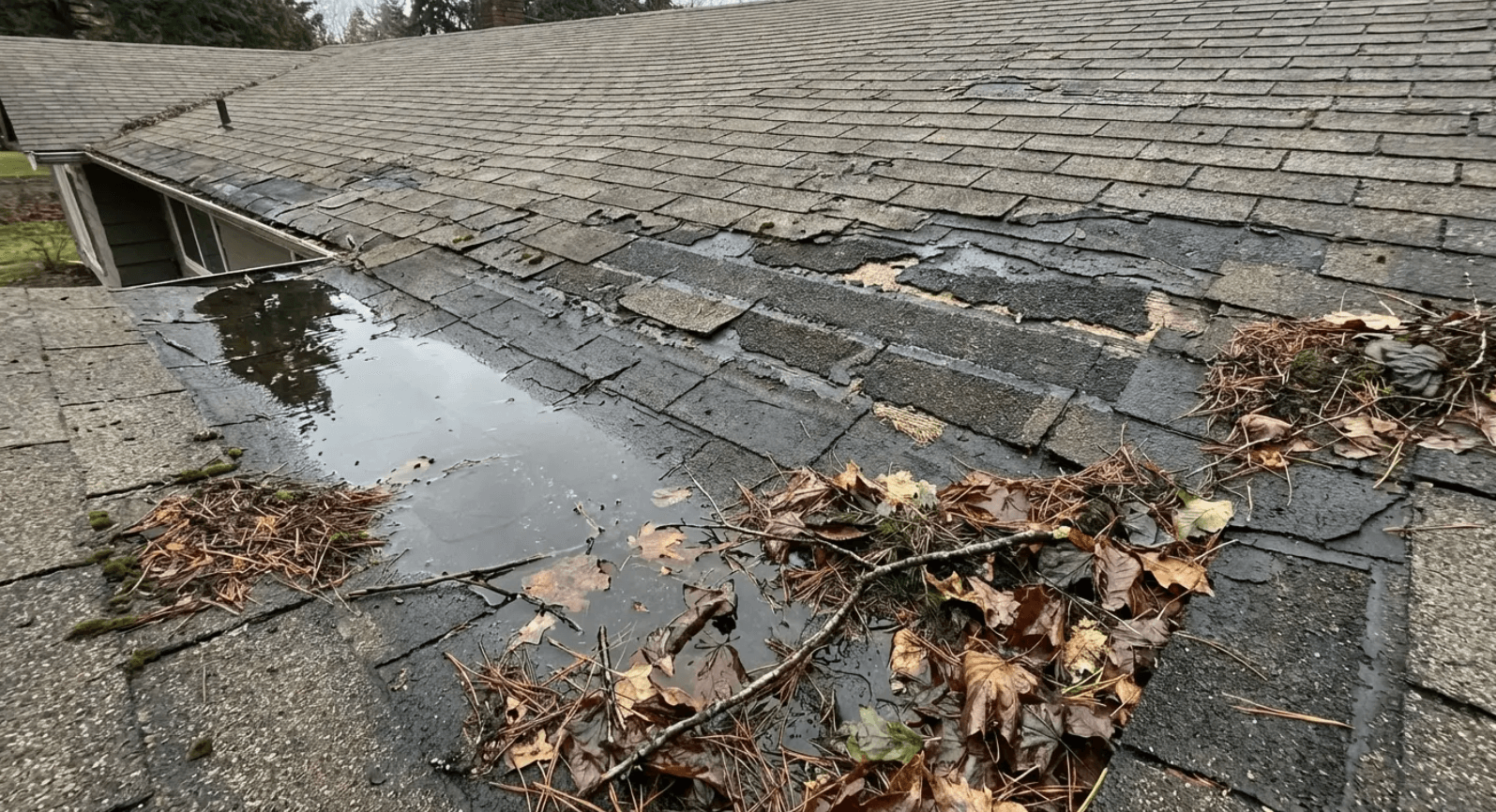
The combination of low pitch and large surface area means ranch roofs collect more debris than steeper house types. Leaves, branches, and dirt accumulate because they don't wash off easily. That debris holds moisture against shingles, promoting algae growth and accelerating granule loss.
The typical ranch roof has fewer natural break points, so when one section fails, water can travel horizontally under shingles for surprising distances before showing up as a leak inside. You might see water damage in your bedroom while the actual roof failure is above the living room.
Here's something most people don't think about: because these roofs are easy to access, homeowners walk on them. Satellite dish installation. Christmas lights. Just checking things out. That foot traffic creates damage that compounds over years. Each footstep compresses the shingle granules and can crack the underlying mat, especially on hot summer days when the asphalt is soft.
Ranch roofs are economical to replace because they have fewer complex angles. That advantage disappears if you're replacing them more frequently than other house types in your neighborhood.
Look, I made you a table because this is easier to see than to explain. But here's what it doesn't show: how much these "advantages" stop feeling like advantages when you're writing the repair check.
| Ranch Roof Characteristic | Maintenance Advantage | Hidden Vulnerability |
|---|---|---|
| Low pitch (3/12 to 4/12) | Easy to walk on for repairs | Water sheds slowly, increasing exposure time |
| Large unbroken surface | Economical to replace | Debris accumulates and doesn't wash away |
| Accessible height | DIY maintenance possible | Foot traffic damage from homeowner access |
| Simple geometry | Fewer leak points initially | Water travels farther horizontally when leaks start |
| Minimal overhang | Lower material costs | Fascia boards exposed to direct weather |
The Attic Ventilation Issue Nobody Warns You About
Ranch homes typically have continuous attic spaces running the entire length of the house. When ventilation problems occur, they affect the whole roof system at once rather than isolated sections. This creates cascading failures that are expensive to fix.
Inadequate intake vents at the eaves or blocked soffit vents create negative pressure that pulls conditioned air from your living space. You're wasting energy and creating moisture problems simultaneously. That moisture condenses on roof decking during temperature swings, leading to mold growth, wood rot, and nail pops that break the shingle seal.
Many ranch homes from the 1960s and 1970s were built with minimal ventilation because energy codes were different. Retrofitting proper ventilation often requires removing soffit panels and installing baffles. That's a cost most people don't anticipate when buying. I've seen homeowners spend anywhere from $2,800 to $5,400 addressing ventilation issues they didn't know existed until their roof started failing prematurely.
The Colonial: Symmetry That Hides Complexity
Colonial homes present a tidy, symmetrical facade with their centered door and evenly spaced windows. From the street, they look straightforward and well-proportioned.
Their roofing systems tell a different story.
The classic Colonial features a steep-pitched main roof with multiple dormers, chimneys, and valley intersections. Each of those features creates a transition point where different roof planes meet. Every transition is a potential failure point. I've inspected hundreds of these house types, and the leak patterns are predictable.
The steep pitch (typically 8/12 or higher) excels at water shedding but makes maintenance dangerous and expensive. Contractors need additional safety equipment and scaffolding just to access the roof safely. What costs $500 to repair on a ranch can easily run $1,200 on a Colonial because of access challenges.
Colonial roofs often include decorative elements that look impressive from the curb. Dentil molding and elaborate cornices create dozens of small gaps where water can wick behind flashing. These architectural details weren't designed with modern waterproofing in mind, and they show their age faster than the main roof surface.
Why Colonial Dormers Cost More Than You'd Think
Dormers add character and light to second-floor spaces. They're also roofing nightmares.
Each dormer creates valleys on both sides where water concentrates and flows faster than on open roof sections. These valleys require careful flashing installation. Most leak problems in Colonial homes originate at dormer valleys where flashing was improperly installed or has deteriorated. I've traced water stains back to dormer valleys that were installed correctly thirty years ago but have finally succumbed to decades of concentrated water flow.
Dormer roofs themselves are small, steeply pitched planes that are difficult to shingle properly. You can't walk on them easily, and edge details require precision. One misplaced nail or inadequately sealed edge can create a leak that doesn't show up for years.
Dormer sidewalls create another transition where roofing meets siding. If the step flashing isn't installed correctly with each course of shingles, water will eventually find its way behind the wall. The problem with house features that look this good is that fixing them requires removing siding, not just shingles. That multiplies labor costs.
What I Actually Check on Colonial Dormers (in order of what usually bites people):
- Valley flashing at each dormer for separation or corrosion (this is the big one, I don't care what else looks good)
- Water stains on interior walls adjacent to dormer sidewalls
- Whether step flashing is visible and properly integrated with siding
- Missing or damaged shingles on dormer roof planes (they're harder to replace than you think)
- Dormer window trim for rot or paint failure indicating water intrusion
- Proper clearance between dormer roof and main roof (minimum 4 inches, but I've seen less)
- Attic space behind dormers for moisture stains or mold growth
- Age of dormer flashing separately from main roof age (they don't always get replaced together)
The Chimney Factor in Two-Story Homes
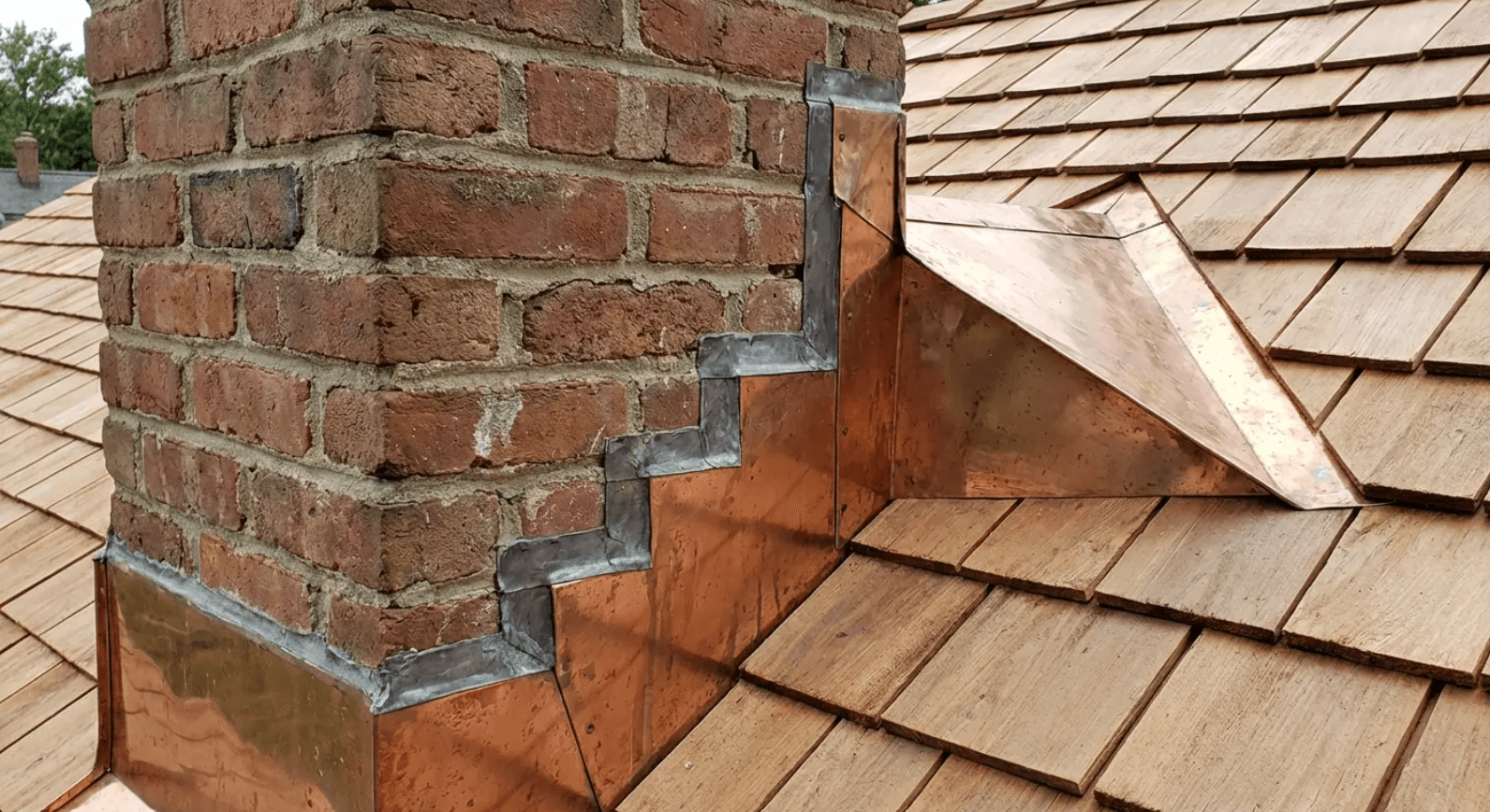
Colonial homes typically feature prominent chimneys that run from basement or first floor through to the roof, creating large penetrations that complicate waterproofing. Chimneys require counter-flashing installed into mortar joints and base flashing that forms a waterproof seal around all four sides.
Chimney flashing fails gradually as mortar deteriorates, metal corrodes, or the chimney settles slightly over decades. Many Colonial chimneys are no longer used for heating because homes have converted to forced air, but the chimney remains as a maintenance liability. You're maintaining a structural element that serves no functional purpose beyond aesthetics.
The uphill side of chimneys requires a cricket (a small peaked structure that diverts water around the chimney). When crickets are omitted or poorly built, water pools behind the chimney and rots the roof decking. I've seen situations where the shingles look fine but the decking underneath has rotted through, requiring structural repairs that cost three times more than the roofing work itself.
The Cape Cod: Charm That Comes With Trade-Offs
$4,500 to fix a bedroom ceiling. That's what happens when someone tells you Cape Cods are "charming" but forgets to mention you're basically living inside your attic.
Cape Cod homes originated in 17th-century New England and remain popular for their cozy proportions and efficient use of space. Their defining feature creates challenges that buyers rarely consider until they're living with the consequences.
The steep roof extends down to cover the first floor, with dormers popping out for second-floor living space. This roof-to-wall transition sits lower than in most house types, making it vulnerable to snow accumulation and ice dams. In regions with significant snowfall, that vulnerability translates to annual problems rather than occasional issues.
The second floor is essentially built into the attic space, which means insulation and ventilation must be perfect or you'll have comfort problems and roof damage simultaneously. Get either one wrong and you're dealing with hot bedrooms in summer and ice dams in winter.
Many Cape Cod homes have been expanded with additions that disrupt the original roofline. These additions create complex intersections that weren't part of the traditional design. I've seen additions that looked seamless from inside but created nightmare water management scenarios on the roof.
Living Space Inside Your Roof Structure
Cape Cod homes blur the line between attic and living space, which complicates everything about roof maintenance. Because bedrooms sit directly under the roof deck with minimal attic buffer, any ventilation failure immediately affects comfort. Those rooms get unbearably hot in summer when heat has nowhere to escape.
Insulation in these spaces must be installed carefully to maintain an air gap for ventilation. Many Cape Cods have been insulated by homeowners who packed fiberglass tight against the roof deck, eliminating airflow. This creates condensation problems that show up as water stains on bedroom ceilings, peeling paint, and musty odors.
Last winter I got a call from a guy in Portland. Mark, software engineer, mid-40s, the kind of guy who researches everything to death. He'd spent three weekends in his attic blowing in insulation because he'd calculated it would pay for itself in 18 months.
When I got there, his daughter's bedroom was 78 degrees and it was 34 outside. "I don't understand," he kept saying. "I followed the instructions exactly."
Yeah, you did. You also blocked every ventilation channel in the roof and turned your attic into a terrarium. The ceiling drywall was soft to the touch.
Four grand to fix what he'd spent $800 creating. He didn't speak to me the entire time we worked.
Addressing these issues often requires removing interior wall coverings to access the rafter bays. You're not just working on the roof from outside. You're doing interior renovation to fix a roofing problem. That's the reality of this style of home.
The Ice Dam Vulnerability Built Into the Design
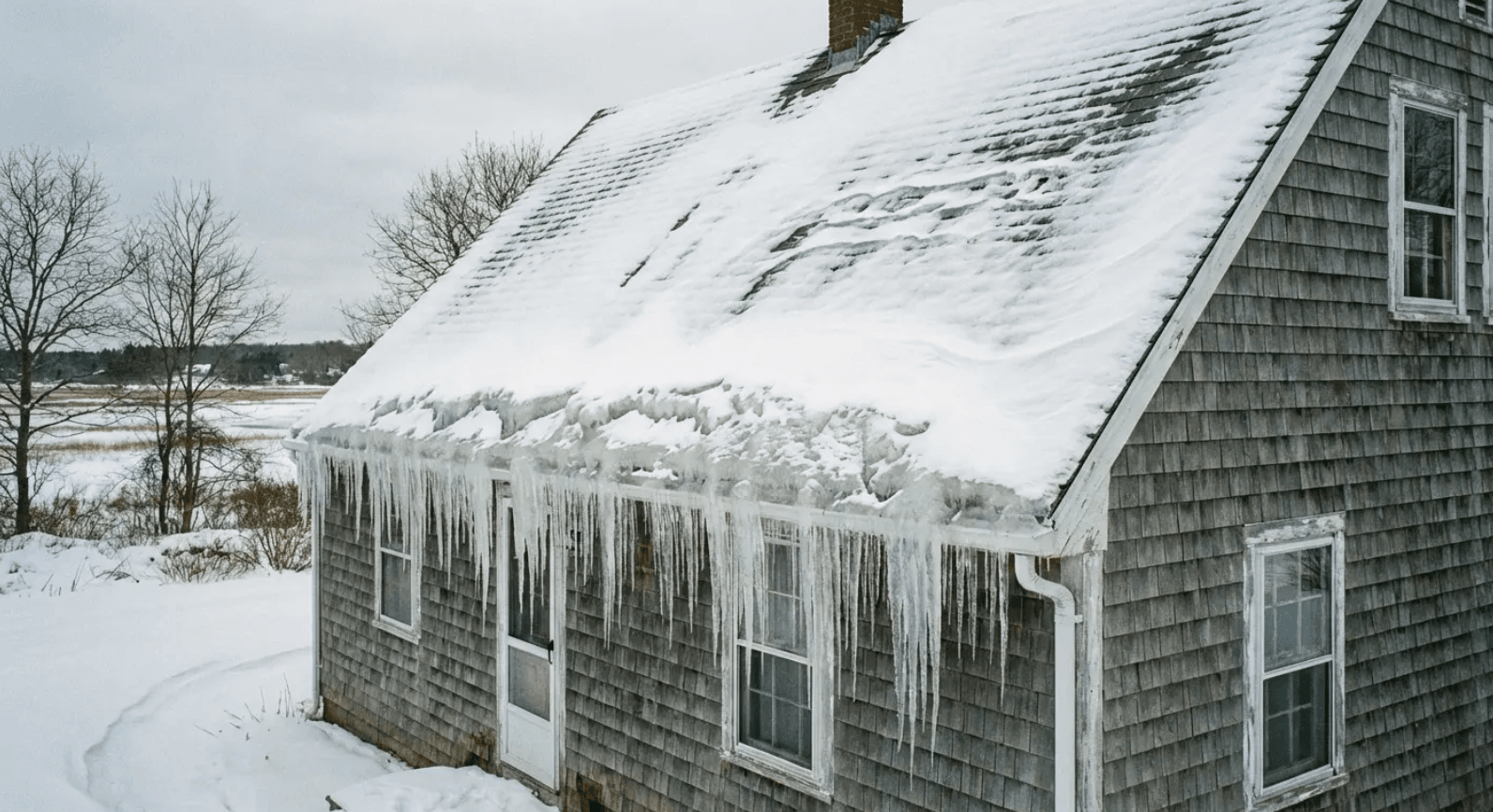
The steep roof pitch of Cape Cod homes sheds snow well, except where it doesn't. The lower roof edge where the roof meets the first-floor wall creates a natural cold spot where snow accumulates and melts slowly.
Heat escaping from first and second floors melts snow higher on the roof. That meltwater runs down until it reaches the cold overhang, where it refreezes into ice dams. These ice dams force water backward under shingles, often traveling several feet upward before finding a gap to leak through.
Cape Cod homes in cold climates need ice and water shield membrane installed much further up the roof than other styles. I recommend 6 to 8 feet from the edge instead of the standard 3 feet. Many older homes don't have this protection because it wasn't standard practice when they were built.
Adding proper ice dam protection during a roof replacement adds $800 to $1,500 to the project cost, but it's money well spent. Without it, you're gambling that each winter won't be severe enough to create problems.
That's a bet you'll eventually lose.
The Split-Level: The Misunderstood Middle Child of American Housing
Of all the house styles we've covered, split-levels frustrate me the most. Not because they're bad (they're not), but because I know guys who've been roofing for thirty years who still screw up split-levels.
Split-level homes emerged in the 1950s as a solution for sloped lots and offer distinct living zones at different heights. Their defining characteristic creates the most complex water management challenges of any common house style.
Multiple roof levels step down following the interior floor levels. Each level change creates a transition where one roof section meets the wall of a higher section. These transitions are inherently vulnerable. Water running off the upper roof hits the lower roof with concentrated force, accelerating wear in those areas.
Split-levels often feature multiple roof pitches and directions on a single house. You might need different shingle installation techniques on different sections of the same roof. Not every contractor understands these nuances, which is why we see so many split-level roofs that fail prematurely despite being installed by licensed professionals.
These house types challenge even experienced roofers. The complexity isn't obvious from the ground, but once you're on the roof examining the transitions, the vulnerabilities become clear.
Why Water Management Gets Complicated Fast
Split-level roofs create multiple opportunities for water to change direction, speed up, or pool in unexpected places. The vertical wall sections between roof levels (called headwalls) require careful flashing that extends behind siding and over the lower roof section.
These headwall flashings are difficult to install correctly and even harder to inspect once they're covered. I use moisture meters and infrared cameras to detect problems that aren't visible to the naked eye, and I find issues on the majority of split-levels I inspect.
Many split-level homes have gutters at multiple heights that need to coordinate drainage. If one gutter backs up, it can overflow onto a lower roof section that wasn't designed to handle that water volume. I've seen situations where a clogged upper gutter dumped water onto a lower roof for months before the homeowner noticed, causing around $8,000 in decking damage.
The inside corners where different roof sections meet create valleys that funnel tremendous water flow during storms. If those valleys aren't reinforced with proper underlayment and flashing, they'll leak within years. Standard installation practices aren't enough for these house types. You need contractors who understand the specific demands of multi-level transitions.
| Split-Level Transition Point | What Happens Here | Common Failure Mode | Inspection Priority |
|---|---|---|---|
| Upper roof to lower roof | Water concentrates and accelerates | Shingle wear in impact zone | Check for granule loss, exposed substrate |
| Headwall flashing | Roof meets vertical wall | Flashing separates from wall or roof | Look for gaps, rust, or lifted edges |
| Multi-height valleys | Water from multiple planes converges | Valley flashing overwhelmed | Verify double-layer underlayment present |
| Gutter overflow points | Upper gutter drains near lower roof | Unintended water volume on lower section | Test drainage during heavy rain |
| Step transitions | Roof pitch changes abruptly | Water pools at pitch change | Check for standing water after storms |
The Maintenance Access Problem
Working on split-level roofs requires moving ladders and equipment multiple times because you can't access all sections from one setup. The stepped configuration means contractors need different ladder positions and safety anchor points for each roof level, which increases labor time and cost.
This complexity means that minor repairs cost disproportionately more on split-levels than on simpler roof shapes. Replacing a few damaged shingles might run $350 on a ranch but $850 on a split-level because of the setup requirements. Many homeowners defer small repairs because getting quotes is complicated, and those small problems grow into major leaks.
The multiple roof levels do offer one advantage: if one section fails, you might be able to replace just that section rather than the entire roof. That advantage only works if the sections were installed at different times originally. Most split-levels had all sections done simultaneously, so they all age at the same rate and need replacement at the same time.
The Craftsman: Character Built Into Every Angle
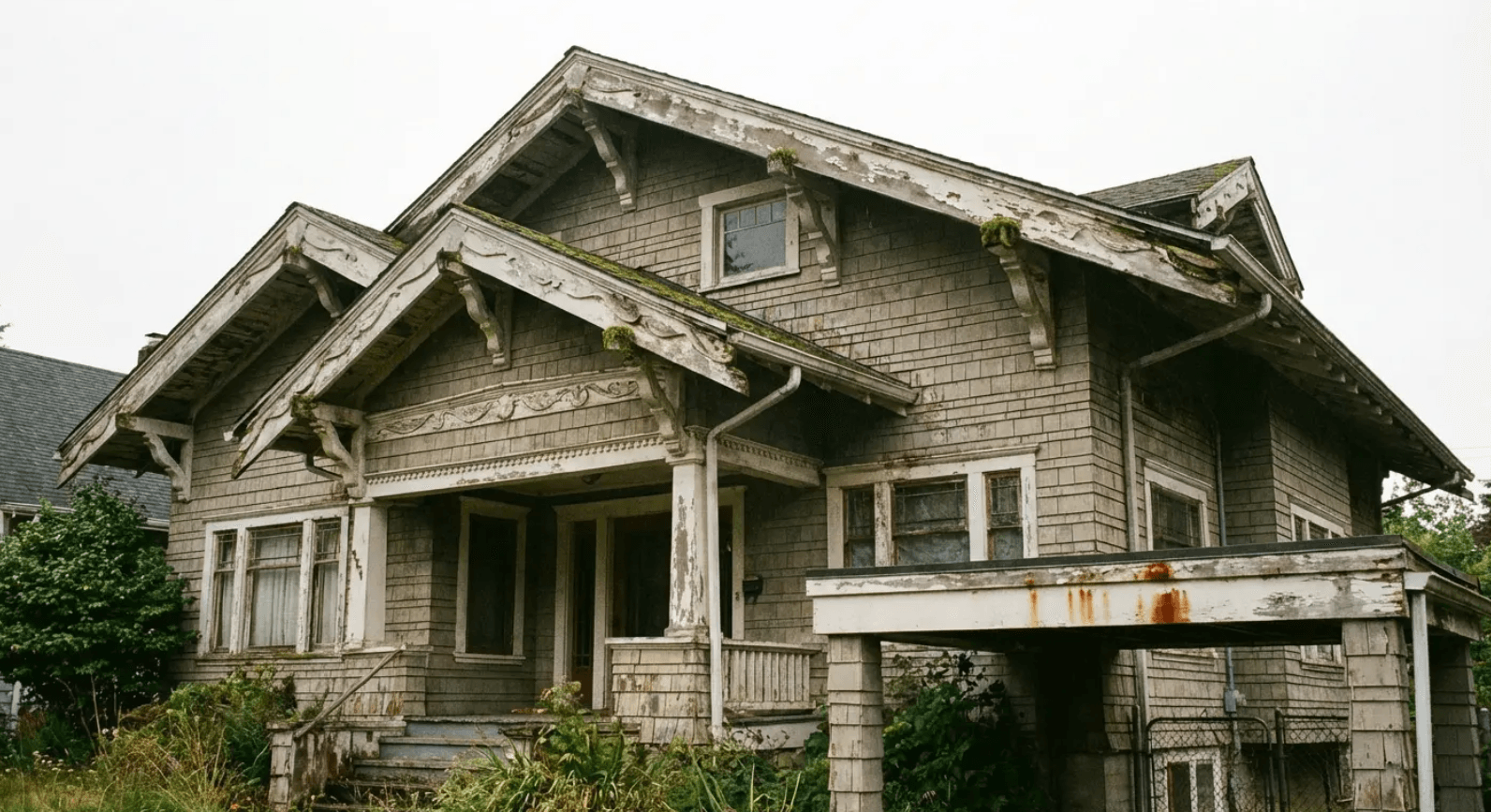
Craftsman homes celebrate visible structural elements and handcrafted details. Exposed rafter tails, decorative brackets, and multiple gables create visual interest that makes these types of houses stand out in any neighborhood.
All that beautiful Craftsman detail? Every bit of it is a maintenance nightmare.
The exposed rafter tails mean your roof structure is constantly exposed to weather rather than protected behind a soffit. Wood rot becomes a constant threat. I've replaced dozens of rafter tails that looked fine from the ground but were rotted through at the attachment point.
Craftsman roofs typically feature multiple intersecting gables at different angles, creating numerous valleys and hips that require precise installation. Each intersection is an opportunity for water to find a weakness. Many Craftsman homes include covered porches with separate roof sections that tie into the main roof, creating transition points where flashing must be perfect.
The architectural authenticity that makes these homes desirable also makes them expensive to maintain properly. You can't take shortcuts with Craftsman details without compromising the home's character.
When Architectural Details Become Maintenance Liabilities
The decorative elements that define this style of home (knee braces, exposed beam ends, ornamental barge boards) all create opportunities for water infiltration. Each decorative bracket or beam penetrates the weather envelope, and those penetrations need proper flashing and sealing.
Exposed rafter tails absorb moisture during rain and then dry out in sun, creating expansion and contraction cycles that crack paint and open gaps. You're repainting these elements every 5 to 7 years if you want to prevent water damage, and that's assuming you catch problems early.
Many Craftsman homes feature built-in gutters concealed within the roof structure. They look clean and period-appropriate but are nearly impossible to maintain properly. When built-in gutters fail, they dump water directly into the wall structure rather than away from the house, causing extensive damage before you notice a problem. I've seen wall repairs exceeding $15,000 because failed built-in gutters went undetected for years.
Craftsman Home Seasonal Maintenance (what I actually do, not what the manuals say):
Spring (After Winter Moisture)
- Hit every exposed rafter tail looking for soft spots or paint that's bubbling
- Check where decorative brackets meet the roof line (this is where water loves to hide)
- Clear debris from built-in gutters if you've got them and test drainage with a hose
- Look at knee brace connections for water staining
Summer (Preparation for Fall)
- Repaint or seal any exposed wood showing wear (don't wait on this)
- Make sure all decorative penetrations are properly caulked
- Check porch roof tie-ins to main roof for flashing integrity
Fall (Before Winter)
- Final gutter cleaning, paying special attention to valley areas
- Get all that leaf buildup out of multi-gable intersections
- Verify all exposed beam ends are sealed against winter moisture
Winter (Periodic Checks)
- Watch for ice dam formation at complex roof intersections
- Check interior ceilings near decorative elements for water stains
- Document any areas where snow accumulates weird
The Multi-Gable Complexity Factor
Craftsman homes rarely feature simple roof shapes. The typical Craftsman has a main gable, cross gables, and often additional smaller gables over porches or bay windows. This creates a roof system with multiple valleys, hips, and ridge lines.
Each valley requires underlayment that extends at least 18 inches on both sides of the valley centerline. If that underlayment isn't properly overlapped and sealed, water will eventually find gaps. I've traced leaks to valley underlayment that was installed with only 12 inches of coverage instead of the required 18. That 6-inch difference created a $3,200 repair bill.
The multiple ridge lines mean multiple ridge vents if you're ventilating properly. Coordinating intake and exhaust ventilation across a complex roof is challenging. You need balanced airflow across all sections, which is difficult to achieve when different gables have different attic volumes and ventilation requirements.
The Contemporary: Where Design Meets Real-World Maintenance
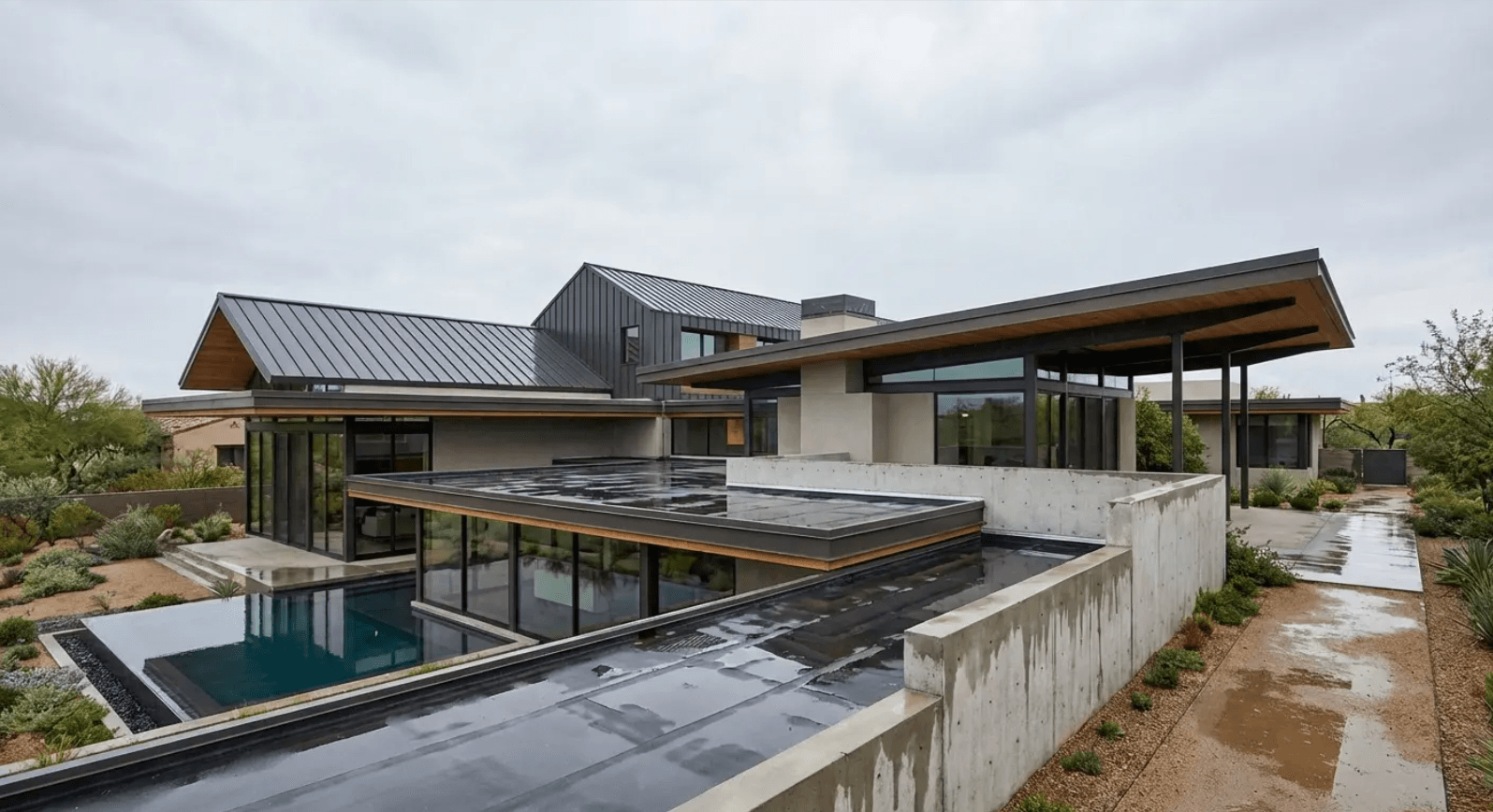
Contemporary homes prioritize clean lines, asymmetrical shapes, and dramatic architectural statements. These design priorities often conflict with practical roofing needs, creating maintenance challenges that weren't part of the architect's vision.
Contemporary homes frequently feature flat or low-slope roof sections mixed with steep sections on the same house. These different types of houses require completely different roofing materials and installation methods than traditional sloped roofs. You can't use asphalt shingles on a flat section, which means you're maintaining two or three different roofing systems on one house.
Many contemporary designs include large overhangs or cantilevered sections that look striking but create structural challenges and expose roof edges to wind damage. I've seen contemporary homes lose entire sections of edge flashing during storms because the design prioritized appearance over wind resistance.
Contemporary homes often use the roof as a design element visible from the street or from interior spaces with high ceilings. Appearance matters more than on traditional homes where the roof is barely visible. That means premium materials and perfect installation, both of which increase costs.
The Flat Roof Sections You Didn't Plan For
Many contemporary homes include flat or nearly flat roof sections over portions of the house, even if the main roof is sloped. These sections require membrane roofing systems (TPO, EPDM, or modified bitumen) rather than shingles. These systems have different lifespans, maintenance needs, and failure modes.
Flat roofs depend entirely on perfect seams and properly installed drains because water doesn't shed naturally. It must be directed to drainage points. Even slight errors in slope create ponding areas where water sits for days after rain, accelerating membrane deterioration.
Flat roofs should have 1/4 inch of slope per foot, but many are installed completely flat. That seemingly minor detail determines whether your roof lasts 20 years or needs replacement in 12.
Transitioning from flat roof sections to sloped sections creates complex flashing details that require specialized knowledge. Many roofers who excel at shingle installation struggle with these transitions.
Last year I worked on a contemporary home in Denver. Dramatic flat roof section over the main living area with a traditional sloped roof over the bedrooms. The architect specified TPO membrane for the flat section and architectural shingles for the sloped portion.
Three years after construction, the homeowner noticed water stains on the living room ceiling near where the two roof types met. The contractor who installed the shingles didn't understand TPO flashing requirements and used standard step flashing instead of the heat-welded transition detail the membrane needed. Water wicked under the membrane at the transition point.
The repair required removing shingles, cutting back the membrane, installing proper transition flashing, and re-welding. A $3,200 fix for a detail that should have been correct from the start.
When Aesthetics Override Water Physics
Contemporary architecture sometimes prioritizes visual impact over drainage practicality. Features like parapet walls that extend above the roof line create water management challenges because water must be directed through scuppers or internal drains rather than flowing naturally off roof edges.
Some contemporary designs include roof valleys that are nearly flat or that direct water toward building corners where drainage is difficult. These designs require larger gutters and downspouts than the architect anticipated. I've retrofitted 6-inch gutters onto homes that were built with 5-inch gutters because the original system couldn't handle the water volume.
Large expanses of unbroken roof surface concentrate water flow at discharge points, sometimes overwhelming standard gutters during heavy rain. You watch water sheet over the gutter during storms, knowing that overflow is soaking your foundation and landscaping.
Fixing these design-inherent problems often requires adding drainage components that alter the clean aesthetic the design intended. That's a difficult conversation to have with homeowners who paid premium prices for architectural purity. Do you want a roof that works or a roof that looks exactly as designed?
Sometimes you can't have both.
The Tudor: Statement Architecture With Hidden Costs
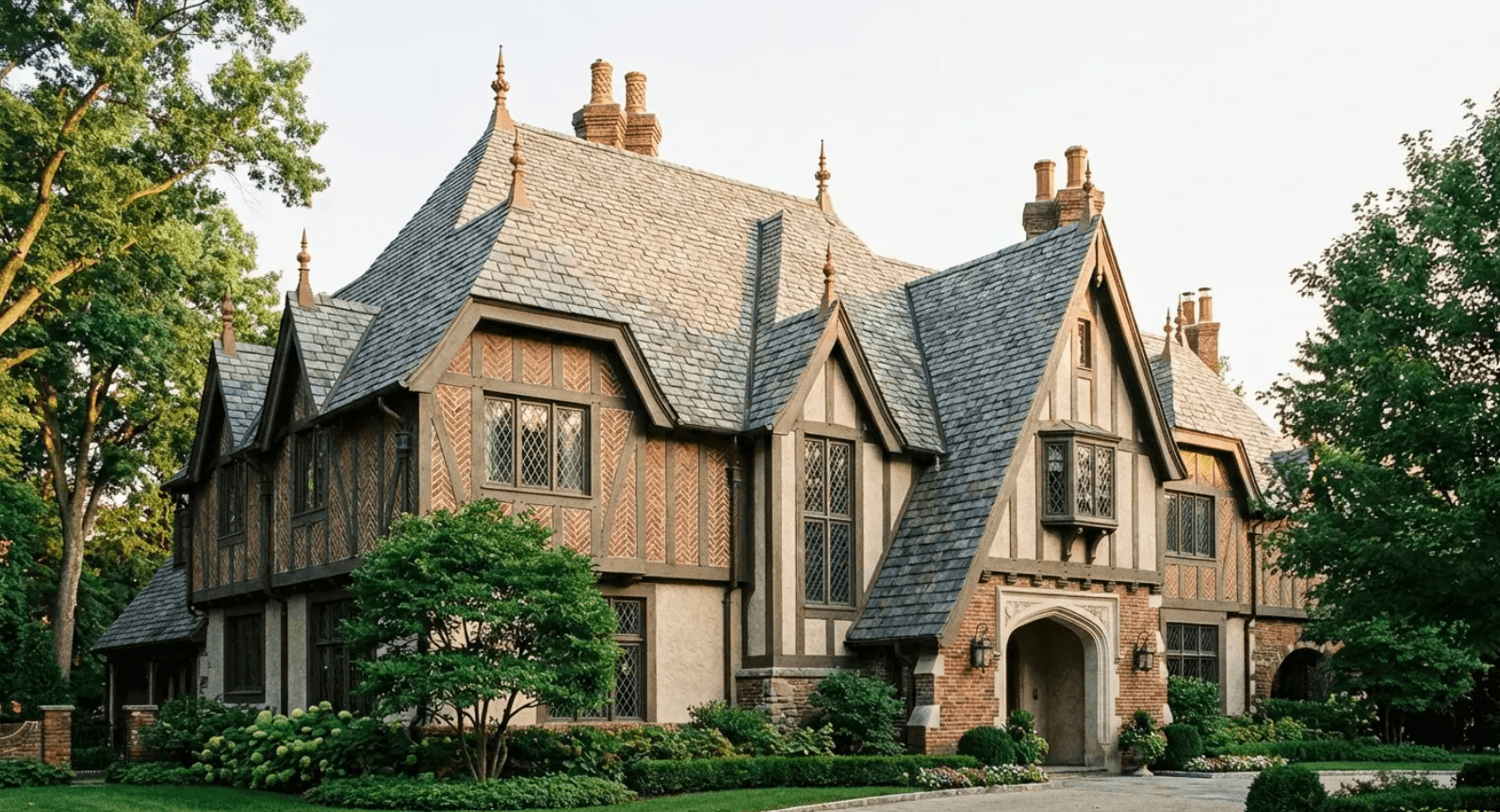
Tudor homes make bold visual statements with their st eeply pitched roofs, multiple cross gables, and distinctive half-timbering. These different types of houses combine steep pitches (often 10/12 or 12/12) with complex intersections and traditionally use materials that cost more than standard asphalt shingles.
Tudor roofs are among the most expensive to maintain because authentic Tudor design calls for slate, clay tile, or wood shake roofing. These materials require specialized installation skills and cost three to five times more than composite shingles. Many American Tudor homes use architectural shingles designed to mimic the appearance of slate or shake, but even these premium shingles don't eliminate the complexity of the roof structure itself.
Tudor roofs often feature decorative elements that add visual interest but multiply installation time and replacement costs. Finials, ornamental ridge caps, and patterned slate work look impressive but require craftsmen with specific expertise.
The Steep Pitch Safety Premium
Tudor roofs typically pitch at angles that make them dangerous to work on without extensive safety equipment. Pitches steeper than 9/12 require roof jacks (temporary platforms) or scaffolding for safe installation and maintenance. That adds substantial labor cost to every roofing project.
Contractors must factor in additional time for setting up and moving safety equipment. The steep angle makes material handling more difficult because shingles slide off more easily and tools must be secured. I've had situations where a bundle of shingles slid off a Tudor roof and went through a car windshield in the driveway. That's a $500 insurance claim that wouldn't happen on a lower-pitched roof.
These safety requirements mean that even minor repairs become expensive jobs because the setup cost is the same whether you're fixing ten square feet or a hundred. Replacing flashing around a chimney might cost $800 on a ranch but $1,800 on a Tudor because of the scaffolding and safety equipment required.
The steep pitch does provide excellent water shedding and reduces debris accumulation. Those benefits don't offset the maintenance cost premium for most homeowners. You're paying 40% to 60% more for roof maintenance over the life of the home compared to more conventional house types.
Material Choices That Lock You Into Expense
Tudor homes often use roofing materials that create long-term cost commitments beyond the initial installation. Slate roofs can last 75 to 100 years, which sounds great until you need to repair them and discover that matching the original slate type, color, and thickness is difficult and expensive.
I've spent weeks sourcing replacement slate that matches a 1920s installation, only to find that the quarry closed decades ago and the closest match comes from a different continent at triple the cost. That's the reality of maintaining authentic materials on this style of home.
Clay tile roofs require specialized underlayment and installation techniques. Individual tiles crack over time from foot traffic or falling branches, requiring repairs that cost far more per square foot than shingle repairs. A tile repair that covers 20 square feet can easily run $1,500 because each tile must be carefully removed and replaced without damaging adjacent tiles.
Wood shake roofs require treatment for fire resistance in most jurisdictions and need replacement every 20 to 30 years at costs that shock homeowners who haven't budgeted for them. A wood shake roof replacement on a 2,500 square foot Tudor can exceed $40,000, compared to $12,000 for architectural shingles.
Switching from the original material to something more economical dramatically changes the home's appearance and potentially its resale value. You bought a Tudor because you wanted that specific aesthetic. Compromising on roofing materials undermines the entire architectural statement.
The Mediterranean: Climate-Specific Design That Travels Poorly
Look, if you're building Mediterranean in Arizona, great. If you're building it in Michigan, call me in ten years when you're replacing everything.
Mediterranean-style homes evoke warm coastal regions with their low-pitched tile roofs, stucco walls, and arched details. These different home styles were designed for specific climate conditions (hot, dry summers and mild, wet winters) and encounter problems when built in regions with different weather patterns.
The signature clay or concrete tile roofs work beautifully in their native climate but create challenges in areas with freeze-thaw cycles, high winds, or heavy snow. Mediterranean roofs typically have lower pitches than most other styles, often 3/12 to 5/12. That's adequate for the occasional rain in Mediterranean climates but problematic in regions with frequent or heavy precipitation.
The tile roofing system includes not just the visible tiles but also underlayment and battens that support the tiles. This complete system must work together or failures cascade quickly. Most homeowners focus on the tiles themselves and ignore the underlayment that's doing the real waterproofing work.
Tile Roofing in the Wrong Climate
Clay and concrete tiles perform differently depending on local weather conditions. In freeze-thaw climates, water that penetrates tiles or gets trapped under them can freeze, expand, and crack the tiles from within.
I've inspected Mediterranean homes in northern climates where tiles suffered progressive damage over 15 to 20 years as micro-cracks accumulated. Eventually they require wholesale replacement rather than individual tile repairs. That's a $35,000 to $50,000 expense that the original builder never warned buyers about.
High-wind regions create uplift forces that can dislodge tiles if they weren't installed with adequate fasteners. Many Mediterranean homes in mild climates use tiles that simply overlap and rely on weight for retention. That installation method fails catastrophically in hurricane-prone areas.
Heavy snow loads can crack tiles or cause the battens supporting them to fail. Once battens fail, entire sections of roof can slide off. I've seen situations where homeowners came home to find 200 square feet of tile roofing in their backyard after a heavy snow.
Modern concrete tiles are more durable than traditional clay in harsh climates, but they're also heavier and require stronger roof framing. Many Mediterranean homes built in the 1980s and 1990s used clay tiles on framing that's inadequate for the heavier concrete alternatives, which means you can't upgrade to more durable materials without structural reinforcement.
The Underlayment Nobody Thinks About
Tile roofs depend on waterproof underlayment beneath the tiles to keep water out of your home. The tiles themselves are the first line of defense, but water inevitably gets past them because tiles overlap but aren't sealed. The underlayment carries water down to the gutters.
Traditional felt underlayment deteriorates faster than the tiles above it, creating a situation where your roof looks fine from the street but is failing underneath. I've removed tiles that were in perfect condition to find underlayment that had completely disintegrated, leaving only the roof decking exposed to weather.
Replacing underlayment requires removing all the tiles, installing new underlayment, and reinstalling the tiles. That's a process nearly as expensive as a complete roof replacement. You're paying for the labor of removing and reinstalling tiles twice (once to take them off and once to put them back).
Many homeowners don't realize their underlayment is failing until they see water stains inside, at which point the roof decking may already have water damage. I've found situations where decking rot required replacing not just the underlayment but also structural components, turning a $15,000 underlayment replacement into a $28,000 structural repair.
Synthetic underlayment products last longer than felt but weren't available when many existing Mediterranean homes were built. If you're buying a Mediterranean-style home built before 2000, budget for underlayment replacement even if the tiles look perfect.
What Most People Miss When Choosing a House Style
Your house style determines your roofing costs, maintenance burden, and vulnerability to specific types of damage. Almost nobody factors this into their home-buying decision.
Buyers focus on interior layout, school districts, and neighborhood character while treating the roof as a generic component that's either "good" or "needs replacement soon."
Here's what I mean. Understanding your different types of house and their specific roofing challenges helps you ask better questions during home inspections. You can request that the inspector specifically check dormer flashing on a Colonial, or verify attic ventilation on a Ranch. These targeted questions reveal problems that standard inspections miss.
This knowledge also helps you evaluate contractor estimates more critically. When you know what actually breaks on your house type, you can call bullshit on inspectors who miss it. When a contractor quotes $18,000 for a split-level roof that would cost $9,000 as a ranch, you'll understand why instead of assuming you're being overcharged.
You'll know when someone's padding the estimate and when they're actually accounting for how much of a pain in the ass your roof is.
You might love a Tudor or Craftsman enough to accept higher roofing costs. That should be an informed choice rather than an expensive surprise five years after purchase.
I know what you're thinking: "But my neighbor has a split-level and never has problems."
Yeah, and my uncle smoked two packs a day and lived to 90. Doesn't mean it's a good bet. Your neighbor either got lucky, maintains it obsessively, or hasn't lived there long enough for the problems to show up yet. Give it time.
You're buying more than square footage and curb appeal when you choose different types of houses. Each architectural style carries specific maintenance obligations that affect your budget for decades. Ranch homes seduce buyers with accessibility but hide ventilation challenges that cook shingles from below. Colonial symmetry conceals dormer valleys where most leaks originate. Cape Cod charm comes with ice dam vulnerability built into the design.
Split-levels create water management puzzles that increase every repair cost. Craftsman character means dozens of decorative penetrations that need constant attention. Contemporary clean lines sometimes ignore drainage physics. Tudor drama requires specialized skills and expensive materials. Mediterranean style transports poorly to climates it wasn't designed for.
These aren't flaws in the architectural styles themselves. They're predictable characteristics that come with specific design choices. A well-maintained Tudor roof can last 75 years. A neglected ranch roof can fail in 12. The difference is understanding what your specific different types of house demand and providing it.
Here's what actually happens when you don't know this stuff: You buy the house in May. Everything's great. First winter comes, you get a little water stain in the corner of the bedroom. "Probably nothing," you think. "I'll check it in spring."
Spring comes, the stain is gone. See? Nothing.
Next winter, the stain comes back. Bigger now. You put a bucket under it during heavy rains. "I really should call someone."
Third winter, you're not getting a stain anymore. You're getting water running down the wall. The drywall is crumbling. There's a smell.
Now you're calling roofers in a panic. Now you're getting estimates that make you nauseous. Now you're finding out the decking is rotted and needs replaced. Now it's not $3,000, it's $12,000.
That's how this actually goes. Nobody fixes the small stuff until it becomes the expensive stuff.
When you tour houses this weekend, look up. Count the dormers. Notice the roof pitch. Ask yourself how water flows off those valleys. Question whether those decorative elements are worth the maintenance they'll require. The answers to these questions matter more than the kitchen backsplash or the paint colors.
I've seen homeowners who bought their dream Craftsman and then resented it five years later when they were writing checks for rafter tail repairs. I've also seen homeowners who bought a simple ranch, understood its limitations, and maintained it properly for 30 years without major problems. The difference wasn't the house. It was the alignment between the house's demands and the owner's expectations.
Different home styles aren't better or worse. They're different maintenance contracts. Read the contract before you sign.
Final Thoughts
Look, I'm not trying to talk you out of any particular house style. Buy the Tudor if you love it. Get the Craftsman if that's your dream.
Just know what you're getting into.
I've watched too many people fall in love with a house on Saturday and start resenting it by Tuesday when they get their first repair estimate. The roof isn't sexy. It's not Instagram-worthy. But it's the difference between a house you can afford to own and a house that slowly bankrupts you.
House style isn't just an aesthetic choice. It's a practical decision with long-term cost implications that affect your budget for as long as you own the home.
Most people choose homes based on how they feel walking through the front door, and that's completely valid. Adding roofing considerations to your evaluation process protects you from budget-breaking surprises. You can still buy the house you love, but you'll know what you're committing to.
Every different type of house discussed here has successful examples with well-maintained roofs. None of these styles are inherently bad choices. Success requires understanding the specific attention each style demands and being willing to provide it.
I encourage you to view your roof as an integrated part of your house's architecture rather than a separate component. That perspective leads to better maintenance decisions and longer roof life. When you understand that your Colonial's dormers aren't decorative afterthoughts but integral structural elements with specific vulnerabilities, you maintain them differently.
Knowledge about your specific house type's vulnerabilities is the foundation for every good roofing decision you'll make as a homeowner. You'll know when to call a specialist instead of a general contractor. You'll recognize warning signs before they become expensive problems. You'll budget appropriately for the maintenance your house actually needs instead of being blindsided by costs you never anticipated.
The roof above your head does more than keep you dry. It shapes your experience of homeownership in ways you won't fully appreciate until you've lived through a few repair cycles.
That's it. That's the whole point of this thing.