
A flat roof replacement estimate can be frustratingly difficult to predict from square footage alone. Two buildings with similarly sized roofs can receive very different proposals once insulation, drainage, access, rooftop equipment, existing materials, and warranty requirements enter the conversation.
For commercial property owners in south-central Pennsylvania, the most useful starting point is a realistic price range followed by a clear explanation of what moves a particular project higher or lower within that range.
Quick answer: Joyland’s current commercial pricing guide lists replacement with a TPO flat-roof system at approximately $8–$15 per square foot. Replacement with an EPDM system generally falls around $10–$15 per square foot.
Those are planning ranges, not automatic prices for every building. The existing roof assembly, insulation, drainage, access, penetrations, removal requirements, and warranty selection all affect the final proposal.
How much does a commercial flat roof replacement cost?
Joyland’s published commercial roofing pricing guide currently provides the following planning ranges:
| Replacement system | Published planning range | Important pricing variables |
|---|---|---|
| TPO membrane roof | $8–$15 per sq. ft. | Insulation, attachment method, tear-off, drainage, penetrations, access, membrane specifications, and warranty requirements. |
| EPDM membrane roof | $10–$15 per sq. ft. | Insulation, removal, roof height, access, penetrations, deck condition, membrane specifications, and warranty requirements. |
At those published ranges, a 5,000-square-foot commercial roof could represent a broad planning range of roughly $40,000 to $75,000. That calculation should only be used as a starting point. It does not confirm whether the existing roof can be recovered, whether wet insulation must be removed, or whether drainage and deck repairs are needed.
The square-foot calculation is the easy part. Flat roofs tend to save the interesting questions for everything attached to, beneath, and draining through them.
Joyland pricing referenced in this article was reviewed on September 11, 2026. Published ranges may change as labor, materials, project specifications, and site conditions change.
What is included in a flat roof replacement?
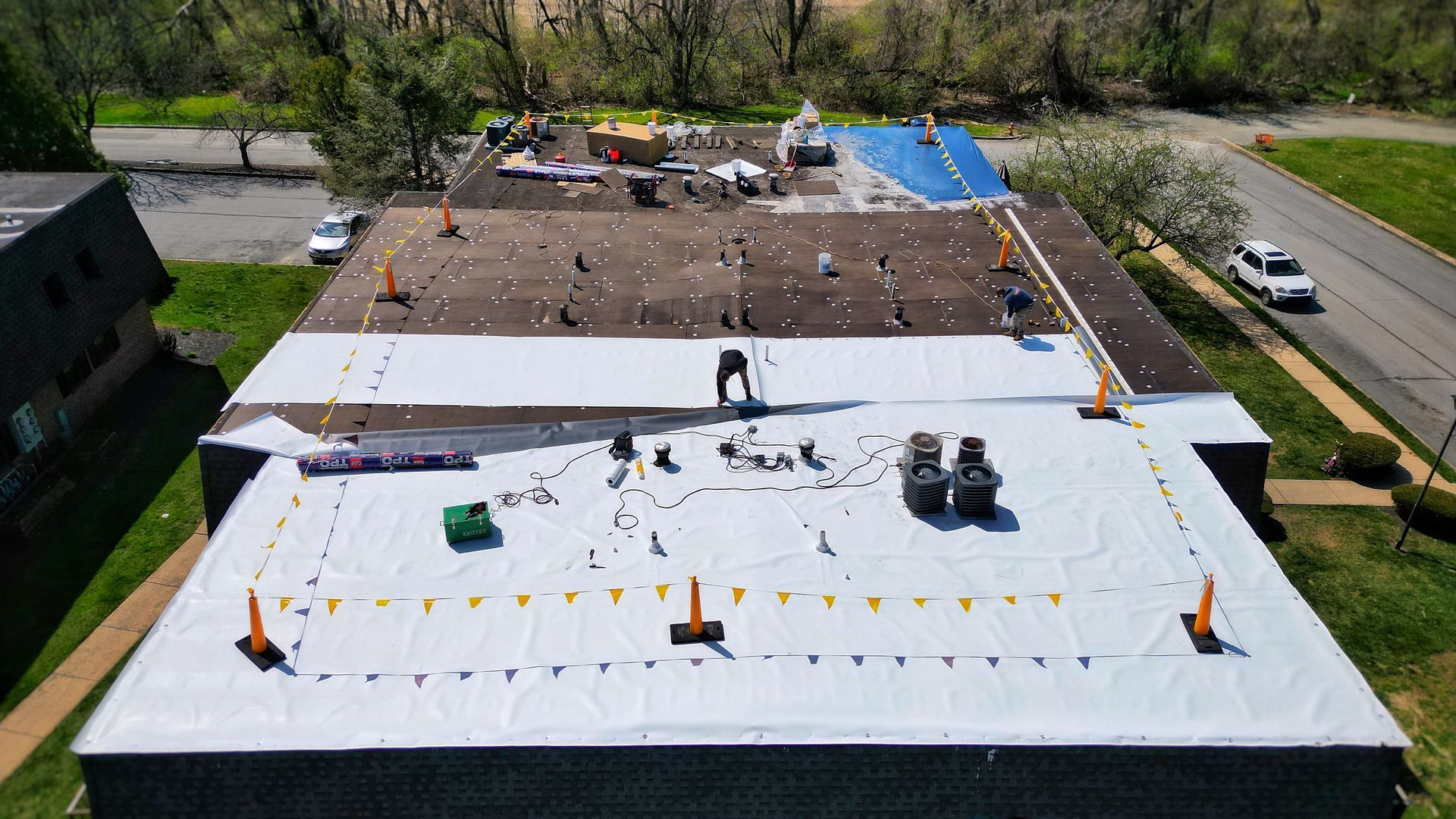
A flat roof is an assembly, not simply a sheet of rubber or plastic stretched across a building. Depending on the design, a replacement project may include:
- Removing or preparing the existing roofing system.
- Inspecting the structural roof deck.
- Removing wet or damaged insulation.
- Installing new insulation or tapered insulation.
- Adding a cover board or approved substrate.
- Installing and attaching the new membrane.
- Completing seams, edges, walls, curbs, and penetrations.
- Repairing or replacing drains, scuppers, and related flashing.
- Removing debris and protecting the occupied building.
- Completing required manufacturer or project inspections.
Joyland’s commercial flat-roofing service guide provides a closer look at the TPO, EPDM, and modified-bitumen systems used on warehouses, manufacturing facilities, retail buildings, offices, and multifamily properties.
What makes one flat roof cost more than another?
Whether the roof is recovered or completely removed
Some buildings may qualify for a roof-recovery system, where an approved new assembly is installed over the existing roof. Other buildings require removal down to the roof deck.
A recovery may reduce demolition, disposal, project time, odor, and disruption. However, it is not appropriate when the existing assembly contains widespread moisture, unsuitable materials, too many roofing layers, structural concerns, or conditions that prevent the new system from being attached properly.
Versico’s official re-roofing guidance explains that recovery decisions involve more than installed cost. Building operation, roof performance, energy efficiency, maintenance, noise, odor, and project timing may all matter.
An inspection should determine whether recovery is feasible. “Installing over it” is not a cost-saving strategy if the existing assembly cannot provide a reliable foundation.
Wet insulation and damaged decking
Water can travel within a low-slope roof assembly before it becomes visible inside the building. That means the ceiling stain may not sit directly beneath the membrane opening, and the visible leak may not reveal the full affected area.
When testing or tear-off identifies wet insulation, deteriorated cover board, rusted steel, damaged wood, or other substrate concerns, those materials may need to be removed before the new roof can be installed.
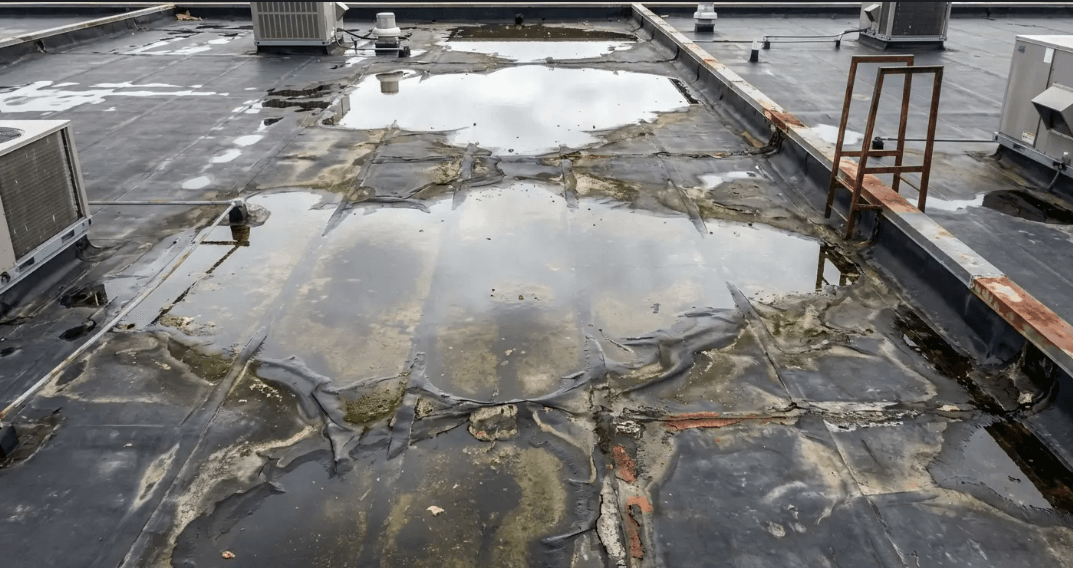
Ask the contractor how concealed conditions will be documented, priced, and approved. A useful proposal explains the process before the first unexpected section of wet insulation comes out of the roof.
Insulation and drainage improvements
Flat roofs are not intended to behave like shallow swimming pools. The system must direct water toward drains, scuppers, or roof edges.
If the existing roof holds water because of low areas or poor drainage, simply installing a new membrane may preserve the same underlying problem. Tapered insulation can be used in certain assemblies to create slope and improve drainage, but it adds material, layout, and installation work.
Insulation decisions also depend on the existing assembly, applicable code requirements, building use, available roof height, drainage design, and compatibility with rooftop curbs and edges. The correct insulation plan should be based on the building, not a generic package copied from another proposal.
Rooftop equipment and penetrations
HVAC units, exhaust fans, pipes, skylights, drains, conduits, curbs, walls, and supports interrupt the open field of the roof. Each one requires cutting, fitting, fastening, flashing, or sealing.
A large, open warehouse roof can sometimes be completed more efficiently than a smaller restaurant or manufacturing roof packed with equipment. Square footage matters, but roof complexity decides how quickly that square footage can be covered correctly.
Height and site access
Commercial membrane rolls, insulation boards, cover boards, tools, and removed roofing materials must move between the ground and the roof.
An open site with room for delivery trucks, lifts, cranes, and dumpsters generally allows work to move more efficiently. A taller building with restricted parking, occupied entrances, utility lines, traffic, or limited equipment access requires a different logistics plan.
Those conditions affect labor and scheduling even when two roofs use the same membrane.
Membrane thickness and warranty specifications
Commercial warranties may require specific membrane thicknesses, insulation assemblies, attachment patterns, edge details, fasteners, flashing procedures, inspections, and approved contractors.
Versico currently publishes commercial re-roofing warranty options ranging from 10 to 30 years for qualifying systems. That does not mean every roof automatically qualifies for every term. The selected assembly and building conditions must meet the manufacturer’s requirements.
Ask whether a proposal includes a contractor workmanship warranty, a manufacturer material warranty, or a manufacturer system warranty. Those terms sound similar across a conference table, but they may cover very different things once everyone leaves the room.
TPO versus EPDM: does the material decide the price?
Material is part of the cost, but it does not decide the total by itself. The condition beneath the membrane and the installation specifications may create a larger difference than the membrane selection.
| Consideration | TPO | EPDM |
|---|---|---|
| Typical appearance | Commonly white or light-colored and reflective. | Commonly black, although other options may be available. |
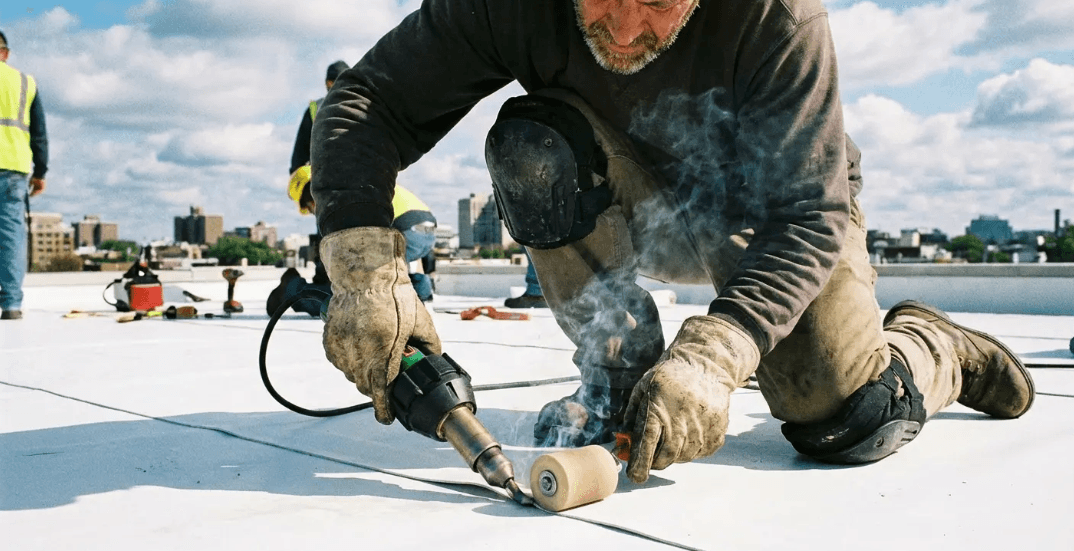
| Seam method | Seams are joined using hot-air welding. | Seams generally use compatible primers, tapes, or adhesives. |
| Common reason for considering it | Reflectivity, welded seams, and suitability for many commercial buildings. | Flexibility, long industry history, large membrane sheets, and repairability. |
| Joyland’s published replacement range | $8–$15 per sq. ft. | $10–$15 per sq. ft. |
| What still affects the final price | Removal, insulation, drainage, deck condition, attachment method, access, penetrations, membrane specifications, and warranty requirements. | |
The better question is not simply, “Which membrane is cheaper?” Ask which complete assembly fits the building, drainage, rooftop activity, operating needs, and expected ownership period.
If you want a deeper material comparison, read Joyland’s guide to TPO versus EPDM roofing.
Three Joyland flat-roof projects that show why costs vary
Joyland’s commercial flat-roofing page includes several completed Pennsylvania projects. These examples help show why total cost cannot be calculated from membrane choice alone.
| Documented project | Roof size | Published 2024 cost | Major scope details |
|---|---|---|---|
| Food-production facility in New Holland | 9,000 sq. ft. | $60,000 | TPO recovery system, insulation, damaged deck repairs, drainage work, and a 20-year No-Dollar-Limit warranty. |
| Office and warehouse in Harrisburg | 1,200 sq. ft. | $22,000 | Removal of EPDM and underlying tar roofing, deck repairs, base insulation, tapered insulation, TPO, penetrations, parapet detailing, and new coping. |
| Warehouse in Lancaster | 10,000 sq. ft. | $87,000 | TPO system, rigid insulation, a 20-year No-Dollar-Limit warranty, and project logistics that kept building traffic moving. |
These are documented historical Joyland projects from 2024, not current offers or estimates. The published totals reflect the scope and conditions of those individual buildings. They should not be used to predict the price of another property.
The Harrisburg project was much smaller than the other examples, but its tear-off, tapered insulation, parapet walls, deck repairs, and penetrations produced a higher cost per square foot. Fixed mobilization and equipment expenses also do not disappear just because the roof is small.
Meanwhile, the larger New Holland project qualified for a recovery system. That reduced the amount of demolition while still allowing Joyland to address damaged decking and drainage.
That is the price lesson hiding in plain sight: scope beats square footage.
Can a flat roof be repaired instead of replaced?
Yes, when the damage is isolated and the surrounding roof remains serviceable. A puncture, localized seam concern, damaged flashing detail, or limited affected area may be repairable.
Joyland’s pricing guide currently lists several commercial flat-roof repair examples:
- Puncture repair: approximately $400–$800.
- Leak investigation and repair: approximately $800–$2,500 or more.
- Larger repairs involving drainage, longstanding leaks, or a wider affected area: approximately $1,500–$5,500 or more.
Those ranges describe different scopes. A puncture with a known cause is not the same assignment as tracing water through several roof layers around an HVAC curb.
Replacement becomes more reasonable when leaks recur across multiple areas, the membrane is broadly deteriorated, insulation is wet across a substantial area, drainage problems require reconstruction, or repairs can no longer provide a dependable result.
Joyland’s commercial roofing team handles inspections, repairs, maintenance, and complete replacement. The purpose of the inspection is to determine which level of work the roof actually needs.
Should you replace a flat roof as soon as it leaks?
Not automatically. A leak establishes that water is entering somewhere. It does not, by itself, establish that the entire membrane must be replaced.
The next step is to determine:
- Where water is entering the assembly.
- Whether the problem is isolated or widespread.
- How much insulation or substrate has been affected.
- Whether drainage contributed to the problem.
- Whether previous repairs are still performing.
- Whether the remaining roof can support another dependable repair.
At the same time, an active leak should not be ignored. Water movement within the assembly can affect insulation, decking, interior finishes, equipment, or inventory. Prompt inspection provides information while there may still be more than one reasonable option.
How long should a new flat roof last?
Service life depends on the roof system, installation, drainage, exposure, rooftop traffic, maintenance, repairs, and warranty specifications. A membrane name alone cannot promise an exact number of years.
Joyland’s guide to how long flat roofs last explains why drainage, seams, flashing, penetrations, maintenance, and workmanship can matter as much as the material selected.
Manufacturer warranty length and expected service life are also not identical. A warranty is a contract with coverage requirements and exclusions. It is not a countdown clock predicting the precise day the roof will stop working.
How to compare flat-roof replacement proposals
Before comparing totals, confirm that the contractors are pricing the same work. Ask each contractor to explain:
- Existing roof: What materials and layers are currently installed?
- Moisture: How will wet insulation or concealed damage be identified?
- Removal: Is this a recovery or a complete tear-off?
- Deck: How will deck repairs be documented and approved?
- Insulation: What type, thickness, and layout are included?
- Drainage: Are tapered insulation, drains, scuppers, or crickets included?
- Membrane: What material, thickness, attachment method, and manufacturer are specified?
- Details: How are walls, edges, HVAC curbs, pipes, and other penetrations handled?
- Operations: How will entrances, tenants, employees, traffic, noise, and debris be managed?
- Warranty: Who provides it, what does it cover, and what maintenance is required?
A lower estimate may be a good value. It may also exclude removal, insulation, drainage corrections, warranty upgrades, or damaged decking included elsewhere. The proposal should make those differences visible before you choose.
Watch a commercial flat roof installation
This short Joyland video shows a commercial flat-roof installation in progress, including the scale, material handling, and coordination involved in completing a membrane-roof project.
Joyland Roofing works with business owners, property managers, churches, warehouses, manufacturers, retail properties, and multifamily buildings throughout south-central Pennsylvania and the surrounding region.
If you are budgeting for replacement or deciding whether another repair makes sense, schedule a commercial roof assessment. Our team can inspect the roof, document its condition, explain the available systems, and provide a proposal for the work your building needs.
The square footage gives you somewhere to begin. The inspection tells you what you are actually buying.
Pricing and project information in this article was reviewed against Joyland’s published commercial roofing pages on September 11, 2026. Manufacturer information was reviewed using current Versico re-roofing resources. Always confirm current pricing, specifications, warranty terms, permits, and code requirements for your individual project.