March 31, 2026
Roofing Repair Costs: What You'll Actually Pay (And Why Your Quote )
Author
If you’ve ever gotten a quote for a roof fix and thought, “There’s no way that’s right,” you’re not alone. Roofing repair costs don’t just vary - they swing wildly depending on timing, hidden damage, and who’s actually assessing the problem. One contractor says $800. Another says $6,000. And somewhere in between, you’re left wondering what’s real and what’s not.
Here’s the truth most homeowners don’t hear until it’s too late: roofing repair costs aren’t just about what’s broken today - they’re about what’s quietly getting worse underneath. A small leak doesn’t stay small. A missing shingle doesn’t fix itself. And waiting? That’s where the real money disappears.
This guide breaks down what you’ll actually pay - and more importantly, why. From the hidden economics of delaying repairs to the gap between insurance estimates and real-world pricing, we’re pulling back the curtain on how roofing costs really work.
If you want a deeper understanding of how roof damage progresses (and why timing matters more than most people think), check out this breakdown ofthe science behind roof repairs.
Because once you understand the “why” behind the numbers, you’re in a much better position to avoid turning a simple fix into a five-figure problem.
Table of Contents
- TL;DR
- The Hidden Economics of Waiting
- What Your Insurance Adjuster Isn't Telling You About Repair Estimates
- The Repair vs. Replace Calculation That Most Contractors Get Wrong
- Material Costs Are Only 30% of Your Bill (Here's Where the Rest Goes)
- Why Three Quotes Can Give You Three Wildly Different Numbers
- Seasonal Pricing Isn't Just About Demand
- The Financing Trap That Costs Homeowners Thousands
- When Joyland Roofing Steps In
- Final Thoughts
TL;DR
- Wait on small repairs and watch them turn into big ones. Fast. We're talking $800 becoming $8,000 in six months.
- Insurance adjusters use depreciation schedules that don't match what repairs actually cost right now. You'll pay the difference out of pocket.
- The repair versus replacement decision isn't about some magic percentage. It's about cost per year of life you've got left in that roof.
- Labor, insurance, and disposal make up about 70% of your bill. Materials? Maybe 30% if that.
- Three different quotes aren't about three different profit margins. They're about three different assessments of what's actually wrong with your roof.
- Winter and summer cost more because materials don't work right in extreme temperatures. It's physics, not price gouging.
- That zero percent financing? It's a trap. You'll pay 24-30% in deferred interest if you miss the payoff deadline by even one day.
The Hidden Economics of Waiting
You've got a leak. Water stain in the bedroom ceiling, maybe. Or a couple shingles that disappeared during that storm last week. You call a roofer, get an $800 quote, and think "Eh, I'll deal with this next quarter when money's not so tight."
Bad move.
That just cost you three grand. Maybe four.
I know that sounds dramatic. Like I'm trying to scare you into calling right now. But I've been doing this for years, and I've seen this exact scenario play out so many times I could write the script in my sleep. Small leak today equals massive disaster six months from now. Every. Single. Time.
Verisk just put out numbers showingroof repair and replacement costs hit $31 billion last year, up nearly 30% since 2022. Yeah, you read that right. And waiting isn't making these problems any cheaper.
We've tracked repair escalation across hundreds of properties, and the pattern is really consistent. A contained roof issue doesn't stay contained. Water finds paths you can't see. It soaks into insulation, which loses its insulating power permanently once it gets wet. It seeps into wall cavities where it feeds mold growth. It compromises structural lumber that won't show visible damage for months.
Last spring, a couple in Toledo noticed a small water stain on their bedroom ceiling. The initial repair quote was $650 for replacing damaged flashing around their chimney. They decided to wait until after their summer vacation.
By August, that small leak had soaked the attic insulation, caused mold growth across 40 square feet of drywall, and rotted two roof joists. Their final repair bill? $8,400. Nearly 13 times the original quote. And they had to coordinate between a roofer, mold remediation specialist, and carpenter just to get it all fixed.
The wife cried when I showed her the estimate. The husband just kept saying "how did this happen?" Water, man. Water doesn't wait for your vacation to end.
The Multiplier Effect Nobody Warns You About
Here's what actually happens when you delay that $800 repair for six months.
The initial leak point expands as surrounding shingles deteriorate from moisture exposure. Your insulation absorbs water, which makes your HVAC work 15-30% harder. That's an extra forty, fifty, maybe ninety bucks a month on your electric bill in most climates. Interior drywall begins to soften, which means you're replacing it, not just patching it. Wooden roof decking starts to delaminate.
By month six, you're looking at $2,400 in roof repairs, $1,800 in insulation replacement, $1,200 in drywall and painting, and potential mold remediation starting at $2,000.
Your $800 problem just became $7,400. And that's assuming you caught it before structural framing needed attention.
The Compounding Cost Structure
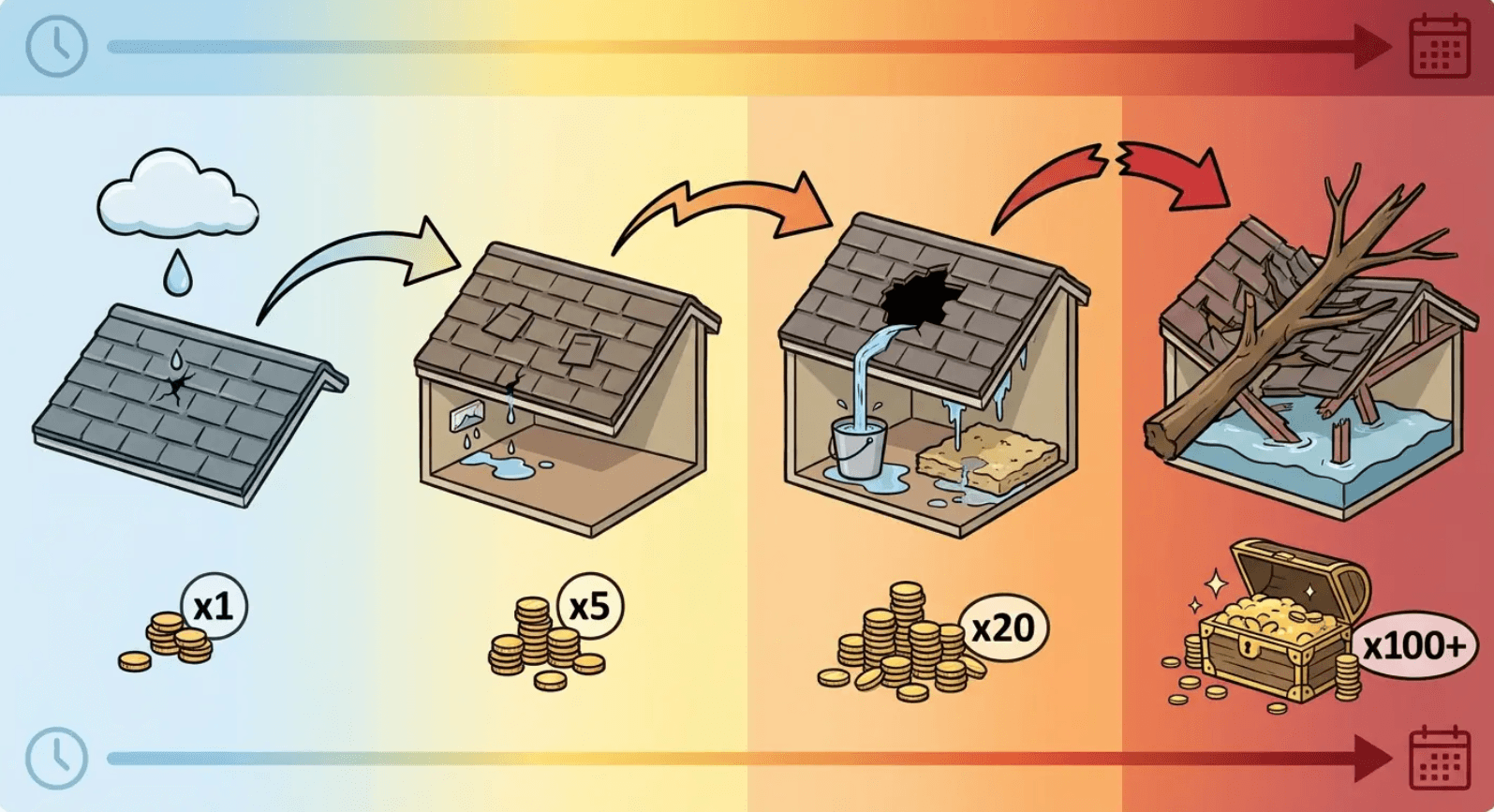
What makes this particularly painful is how these costs don't just add up. They multiply.
You can't replace insulation without addressing the roof first. You can't repair drywall while the leak's still going. You can't ignore mold once it's established. Each repair becomes dependent on the others, and contractors charge more for complex multi-system repairs than they do for isolated fixes.
The cost per square foot increases as the scope expands. A focused repair might run $8-12 per square foot. A deteriorated section requiring decking replacement jumps to $18-25 per square foot. Once you're into structural framing, you're at $35-50 per square foot for that portion.
Let me break down how this plays out at different stages. If you catch it in the first two months, you're looking at $600-$1,200 for isolated shingle damage. That's your baseline. Wait three to six months? Now it's $2,400-$7,400 because you're into insulation and interior damage. The cost just multiplied by four to six times. Seven to twelve months? You're looking at $8,000-$15,000 with structural framing and mold involved. That's ten to eighteen times your original cost. Wait over a year and you're into widespread failure affecting all your building envelope systems, potentially even foundation issues. $15,000-$35,000 or more. Twenty to forty times what you would've paid if you'd just fixed it when you first noticed.
Look, I know this sounds like scare tactics. It's not. I'm showing you what happens when water gets inside your walls because I've seen it a hundred times and I'm tired of watching people turn an $800 fix into a $15,000 nightmare.
Understanding roofing repair costs means recognizing that delaying action today creates compounding expenses tomorrow. Time doesn't make roof damage better or cheaper. It makes it exponentially worse.
What Your Insurance Adjuster Isn't Telling You About Repair Estimates
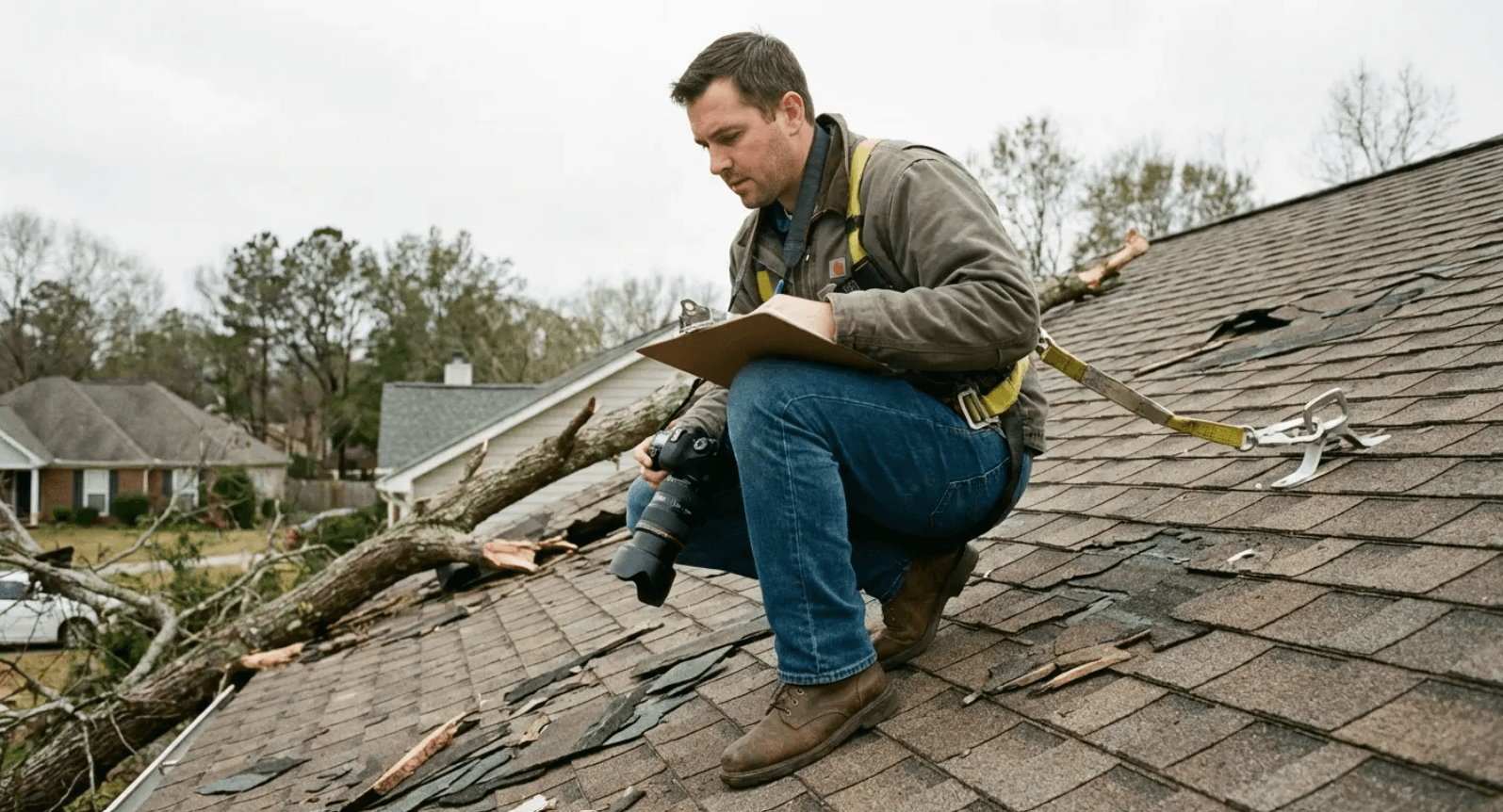
Your insurance company sent an adjuster. They took photos, measured sections, generated an estimate. You feel relieved. The damage is covered.
Then the contractor quotes come in at 30-40% higher than the insurance estimate, and you're suddenly facing a $4,000 gap you didn't budget for.
Nobody's committing fraud here. The insurance company's not trying to screw you. Your contractor's not making up numbers. But they're living in two completely different worlds when it comes to pricing, and you're stuck in the middle holding the bill.
The Depreciation Schedule Problem
Insurance policies usually use Actual Cash Value (ACV) for initial payments, which means they depreciate your roof based on age. A 12-year-old roof with a 25-year warranty gets depreciated by roughly 48%. If your repair needs $10,000 in materials, they're cutting you a check for $5,200 and telling you the rest is "recoverable depreciation" you'll get back after repairs are complete.
Except contractors don't accept depreciated payment for non-depreciated materials. They need $10,000 for $10,000 worth of shingles, underlayment, and flashing. You're fronting the difference.
Database Pricing vs. Market Pricing
Adjusters use software like Xactimate, which pulls from regional pricing databases. These databases update quarterly at best, and they average prices across all contractor types, including unlicensed operators who undercut market rates. Right now, in most markets, Xactimate pricing runs 15-25% below what licensed, insured contractors actually charge.
Why?
The databases don't account for current supply chain costs, recent labor rate increases, or the liability insurance premiums that legitimate contractors pay. They're backward-looking averages, not forward-looking market rates. It's like using 2022 gas prices to budget for 2025 fuel costs.
You'll see this gap most clearly in labor pricing. Xactimate might show $45 per square for installation labor. Actual contractor rates in your area might be $65 per square because they're covering workers' comp insurance, liability coverage, and paying wages that actually attract skilled labor.
The Line Items They Minimize
Insurance estimates consistently undervalue certain repair components.
Decking replacement gets listed at minimal square footage. They only pay for "visibly damaged" sections, not the surrounding compromised area. Ventilation upgrades get excluded entirely, even when code requires them for the repair.
Disposal and dump fees get capped at flat rates that don't reflect actual landfill costs. I've seen adjusters allow $250 for disposal on a project that generated 4 tons of debris. Actual disposal cost? $680. That $430 gap comes from your pocket unless you negotiate the supplement.
Before you accept that insurance estimate as final, check these things: Are they lowballing the decking replacement? Request moisture readings for areas adjacent to visible damage. Do the labor rates match what contractors actually charge right now? Compare to at least two licensed contractor quotes. Did they cap disposal fees at some ridiculous number like $250 when you've got four tons of debris? Calculate it yourself: damaged area times 2.5 pounds per square foot for asphalt shingles. Are they including ventilation components if required by current building code? What about flashing replacement around all penetrations like chimneys, vents, and skylights? Does the underlayment specification match manufacturer warranty requirements? Are permit fees and inspection costs included? Is material depreciation clearly stated with a timeline for recoverable depreciation? Is the supplement process documented in writing?
Here's what you need to do: Get your contractor to document every discrepancy between the insurance estimate and their quote. Most insurance companies will negotiate supplements, but only if you provide detailed justification for each line item difference.
Don't accept the first estimate as final.
The Repair vs. Replace Calculation That Most Contractors Get Wrong
Every contractor has their threshold. "If repairs cost more than 30% of a new roof, just replace it." Or 25%. Or 40%, depending on who you ask.
These percentage-based rules are nearly useless for your specific situation.
The Cost Per Serviceable Year Formula
What actually matters is how much you're paying per year of remaining useful life.
A roof that's 15 years old with a 25-year rated lifespan has roughly 10 years of serviceable life remaining, assuming average conditions and maintenance. If repairs cost $4,000 and a full replacement costs $15,000, you're looking at $400 per year for repairs versus $1,500 per year amortized for replacement.
The repair wins financially, assuming those repairs extend the roof's life to its expected endpoint.
But here's where it gets messy. Not all repairs extend life equally. Replacing a few damaged shingles restores full functionality to that section. Patching widespread granule loss doesn't restore the shingles' UV protection or waterproofing capacity. You're buying time, not restoration.
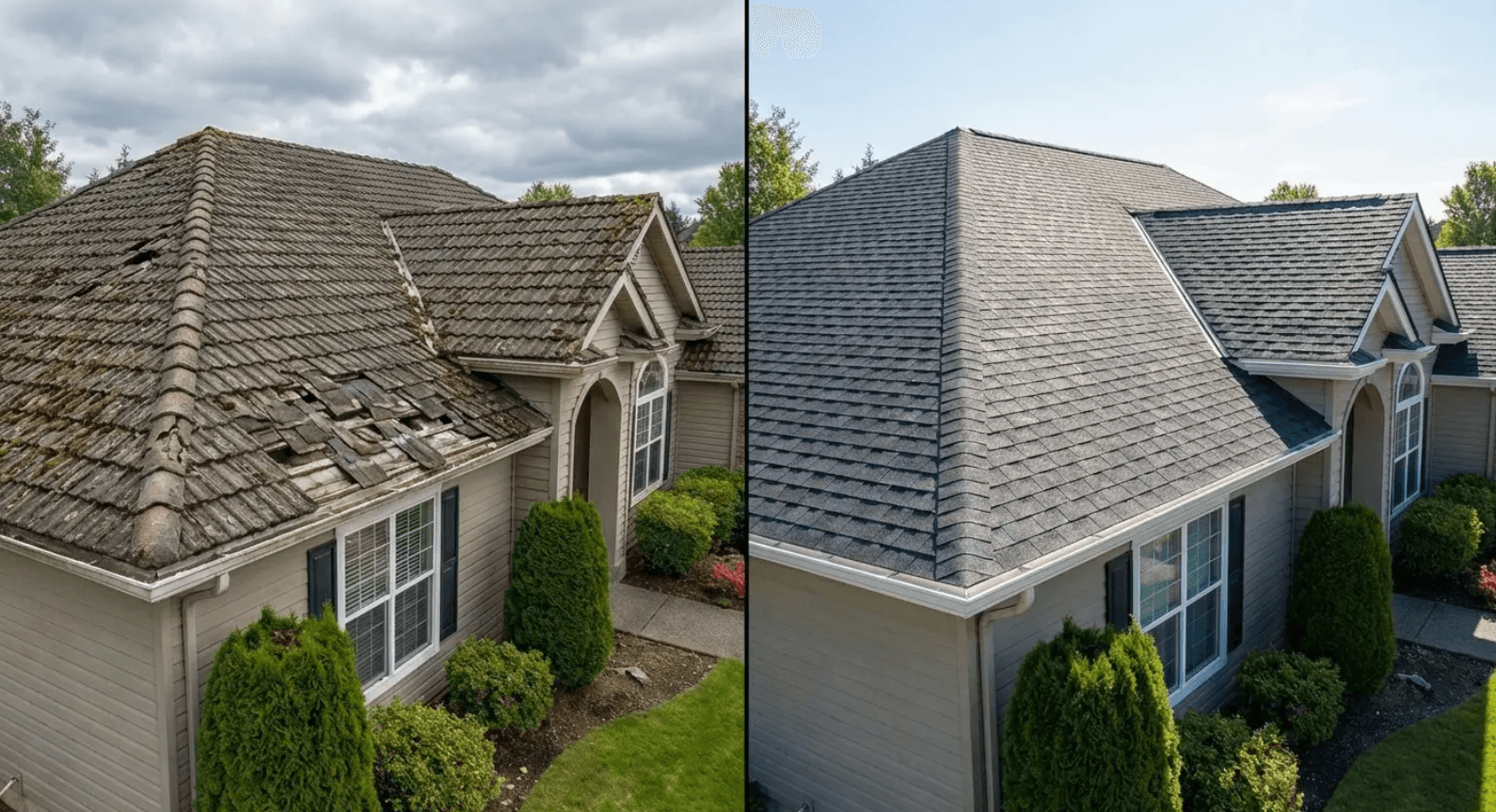
Let me show you how this plays out in real scenarios. Say you've got minor localized damage on an 8-year-old roof. Repair costs $2,500, replacement costs $18,000. You've got 17 years of life remaining. That's $147 per year for repair versus $1,059 per year for replacement. Repair wins, hands down.
Moderate damage in multiple areas on a 12-year-old roof? Repair costs $6,000, replacement still $18,000. You've got 13 years remaining. That's $462 per year for repair versus $1,385 per year for replacement. Still makes sense to repair.
Widespread deterioration on a 16-year-old roof? Repair costs $7,500, replacement $18,000. Nine years remaining. Now you're at $833 per year for repair versus $2,000 per year for replacement. This is borderline. You need to factor in the probability of additional repairs within that remaining lifespan.
Multiple failures plus structural issues on an 18-year-old roof? Repair costs $9,000, replacement $18,000. Seven years remaining. That's $1,286 per year for repair versus $2,571 per year for replacement. But here's the thing: replacement gives you a new 20-30 year warranty period, which changes the math entirely.
The Warranty Implication Nobody Calculates
Repairs can void or limit your existing warranty, depending on your manufacturer's terms. If your roof has 8 years of material warranty remaining and your repair invalidates that coverage, you've just lost $2,000-4,000 in warranty value based on average claim values for material defects.
Replacement gives you a new 20-30 year warranty period. That warranty has real financial value because it shifts risk from you to the manufacturer. When calculating replacement cost, you should subtract the value of that warranty coverage from the total price. A $15,000 replacement with a $3,000 warranty value is really a $12,000 investment.
Future Repair Probability
This is where contractors often mislead you, usually unintentionally. They see current damage and quote current repairs without projecting failure probability for the rest of the roof.
If your roof is showing failure in multiple areas, statistics say you'll need additional repairs within 2-3 years. You're not making one $4,000 decision. You're making a series of repair decisions that might total $8,000-12,000 over the remaining roof life.
I run a probability analysis for clients facing this decision. We map current damage, assess overall roof condition, and project likely repair frequency based on material age and local weather patterns.
Sometimes repair makes sense. Sometimes it's throwing money at a failing system.
A homeowner with a 14-year-old architectural shingle roof faced $5,800 in repairs for storm damage affecting three separate roof slopes. Replacement would cost $22,000. Using the percentage rule (5,800 divided by 22,000 equals 26%), most contractors recommended repair.
But detailed assessment revealed the undamaged sections showed advanced granule loss and early curling. Those are indicators of failure within 3-4 years. We projected two additional repair events at $3,500 each over the roof's remaining 7-year lifespan, bringing total repair costs to $12,800 ($1,829 per year) versus replacement at $22,000 ($3,143 per year amortized, but with a new 25-year lifespan).
The homeowner chose replacement, avoiding $12,800 in staged repairs and gaining 18 additional years of roof life.
You need both numbers: cost per serviceable year AND probability-adjusted total repair costs over remaining life. Only then can you make an informed decision.
Material Costs Are Only 30% of Your Bill (Here's Where the Rest Goes)
You price shingles at a local supplier. They're $95 per square. Your repair needs 8 squares. That's $760 in materials.
The contractor quotes $3,200 for the job, and you're wondering where the extra $2,440 went.
It went into the 70% of roofing work that isn't materials.
Labor Rate Reality
Roofing labor isn't priced at hourly wages. It's priced at production rates per square, and those rates include far more than the worker's paycheck.
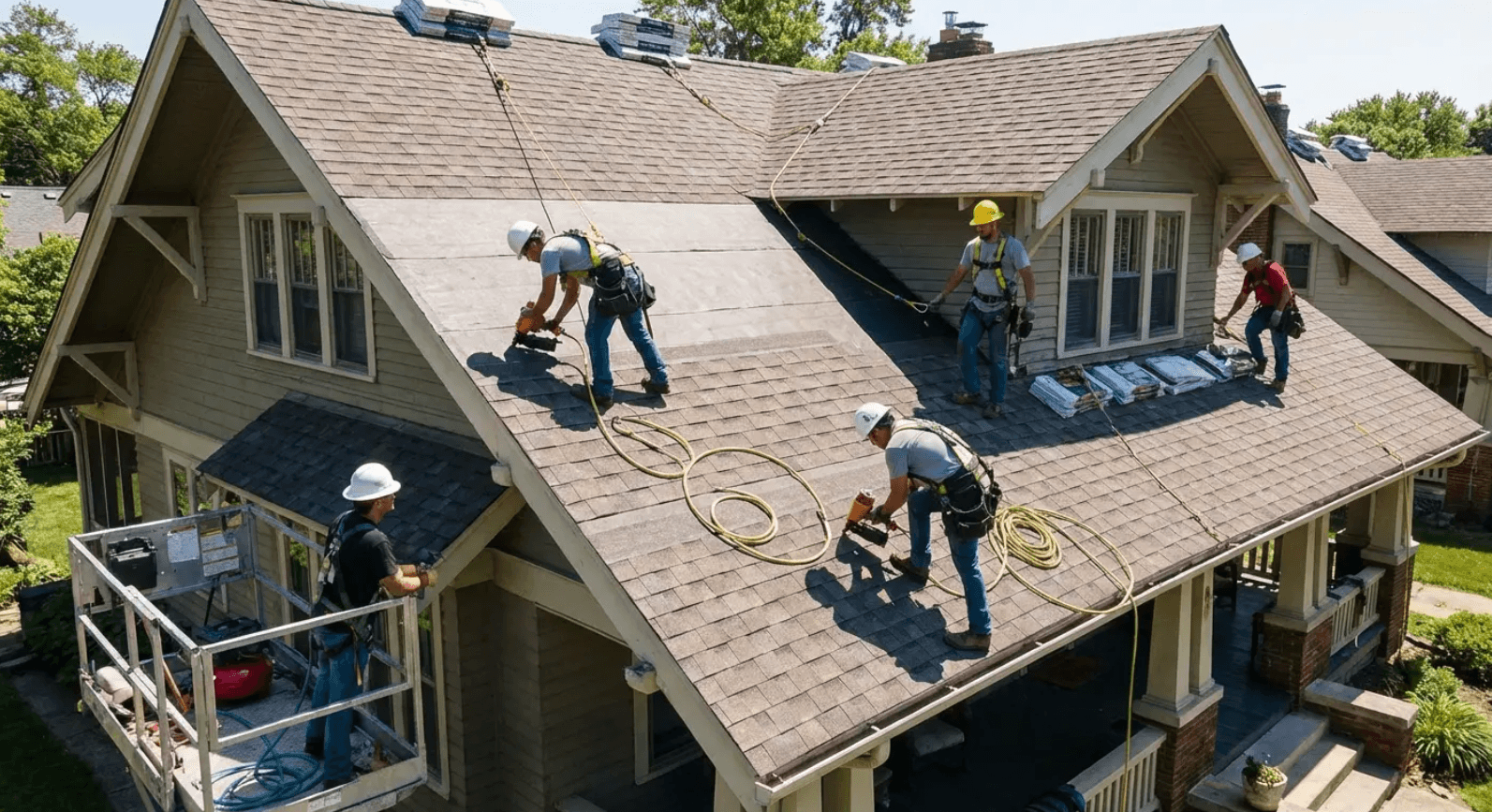
A two-person crew completing your 8-square repair in one day generates roughly $1,200 in labor costs. That breaks down to about $320 in actual wages, $180 in payroll taxes, $240 in workers' compensation insurance, and $460 in general liability insurance allocation.
Workers' comp for roofers is insane. Thirty-five, forty, sometimes fifty-five percent of payroll depending on your state. It's a high-risk job, so insurance companies charge accordingly. General liability insurance costs $8,000-15,000 annually for small roofing companies, and that cost gets distributed across every job.
The Equipment and Disposal Line Items
Your contractor's got probably $10,000-$15,000 in equipment. Pneumatic nailers. Compressors. Safety harnesses because nobody wants to die falling off your roof. Ladder jacks. Scaffolding if your roof is steep or high. All that stuff costs money, and it gets factored into every job. Equipment cost allocation usually adds $180-280 to a standard repair.
Disposal is where homeowners consistently underestimate costs. Roofing debris is heavy and bulky. Your 8-square repair generates roughly 1,600 pounds of material. Dumpster rental runs $400-600 for the size needed, plus dump fees of $80-120 per ton. Total disposal cost: $480-680.
Permits, Inspections, and Overhead
Most jurisdictions require permits for roofing work exceeding basic maintenance. Permit fees run $75-200 depending on your location, and they include mandatory inspections that require the contractor to schedule around inspector availability, which adds coordination time and potential weather delays.
Business overhead like office costs, estimating time, vehicle expenses, licensing fees, continuing education, all that adds another 12-18% to job costs. A company that doesn't include overhead pricing is either operating on unsustainably thin margins or cutting corners somewhere else.
Profit Margin Transparency
After all those costs, roofing contractors usually operate on 8-15% net profit margins. On your $3,200 repair, that's $256-480 in actual profit.
This isn't price gouging. It's a service business with high liability, significant equipment costs, and specialized skilled labor.
When you see the full cost breakdown, that $3,200 quote starts making sense. You're not paying for $760 in shingles plus $2,440 in markup. You're paying for a complete service that includes skilled labor, insurance protection, proper disposal, code compliance, and business sustainability.
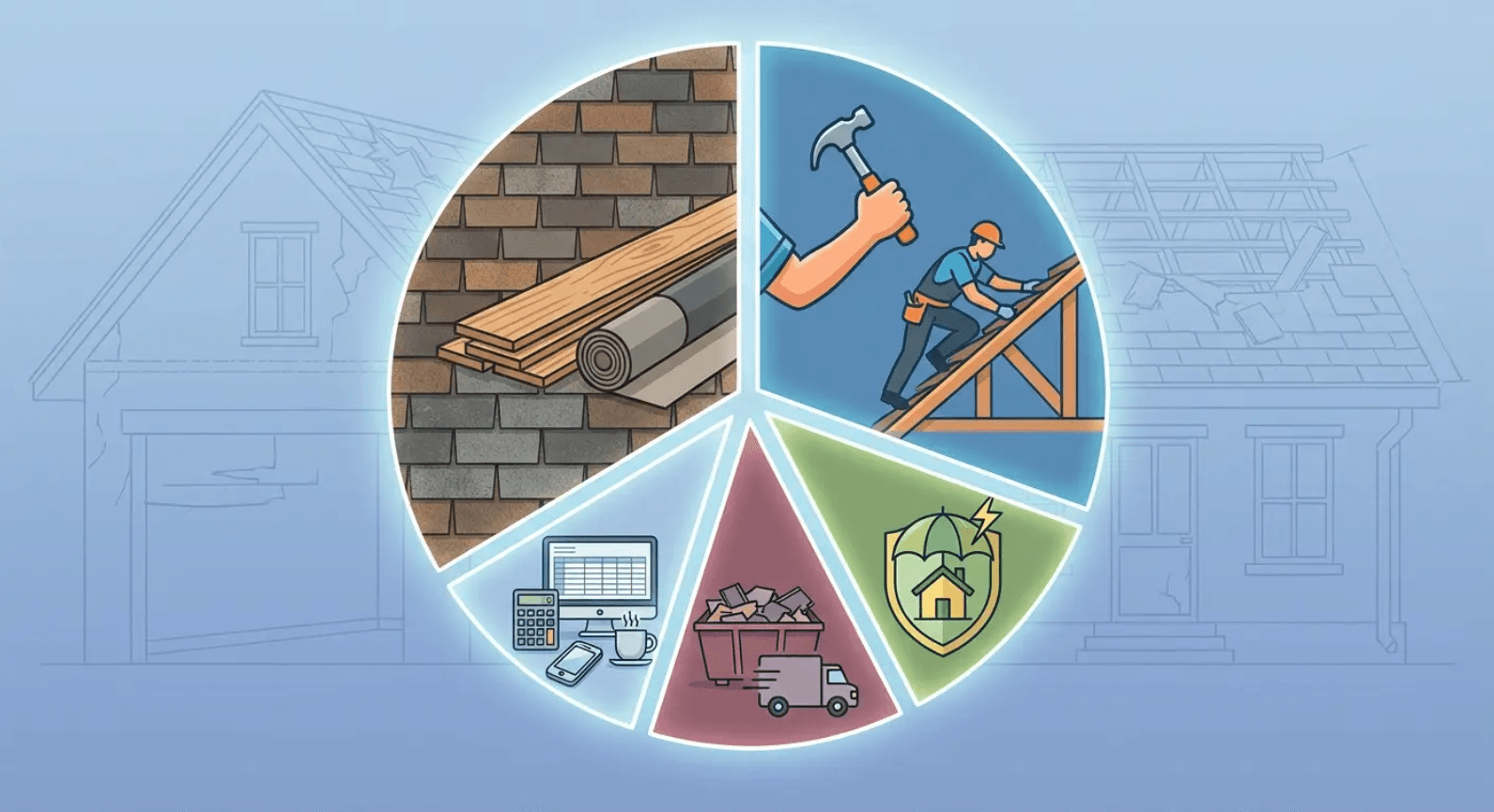
Request this breakdown from every contractor to understand where your money goes. Materials, typically 25-35% of total: shingles or roofing material, underlayment, flashing and fasteners, sealants and adhesives. Labor, typically 35-45% of total: installation labor for however many crew members for however many hours, workers' compensation insurance allocation, payroll taxes. Insurance and liability, typically 10-15% of total: general liability insurance allocation, bonding if applicable. Disposal and equipment, typically 8-12% of total: dumpster rental and dump fees, equipment usage or rental. Permits and compliance, typically 2-5% of total: building permits, inspection fees. Overhead and profit, typically 10-18% of total: business overhead allocation, net profit margin.
Get those numbers in writing so you know exactly what you're paying for.
Why Three Quotes Can Give You Three Wildly Different Numbers
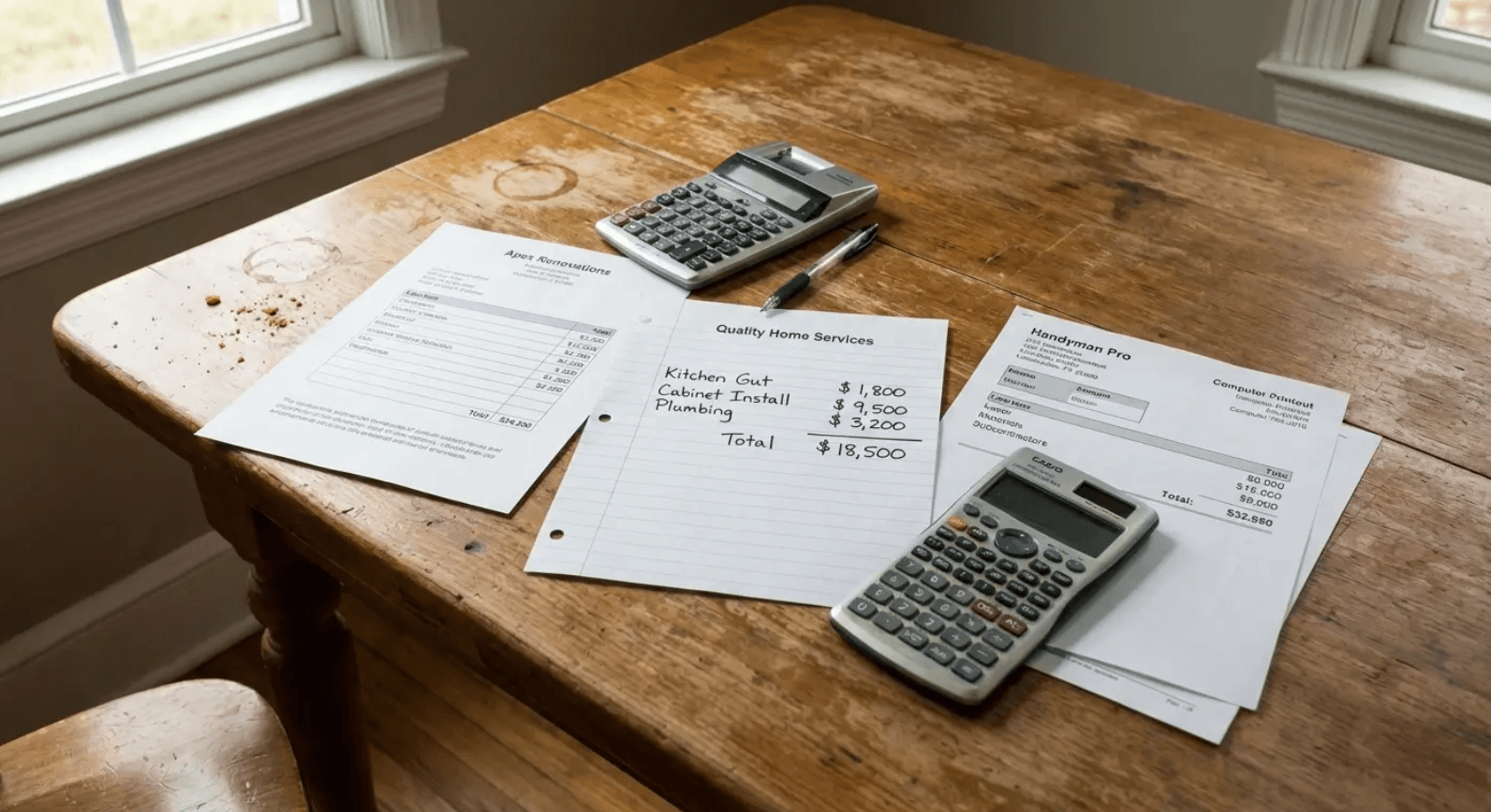
You did your homework. You got three quotes from licensed contractors. They're $2,800, $4,100, and $5,300 for what appears to be the same repair.
What the hell?
The price spread isn't random, and it's probably not about greed.
Scope Interpretation Differences
Contractors assess risk differently based on their experience. The $2,800 quote might address only the visible damage. The $4,100 quote includes adjacent areas that show early deterioration. The $5,300 quote factors in decking replacement that the contractor expects to find once they remove shingles, based on moisture readings or visible sagging.
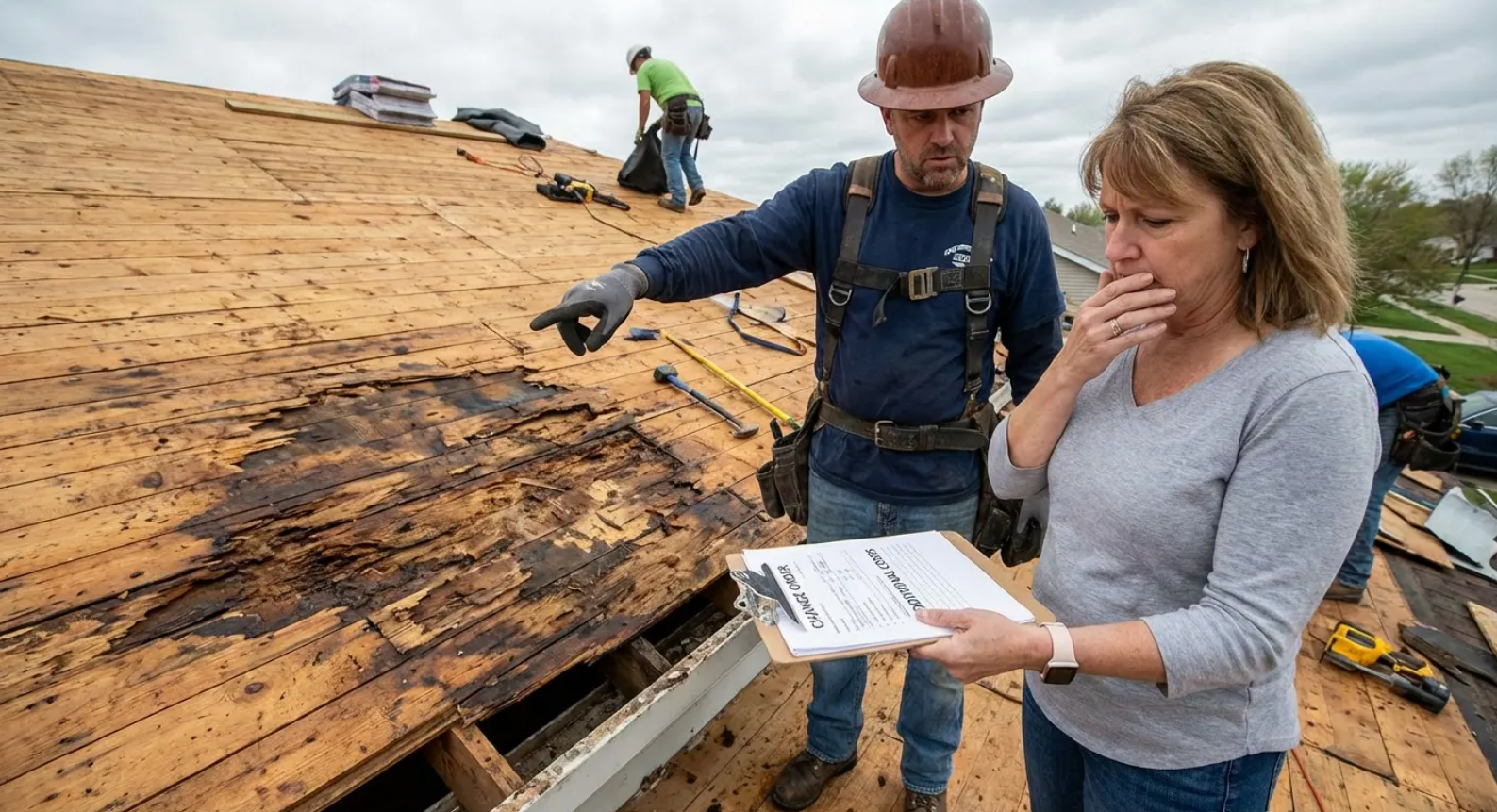
You won't know which assessment is accurate until work begins, and that's when change orders happen. The low bidder often becomes the middle or high bidder once they discover conditions that weren't visible during estimation.
Experienced contractors price in contingencies for likely hidden damage. Inexperienced or aggressive bidders don't.
Material Grade Selection
Not all shingles are the same, even within the same manufacturer's lineup. Architectural shingles range from 25-year basic lines to 50-year premium lines with enhanced wind ratings and algae resistance. The price difference is $30-60 per square, which adds $240-480 to an 8-square repair.
Some contractors default to builder-grade materials to keep quotes competitive. Others spec mid-grade or premium materials because they've seen performance differences in your climate. Your quotes should list exact material models, not just generic descriptions like "architectural shingles."
Warranty Structure Variations
This is the hidden value difference that most homeowners miss.
Contractor A offers a 1-year labor warranty, which is industry minimum. Contractor B offers 5-year labor warranty. Contractor C offers 10-year labor warranty and is certified to provide enhanced manufacturer warranties.
That warranty difference has real value. If a repair fails in year three, you're paying full price for a redo with Contractor A, getting free labor with Contractor B, or getting free labor and materials with Contractor C if failure is material-related. The warranty value on a $4,000 repair over 10 years is worth about $800-1,200 in risk transfer.
Insurance and Licensing Cost Differences
Look, I'm gonna be straight with you. Not all contractors carry equal insurance coverage.
State minimums for general liability might be $300,000, but responsible contractors carry $1-2 million in coverage. That additional coverage costs $3,000-6,000 annually, and it gets priced into quotes.
The contractor with the lowest quote might be carrying minimum coverage, or none at all despite what they claim. If something goes wrong, your homeowner's insurance becomes the target for claims.
The contractor with higher pricing might be carrying coverage that actually protects you.
You should request certificates of insurance from every contractor and verify coverage amounts directly with their insurance carrier. The phone number's on the certificate. Make the call.
How to Evaluate Quote Differences
Stop choosing based on lowest price. Start evaluating based on scope clarity, material specifications, warranty terms, and insurance verification.
Ask each contractor to explain their quote line by line and justify why their assessment differs from the others.
Three contractors quoted a wind damage repair on a 1,800 square foot ranch home. Contractor A quoted $3,200 for replacing visible damaged shingles on the south-facing slope only, using 30-year architectural shingles with a 1-year labor warranty. Contractor B quoted $4,800 for the same visible area plus preventive replacement of weathered shingles on adjacent slopes, using 40-year premium shingles with algae resistance and a 5-year labor warranty. Contractor C quoted $6,100 for the full scope plus anticipated decking replacement in two sections showing moisture meter readings above 19%, with 50-year designer shingles and a 10-year labor warranty.
Upon tear-off, Contractor C's assessment proved accurate. Both decking sections required replacement. Had the homeowner chosen Contractor A, they would have faced an $1,800 change order plus the original $3,200, totaling $5,000 with inferior materials and minimal warranty protection.
The right quote isn't the lowest or the highest. It's the one that accurately scopes your repair needs, specifies quality materials, includes meaningful warranty protection, and comes from a properly insured contractor who'll still be in business when you need that warranty honored.
Seasonal Pricing Isn't Just About Demand
Everyone tells you to schedule roofing work in spring or fall when prices are lower. Contractors are less busy, so they discount to fill schedules.
That advice ignores the physics of roofing materials.
Temperature-Dependent Material Performance
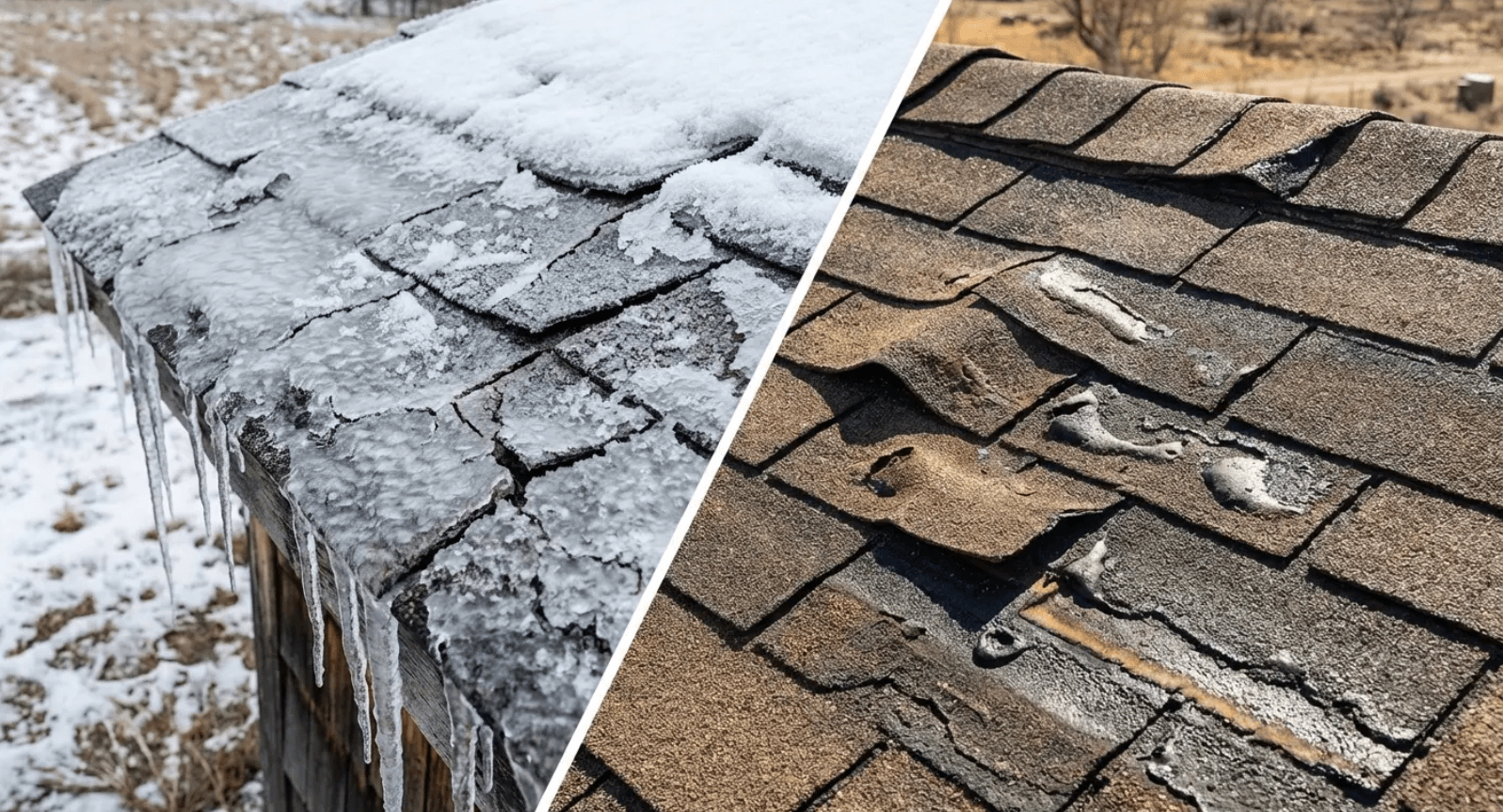
Asphalt shingles are designed to seal through thermal activation. The adhesive strips need sustained temperatures above 70°F to properly bond. Install shingles in January when it's 35°F, and those shingles won't seal until the following summer.
You've got six months of vulnerability to wind uplift, and you've potentially voided your wind warranty because manufacturer specifications require proper sealing.
Contractors working in cold weather have to hand-seal every shingle with roofing cement. That adds 2-3 hours of labor to a standard repair, which translates to $200-400 in additional costs.
Your "off-season discount" just disappeared.
Summer heat creates different problems. When surface temperatures exceed 90°F, shingles become fragile and tear easily during installation. Workers move slower to avoid damage and heat exhaustion. Installation time increases by 30-40%, driving up labor costs proportionally.
Material Waste and Damage Rates
Cold weather makes shingles brittle. Breakage rates during handling and cutting increase from typical 3-5% waste to 8-12% waste. On an 8-square repair, that's an extra $150-200 in material costs that someone has to absorb.
Extreme heat softens shingles to the point where foot traffic creates permanent dimples and damage. Contractors need additional plywood walkways and more careful staging, which adds time and materials.
Sealant and Adhesive Complications
Roofing sealants and adhesives have application temperature ranges printed right on the tube. Most specify 40-100°F for proper curing. Outside that range, you're getting substandard adhesion that will fail prematurely.
Contractors need specialty cold-weather or high-temp formulations that cost 40-60% more than standard products.
Weather Delay Probability
Winter and summer repairs face higher probability of weather delays. Your contractor schedules your repair, mobilizes their crew, and gets rained out or faces unsafe wind conditions. They've already incurred mobilization costs like fuel, equipment transport, crew wages for partial day that have to be recovered somehow.
Some contractors build delay contingencies into off-season pricing.
Spring and fall offer stable temperatures, predictable weather windows, and materials that perform according to specifications. The higher demand during these seasons is justified by lower risk and better installation conditions.
You're not paying a premium for convenience. You're paying fair market rate for installation conditions that actually extend repair longevity.
The Financing Trap That Costs Homeowners Thousands
Your contractor offers convenient financing. Zero percent interest for 12 months, no payment for 90 days. It feels like a solution to your cash flow problem.
You're about to pay $1,200-2,400 extra for that convenience if you're not careful.
The Deferred Interest Mechanism
Most contractor financing programs use deferred interest structures, not true 0% APR. Here's the difference that matters: if you don't pay the entire balance before the promotional period ends, you owe retroactive interest from the original purchase date at rates usually between 24-30% APR.
Your $4,000 repair financed for "12 months interest-free" will cost you $4,960 if you still carry a $500 balance in month 13. That interest gets calculated on the full $4,000 for the entire 12 months, not just the remaining balance.
Miss that payoff deadline by one day, and you've just paid an effective 24% interest rate.

Minimum Payment Structures
The financing company sets minimum payments deliberately low to make sure most customers don't pay off balances during the promotional period. On a $4,000 balance, minimum payments might be $85 monthly. That's $1,020 over 12 months, leaving you with a $2,980 balance that triggers full retroactive interest.
You need to pay $334 monthly to clear that balance in 12 months.
The minimum payment is designed to trap you.
Origination Fees and Hidden Costs
Many contractor financing programs charge origination fees of 3 -6% that get rolled into your financed amount. Your $4,000 repair becomes a $4,200-4,240 loan before you've paid a cent in interest.
Some programs also charge annual fees of $50-95 that appear in the fine print.
Better Financing Alternatives
Home equity lines of credit, HELOCs, currently run 8-10% APR with no origination fees and true interest-only payment options. A $4,000 draw costs you $320-400 in annual interest if you carry the balance for a full year. That's $560-640 less than the contractor financing trap.
Personal loans from credit unions average 9-12% APR for qualified borrowers. Even at 12%, you're paying $480 in interest over two years on a $4,000 loan. Still far less than the deferred interest trap.
Credit cards with 0% introductory APR offers, genuine 0% not deferred interest, give you 12-18 months of interest-free financing if you qualify. Pay it off during the intro period and you've paid zero interest legitimately.
The Cash Discount Reality
Some contractors offer 3-5% discounts for cash payment because they avoid credit card processing fees and financing program costs. On a $4,000 repair, that's $120-200 in immediate savings.
Combine that with a HELOC or credit union loan at reasonable interest rates, and you're thousands ahead of contractor financing.
Financing can make sense for emergency repairs when you don't have liquid funds available. Just understand the costs, read every word of the financing agreement, and calculate the exact monthly payment needed to avoid deferred interest traps.
Your contractor's finance partner isn't offering you a favor. They're offering you a high-interest loan with aggressive terms designed to maximize their profit.
When Joyland Roofing Steps In
Community-focused roofing initiatives are demonstrating what's possible when contractors prioritize homeowner protection over profit maximization.Roofs from the Heart recently completed a critical roof replacement for a Delaware senior whose home had been damaged since 2019, coordinating donated materials from GAF, grant funding from Bank of America, and volunteer services to restore safe living conditions. It's proof that the roofing industry can deliver transparent, homeowner-first solutions when properly motivated.
If you're still reading, you've made it through a lot of information about costs, insurance, and financing traps. You're probably more informed than you were, but possibly more overwhelmed about making the right decision for your specific situation.
That's where we come in.
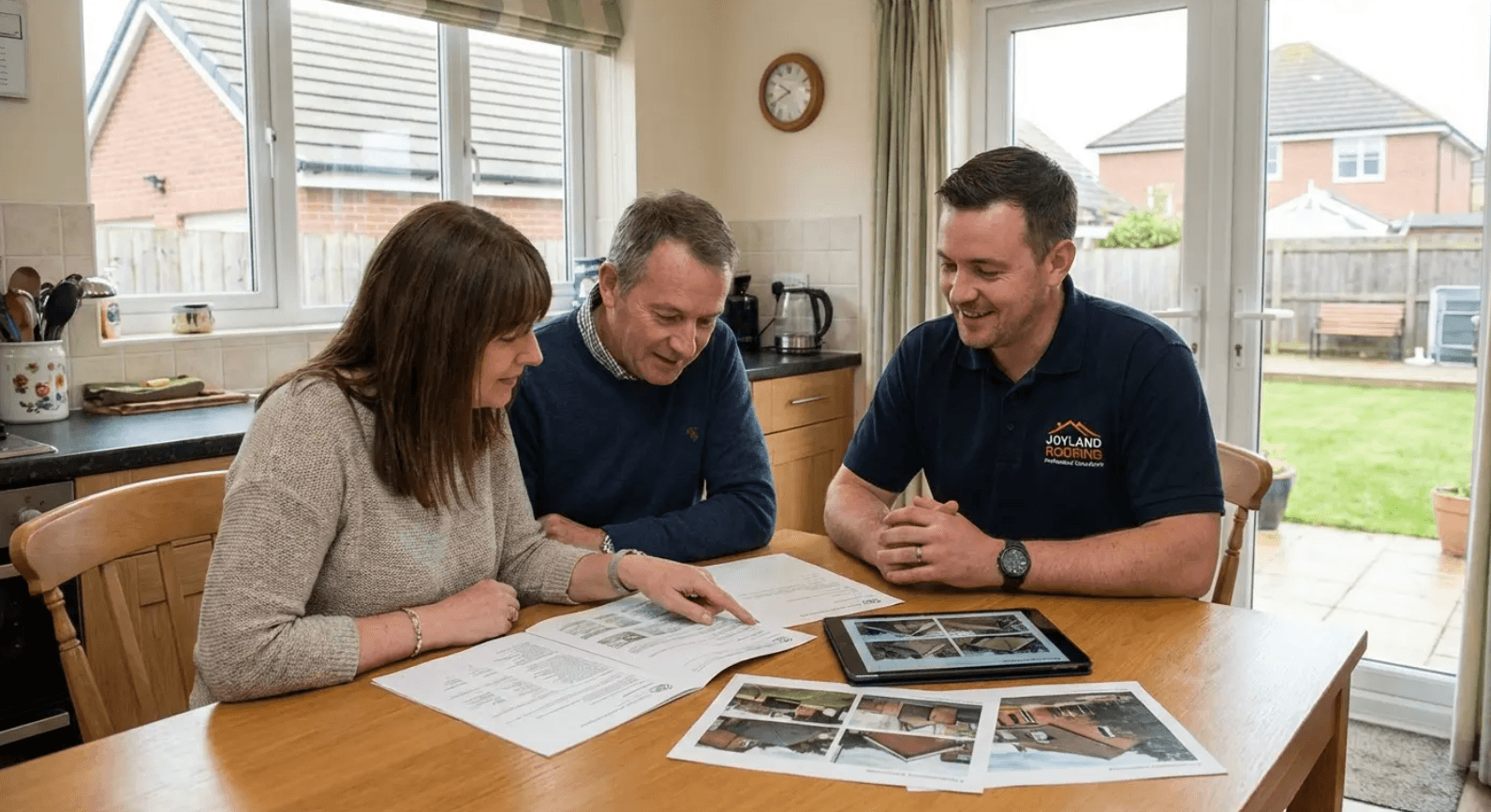
Here's how we do things differently. When we quote you a job, you get a line-by-line breakdown. Not just a number. You see what the shingles cost, what labor runs, what we're paying for insurance and disposal. Everything.
When you're facing the repair versus replace decision, we run the actual numbers for your specific roof: cost per serviceable year, probability-adjusted future repair costs, and warranty value calculations.
I've walked away from repair jobs because I knew the homeowner needed a replacement. Yeah, I could've taken their money for a patch job. But they'd be calling me back in a year, pissed off, and I'd deserve it. Rather lose the sale than lose my reputation.
We'll review your insurance estimate line by line, document legitimate discrepancies, and help you navigate the supplement process. We know which line items adjusters usually undervalue, and we provide the documentation your insurance company needs to approve fair pricing.
We're not here to run up the bill. We're here to fix your roof so it lasts.
Get a detailed roof assessment from Joyland Roofing that includes cost per serviceable year analysis, insurance estimate review, and transparent pricing breakdowns. We'll give you the information you need to make a confident decision, not a sales pitch designed to pressure you into immediate commitment.
Final Thoughts
Look, roofing costs are complicated. But they make sense once you understand what you're actually buying.
You're not paying for shingles. You're paying for someone to keep water out of your house for the next 20 years. You're paying for insurance that protects you if something goes wrong. You're paying for code compliance so you don't get dinged when you sell. You're paying for expertise that keeps a $900 repair from turning into a $9,000 disaster.
The real cost of roofing repairs isn't the invoice you receive today. It's the total financial impact of the decision you make right now. Repair now versus delay. Patch versus replace. Low-bid versus value-based selection. Promotional financing versus legitimate loan products.
Every choice has consequences that multiply over time. Small leaks become structural damage. Insurance estimates become out-of-pocket surprises. Deferred interest becomes thousands in unnecessary fees. Low bids become change orders and warranty gaps.
You now have the framework to evaluate these decisions based on financial impact rather than surface-level pricing. Use it to ask better questions, demand transparent answers, and choose contractors who treat you like an informed client rather than a transaction to close.
Your roof is a system, not a surface. The costs associated with maintaining it reflect that complexity.
Is it expensive? Yeah. Is it worth it? Absolutely.
Just do me one favor: don't wait. That leak you're ignoring right now? It's costing you money every single day. Call someone. Get it fixed. Your future self will thank you.