February 7, 2026
Can You Put Shingles Over Shingles? Here's What Happens When You Stack the Deck
Author
If you’ve been searching “can you put shingles over shingles,” chances are you just got a roofing quote that made your stomach drop.
Then someone mentioned a cheaper option: skip the tear-off and install new shingles right over the old ones. Same roof, faster job, a few thousand dollars saved. Sounds like an easy decision.
And technically? In many places, building codes allow it.
But what the sales pitch rarely explains is what actually happens under those stacked layers of shingles after the crew leaves. Hidden moisture, extra structural weight, buried flashing problems, and roofing warranties that suddenly become a lot more complicated than you expected.
Overlaying shingles can work in certain situations. But in plenty of others, it creates problems that don’t show up until years later—when the next repair or replacement becomes far more expensive than the one you were trying to avoid.
Before deciding which route to take, it helps to understand how roofing systems really behave over time and why shortcuts sometimes create bigger issues later. Our guide on metal roofing done right explains how installation choices and material decisions can impact a roof’s long-term performance far more than most homeowners realize.
Table of Contents
- TL;DR
- Why the "Layer Over" Question Is Really About Money (and Fear)
- The Code Says Yes, But Your Roof Might Say No
- What Actually Happens Between Those Layers
- The Hidden Costs That Make Overlays More Expensive Than Tear-Offs
- When Overlaying Makes Sense (Yes, There Are Exceptions)
- How to Know If Your Roof Can Handle Another Layer
- What Contractors Don't Disclose About Overlay Installations
- The Inspection Problem That Comes Back to Haunt You
- Why Your Next Roof Will Cost More If You Overlay Now
TL;DR
- Codes say yes, but that doesn't mean your roof can handle it
- Moisture gets trapped between layers and rots your decking. We've seen it destroy homes
- You'll save maybe $2,500 now and pay an extra $5,000+ on your next roof
- Two layers of shingles stress your roof framing, especially on older homes not built for the weight
- Warranties get complicated with overlays. Many manufacturers limit coverage or void it entirely
- Once you cover existing problems, proper inspection becomes impossible
- Overlays work in limited scenarios: single-story homes, newer decking, flat roofs, and if you're selling soon
Why the "Layer Over" Question Is Really About Money (and Fear)
You're sitting there Googling "can I put shingles over shingles" at 11 PM because you got that quote today and you can't sleep. I know. That's how most people end up reading this.
Some roofer just quoted you $15,000 and you're thinking "for shingles?" I get it. That's a new used car. That's a kitchen remodel. That's a lot of money. And when another contractor mentions you could save a few thousand by just laying new shingles over the old ones, that sounds pretty appealing when you're already stressed about the expense.
The real question isn't whether you can put shingles over shingles (you probably can, legally speaking). What you're trying to figure out is whether you should do it without regretting the decision in five years when something goes wrong.

Most homeowners hit this crossroads after a storm, a failed inspection, or noticing their roof looks tired. You're already stressed, and now you're supposed to decide between two options that sound completely different depending on which contractor is talking.
Nobody's gonna tell you this, but the whole overlay vs. tear-off thing? It's not about roofing. It's about how much risk you can stomach, how long you're staying in the house, and whether you're planning to sell soon or die here.
I've been roofing for over a decade. Started as a laborer, worked my way up, now I run jobs and consult with homeowners. I've done probably a hundred overlays and way more tear-offs, and I've seen what works and what turns into expensive disasters. So when people ask me about overlaying, I've got opinions. Strong ones.
Every choice you make now creates consequences you'll live with (or pass on to the next owner). I've seen homeowners make both choices and end up fine. I've also seen both choices turn into expensive regrets. The difference comes down to understanding what you're really choosing and whether it matches your situation.
The Code Says Yes, But Your Roof Might Say No
Your specific roof might be a terrible candidate for roofing over existing shingles even if it's perfectly legal. Codes don't account for the age of your decking, the condition of your flashing, or whether your attic has ventilation issues that are already causing problems. They don't care about your climate, your roof pitch, or whether your framing was designed to carry the extra weight.
It's like getting a D on a test. You passed, but barely, and you're probably screwed for the final.
The Weight Math Nobody Runs Until It's Too Late
You're asking your roof framing to support an additional 2,000 to 5,000 pounds depending on your home's size. That might not sound catastrophic, but roofs built before the 1990s were often engineered for lighter materials and different snow load calculations.
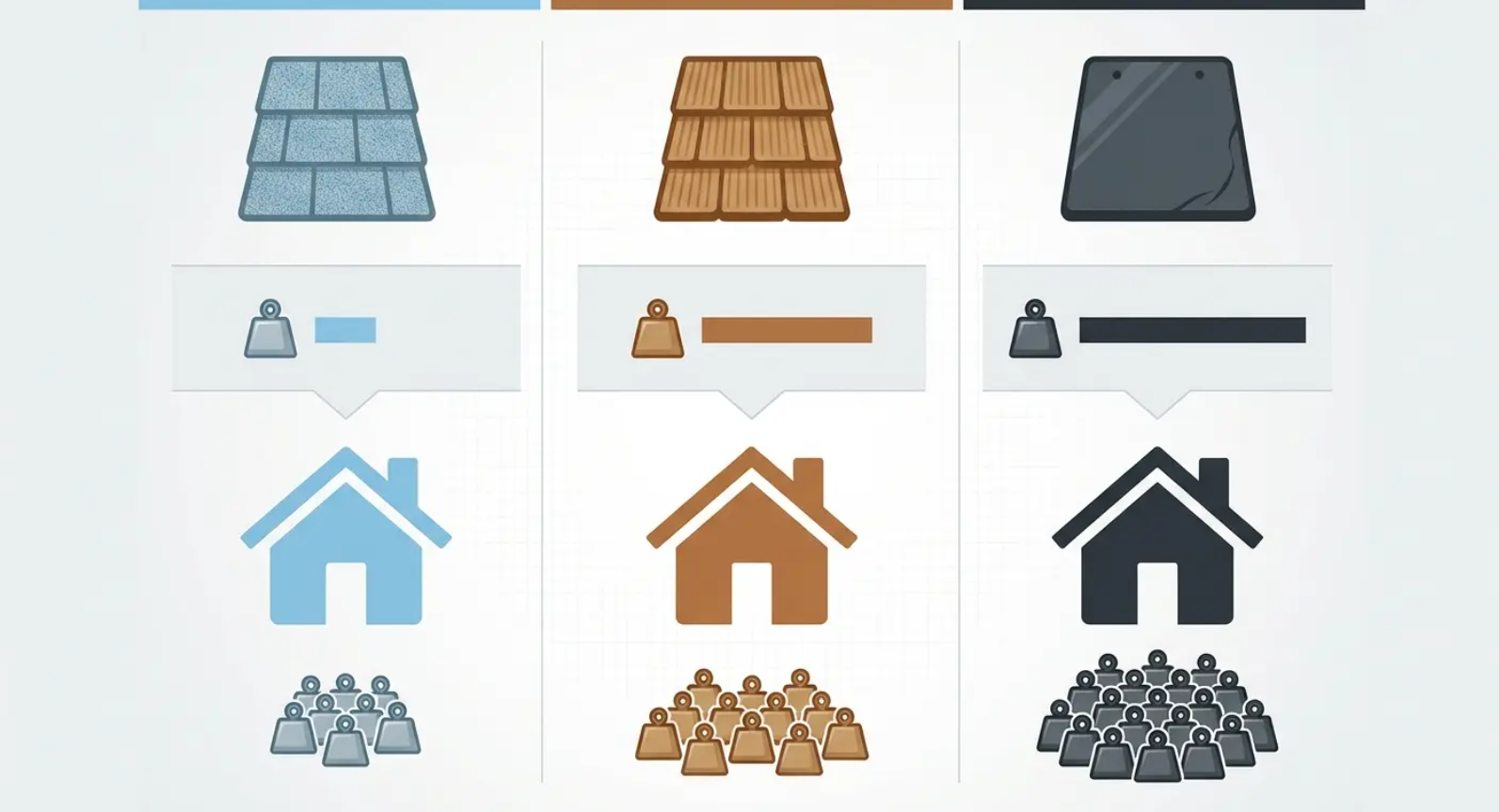
| Shingle Type | Weight Per Square (100 sq ft) | Total Added Weight (2,000 sq ft roof) |
|---|---|---|
| Three-tab shingles | 180-220 lbs | 3,600-4,400 lbs |
| Architectural shingles | 200-250 lbs | 4,000-5,000 lbs |
| Premium composite shingles | 350-450 lbs | 7,000-9,000 lbs |
Your roof's not gonna cave in tomorrow from the extra weight. This isn't a disaster movie. But over years? Things start sagging. Joints get stressed. And by the time you notice, you're already dealing with structural issues on top of roofing costs.
I've walked into attics where the rafters had visible deflection from years of carrying double shingle weight, and the homeowners had no idea until they called us for what they thought was a simple leak repair. By then the damage was done and we were talking about structural work before we could even think about the roof.
What Your Home Inspector Will (and Won't) Catch
Home inspectors can tell you've got two layers. They'll note it in the report, and it'll become a negotiating point when you sell.
What they can't do is tell you whether the decking underneath is rotting, whether the original installation was done correctly, or whether moisture is trapped between the layers. Those problems are invisible until someone peels back the shingles.
I had a client in Portland (nice lady, trying to save money for her daughter's wedding) who did an overlay in 2018. Saved about $2,800. Fast forward to 2023 when she's selling, and the buyer's inspector flags it in his report. Suddenly she's giving back $5,000 at closing because the buyers wanted a credit for the unknown deck condition and the inevitable need for a more expensive two-layer tear-off down the road. She called me after and said, "You told me. You literally told me this would happen and I didn't listen because I wanted to save money for the wedding. Now I'm out five grand anyway." What do you even say to that?
Buyers get nervous when they see overlay roofs in inspection reports. They know they're inheriting unknown risks, and they'll either ask for a price reduction or request a full tear-off before closing. You might save money now, but you'll likely give it back (plus some) when you sell.
This isn't speculation. Real estate agents will tell you that overlay roofs consistently create friction in transactions, especially in competitive markets where buyers have options.
What Actually Happens Between Those Layers
Shingles aren't designed to be buried. They're engineered to be the top layer, exposed to air and sun, with the ability to dry out after rain or snow.
When you shingle over shingles, you create a dark, enclosed space where moisture can accumulate without evaporating. Any water that gets through the top layer (and it will, eventually) becomes trapped. It can't dry from above because there's another shingle layer blocking it. It can't dry from below because the old shingles are in the way.
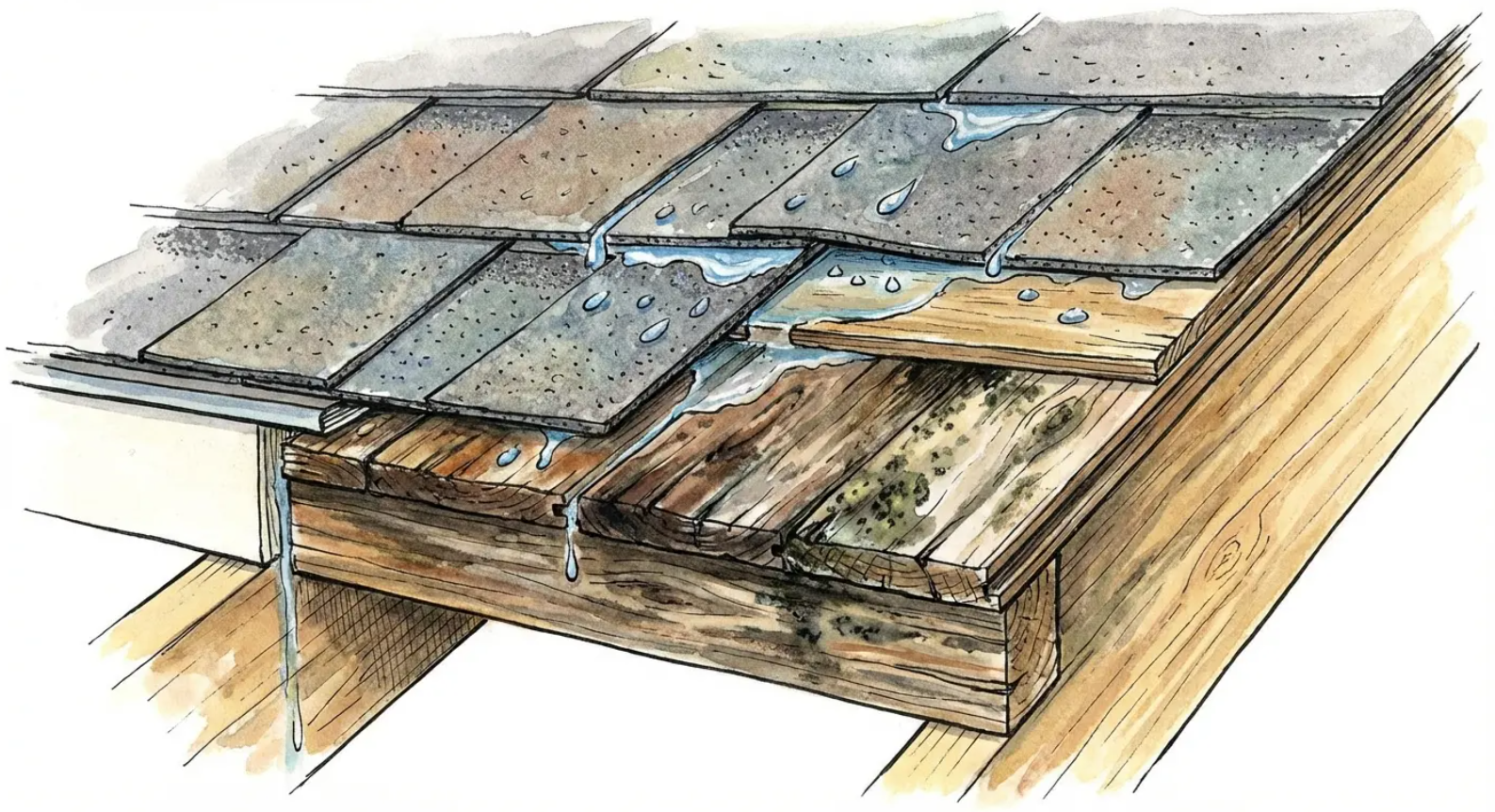
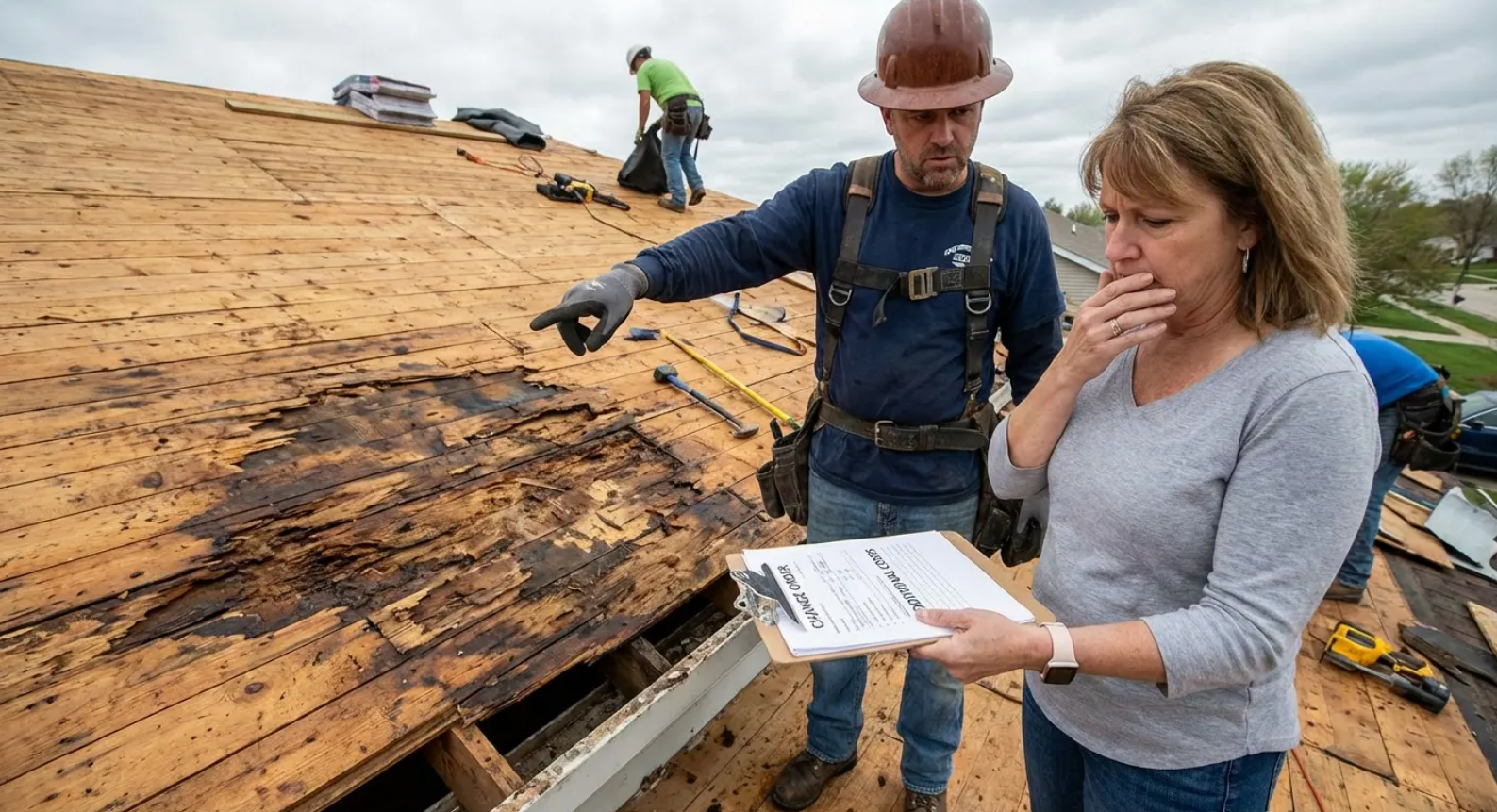
That trapped moisture sits against your roof deck, which is usually plywood or OSB. Both materials turn into mush when exposed to prolonged wetness. You're essentially creating perfect conditions for rot, mold, and structural decay.
When you peel back an overlay and hit rot, you smell it before you see it. That sweet, musty smell of wood that's been wet too long. I've pulled off overlay roofs where the bottom layer looked fine from the edges, but once we got into the field of the roof, we found decking so soft you could push your finger through it. The homeowner had no idea because everything looked perfect from the ground and from inside the attic until it didn't.
The Thermal Trap That Cooks Your Decking
Last summer I pulled shingles off a house in Phoenix. The overlay was only 8 years old but it looked like it had been there for 20. The heat between those layers had basically cooked the adhesive right out of the shingles. That's what happens when you trap heat like this.
Your attic gets hotter because the extra layer traps more heat. Your shingles get hotter because they can't dissipate warmth as efficiently. The temperature swings become more extreme, and materials expand and contract more aggressively.
This accelerated thermal cycling breaks down shingle adhesives faster, makes granules fall off sooner, and causes the decking to dry out and crack. You're shortening the lifespan of both layers at the same time.
Down in Arizona and Texas? Forget it. I've seen overlay roofs in those climates that looked 20 years old after 8 years. The heat just destroys them. You might get 15 years out of a properly installed single-layer roof but only 10 to 12 from an overlay, even with identical shingle quality. I've seen this pattern repeat across hundreds of installations, and the numbers don't lie.
Why Ventilation Problems Get Worse, Not Better
Proper attic ventilation depends on air flowing from soffit vents at the eaves up to ridge or gable vents at the peak. It's a balanced system that needs to work right.
When you're considering roofing over existing shingles, the added thickness at every transition point can block or restrict soffit vents. Roofers sometimes don't account for this, or they don't bother adjusting vent positions to compensate.
Reduced ventilation means hotter attics, more moisture buildup, and faster deterioration of everything in that space. Your insulation loses effectiveness, your HVAC works harder, and your roof ages faster from the inside out.
You might not connect your rising cooling bills to the overlay you did three years ago, but they're related. Poor ventilation creates problems that ripple through your entire home system. I've measured attic temperatures in overlay situations that were 15 to 20 degrees hotter than properly vented single-layer installations on the same street. That's not a small difference.
The Hidden Costs That Make Overlays More Expensive Than Tear-Offs
That $2,500 you save by skipping the tear-off? You'll pay it back, with interest, in ways you're not anticipating.
The next time you need a roof (which will come sooner with an overlay), you'll pay to remove two layers instead of one. Tear-off labor costs jump by about 50% to 75% when there are multiple layers. Disposal fees double because you're hauling twice the material to the landfill.
You're not saving money. You're just pushing the bill down the road, and it's gonna cost you more when it comes due.
The Warranty Fine Print That'll Burn You
Most major shingle manufacturers will honor their product warranty on overlay installations, but read the details carefully. Coverage periods are often shorter, and certain failures (especially those related to deck issues) may be excluded.
Contractor workmanship warranties get even trickier. Many roofers offer 10-year labor warranties on tear-off installations but only 2 to 5 years on overlays. They know the risks, and they're protecting themselves.
| Warranty Type | Tear-Off Installation | Overlay Installation | Coverage Gap |
|---|---|---|---|
| Manufacturer material warranty | 25-50 years (full coverage) | 25-50 years (limited coverage) | Deck-related failures often excluded |
| Contractor workmanship warranty | 10 years (typical) | 2-5 years (typical) | 5-8 years less protection |
| Deck damage coverage | Usually included | Usually excluded | Serious financial exposure |
| Transferability to new owner | Often transferable | Limited or non-transferable | Reduced home value |
If something goes wrong in year seven, you're paying out of pocket for repairs that would've been covered under a full tear-off warranty. That gap in protection has real financial consequences.
These numbers come from actual warranties I've read through, and trust me, reading roofing warranties is about as fun as it sounds. But this stuff matters when something goes wrong.
You need to get warranty terms in writing and compare them side-by-side. The differences are rarely explained upfront unless you ask specifically. I make sure every client sees these comparisons before they decide, because discovering warranty limitations after a failure is a terrible way to learn this lesson.
The Repair Costs Nobody Mentions
When an overlay roof develops a leak, finding the source becomes detective work. Water travels between the layers, showing up inside your home several feet away from where it's entering.
Roofers have to remove sections of both layers to trace the leak, then patch or replace multiple areas. What would be a $300 repair on a single-layer roof becomes an $800 repair because of the extra time and materials.
You'll also find that many roofers don't want to touch overlay repairs. They know it's a pain, the results are less reliable, and callbacks are more common. The ones who will do it charge premium rates.
Small problems become expensive headaches. I've had clients call me for simple flashing repairs that turned into multi-day investigations because we couldn't pinpoint the entry point without removing large sections of both layers. You end up paying for exploration time before we even get to the actual fix.
When Overlaying Makes Sense (Yes, There Are Exceptions)
Look, I'm being harsh on overlays. You know why? Because I've gotten calls from homeowners three years after some other contractor did an overlay, and now there's water damage in their ceiling, and they're asking me to fix it. And I have to tell them the whole thing needs to come off. Those calls suck.
But overlaying isn't always wrong. There are legitimate scenarios where it's the practical choice, even if it's not the ideal one.
If you're planning to sell within three to five years and your roof is functional but ugly, you can roof over old shingles to get you through the sale without major investment. You'll disclose it to buyers, they'll negotiate a bit, and everyone moves on.
Single-story homes with good attic access and newer decking (less than 15 years old) are also better candidates. The structural concerns are less severe, and if problems develop, they're easier to address.
I've recommended overlays in these situations when the conditions were right and the homeowner understood the tradeoffs. The key is being honest about your timeline and realistic about what you're getting.
The Low-Slope and Flat Roof Exception
Low-slope commercial roofs and flat residential roofs operate differently than steep-slope shingle roofs. Many are designed for multiple membrane layers, and overlaying is standard practice in these applications.
Those rubber and membrane roofs (TPO, EPDM, that kind of stuff) handle layering better than asphalt shingles. Water drainage works differently, and the structural loading is calculated with multiple layers in mind from the start.
If you've got a flat or low-slope section on your home, the conversation about whether you can put new roof shingles over old ones becomes different. You're not dealing with the same thermal, moisture, and weight issues that plague steep-slope overlay installations.
This is one area where overlaying often makes both technical and financial sense, but you still need a qualified commercial roofer to assess the specifics. The installation methods are completely different, and residential roofers often don't have the expertise for proper flat roof overlays.
The "I'm Staying Here Forever" Calculation
If you're planning to stay in your home for 20-plus years, you need to think through the full timeline.
Can you put shingles on top of shingles? Sure. But that overlay might last 12 to 15 years. Then you'll need a tear-off and replacement, which will cost more than if you'd done it now. You're basically taking out a payday loan on your roof. Sure, you've got cash now, but you're gonna pay it back with interest, and that interest is gonna hurt.
For long-term owners, the math usually favors tear-off because you're optimizing for total cost over your ownership period, not just immediate expense.
A homeowner in Denver chose an overlay in 2010 for $7,500 instead of a $10,000 tear-off. By 2023, the overlay was failing and required replacement. The two-layer tear-off cost $4,200, plus $11,500 for the new roof. Total of $15,700. Combined with the original overlay, he spent $23,200 over 13 years. If he'd done the tear-off in 2010, that roof would likely still be performing well in 2025, saving him over $13,000 and years of worry.
That said, if your budget genuinely can't absorb a tear-off right now and you need a functional roof, an overlay can buy you time to save for the proper job later. Just go in with your eyes open about what you're trading.
How to Know If Your Roof Can Handle Another Layer
You can't make this decision based on cost alone. Your roof's current condition determines whether an overlay is even worth doing.
Start with the decking. If you've got soft spots, sagging, or visible water damage in the attic, you're disqualified. Overlaying over compromised decking is asking for catastrophic failure.
Check your roof pitch. Anything below a 4:12 slope is risky for overlays because water doesn't shed as quickly, increasing the chance of moisture problems between layers.
Pre-Overlay Roof Assessment Checklist
Before considering how to install shingles over existing roof, verify each of these conditions:
- Only one layer of shingles up there right now
- Existing shingles lie flat, no cupping, curling, or buckling
- No soft spots or sagging you can see from ground or attic
- No active leaks or water stains in attic
- Roof pitch is 4:12 or steeper
- Roof decking is less than 20 years old (or verified solid)
- Attic ventilation is good and nothing's blocking it
- You're not planning to die in this house (10-15 years max)
- Local building codes permit overlay installation
- You understand and accept warranty limitations
- Budget cannot accommodate tear-off within next 12 months
If you can't check most of these boxes, you're probably looking at a tear-off whether you want one or not.
The Attic Inspection You Need to Do Yourself
Grab a flashlight and get into your attic on a sunny day. Look at the underside of your roof deck.
You're checking for dark spots (water stains), soft or spongy areas, visible mold, and daylight coming through gaps. Any of these signs mean you've got problems that need addressing before anyone lays new shingles, overlay or otherwise.
Run your hand along the decking if you can reach it safely. Does it feel solid or does it give under pressure? Healthy plywood should be firm and dry. I've had shingles in my hands that were so brittle from heat cycling they'd crack if you bent them even a little. You want solid material up there.
Check around chimneys, vents, and anywhere pipes penetrate the roof. These are common failure points, and if water's been getting in, you'll see evidence here first.
This inspection won't tell you everything, but it'll tell you if you're starting with a solid roof or a disaster waiting to happen. If you find problems, whether you can shingle over architectural shingles becomes irrelevant. You need to fix the underlying issues first.
Questions to Ask Before You Sign Anything
Any contractor pushing hard for an overlay without discussing alternatives should raise your suspicions. Here's what you need to ask when considering how to shingle over existing shingles:
- How old is my decking, and what condition is it in?
- Will you inspect the deck before installation or just overlay what's there?
- What warranty are you offering on labor, and how does it compare to your tear-off warranty?
- How will you handle ventilation at the eaves and ridge with the added thickness?
- What happens if we discover deck damage during installation?
- Have you checked my attic for ventilation and moisture issues?
How they answer (and whether they get pissy when you ask) tells you everything. If they're dodging questions or making you feel stupid for asking, that's your sign to walk.
Contractors who won't put warranty terms in writing or who get defensive about questions are showing you exactly who they are. Believe them.
What Contractors Don't Disclose About Overlay Installations
Some roofers love overlay jobs because they're fast. Tear-off is labor-intensive, time-consuming, and creates disposal headaches. Overlays let them finish in a day instead of three, which means they can book more jobs and keep crews moving.
That efficiency benefits them, not necessarily you. The faster timeline doesn't improve quality, and it often means less attention to detail on the prep work that determines how well your overlay performs.
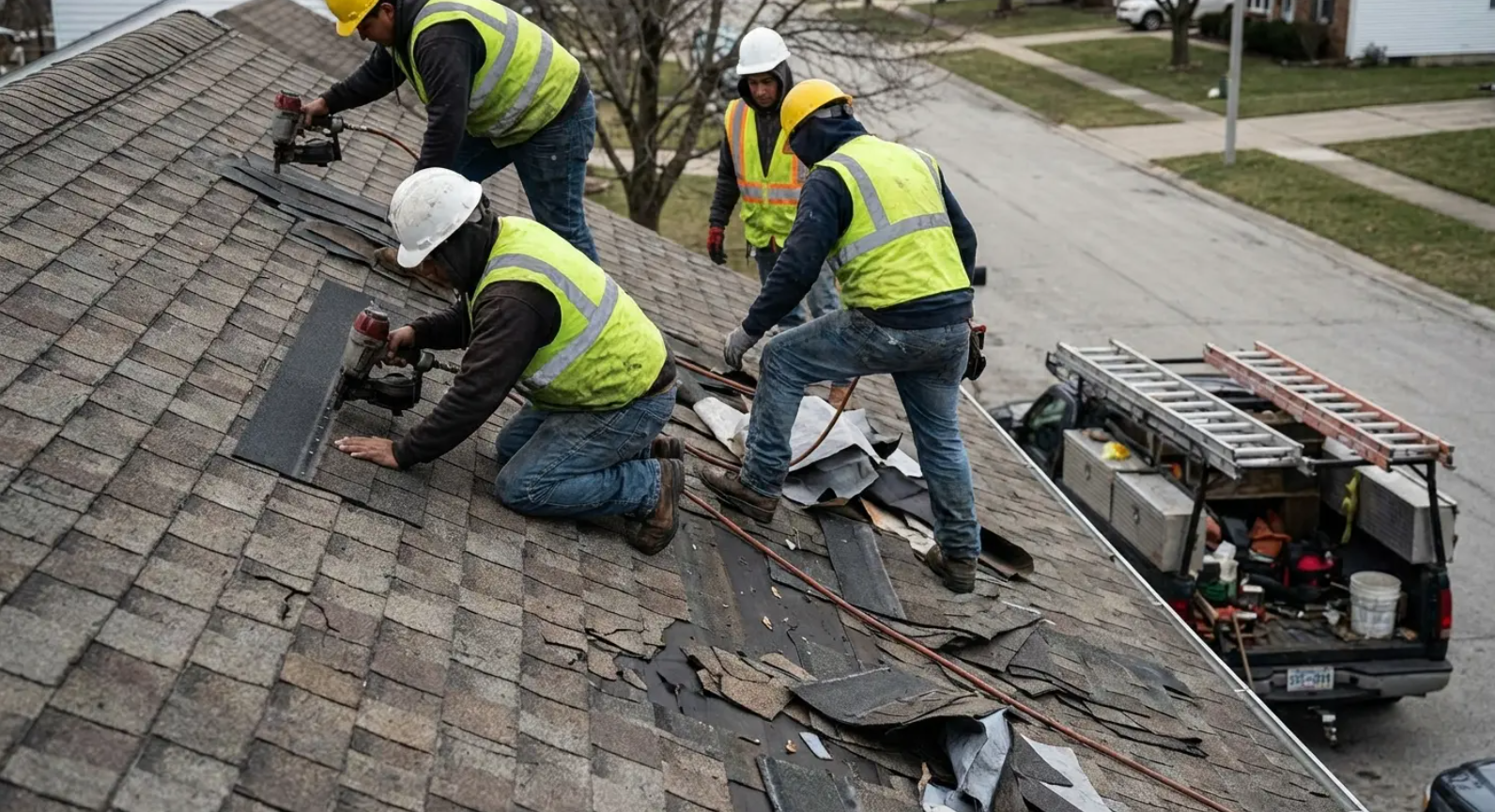
You know why most roofers push overlays? Because they can do three jobs in the time it takes to do one tear-off properly. I'm gonna catch hell from other contractors for saying this, but it's true.
Other contractors won't touch overlays at all. They've seen too many callbacks, too many angry homeowners dealing with premature failures, and they don't want their name attached to work they consider substandard.
Both perspectives are valid, but you need to know which type of contractor you're dealing with and what's motivating their recommendation. I've turned down overlay jobs when the conditions weren't right, even though it meant losing the sale. My reputation matters more than quick revenue.
The Prep Work That Gets Skipped
Overlays require more prep work than many contractors perform. The existing roof surface needs to be relatively flat and smooth. Curled, cupped, or buckled shingles need to be flattened or replaced.
Protruding nails should be removed or pounded down. Ridge caps need to be removed entirely. Valleys require special attention because you're working with double thickness.
Roofers in a hurry skip these steps. They nail right over curled shingles, ignore surface irregularities, and don't properly integrate flashing with the new layer.
You end up with a bumpy, uneven roof that looks unprofessional and performs poorly. Water pools in low spots, fasteners don't seat properly, and the new shingles don't seal correctly because the surface underneath isn't uniform.
This prep work adds time and cost, which is exactly why it gets skipped. But without it, your overlay is compromised from day one. I've seen roofs that looked wavy and irregular from the street because the contractor didn't bother addressing the underlying surface issues before nailing down new shingles. You ever see a roof that just looks... wrong? Like it's got lumps in weird places? That's usually a rushed overlay job.
Why the Cheapest Bid Is Usually a Red Flag
If one overlay bid is $3,000 and another is $6,000, that gap isn't just about profit margin. It reflects different approaches to the work.
The cheap bid probably includes minimal prep, basic shingles, no deck inspection, and a crew that's rushing through multiple jobs per day. The higher bid might include thorough prep, better materials, proper flashing integration, and experienced installers who know how to handle the complications that arise with roofing over shingles.
You're not comparing apples to apples. You're comparing a patch job to a proper installation.
Overlays done right cost maybe 60% to 75% of a full tear-off. If someone's quoting 40% or less, they're either desperate for work or planning to cut corners that'll cost you later.
Price shopping makes sense, but the lowest number rarely represents the best value. You want the contractor who explains what they're doing and why, not the one who promises the moon for half the price.
The Inspection Problem That Comes Back to Haunt You
Once you overlay, you've created a black box. It's like putting a fresh coat of paint over a wall crack. Looks great for now, but that crack's still there, still growing, and now you can't see it to fix it until it's bad enough to show through the paint.
Nobody knows what's happening under those shingles unless they remove them.
Insurance adjusters get suspicious when they can't verify deck condition after storm damage. They might deny claims or reduce payouts because they can't confirm the damage wasn't pre-existing.
Future contractors can't give you accurate assessments or quotes without tearing off sections for inspection, which costs money before you've even committed to repairs.
You've essentially traded short-term savings for long-term uncertainty, and that uncertainty has real costs attached.
The Insurance Claim Complications Nobody Warns You About
Storm damage claims on overlay roofs turn into arguments about causation. The adjuster can see damaged shingles, but they can't see whether the deck underneath was already compromised.
Insurance companies don't want to pay for pre-existing damage, and overlays make it impossible to prove what was there before the storm. They'll often require an engineer's assessment, which delays your claim and might result in reduced coverage.
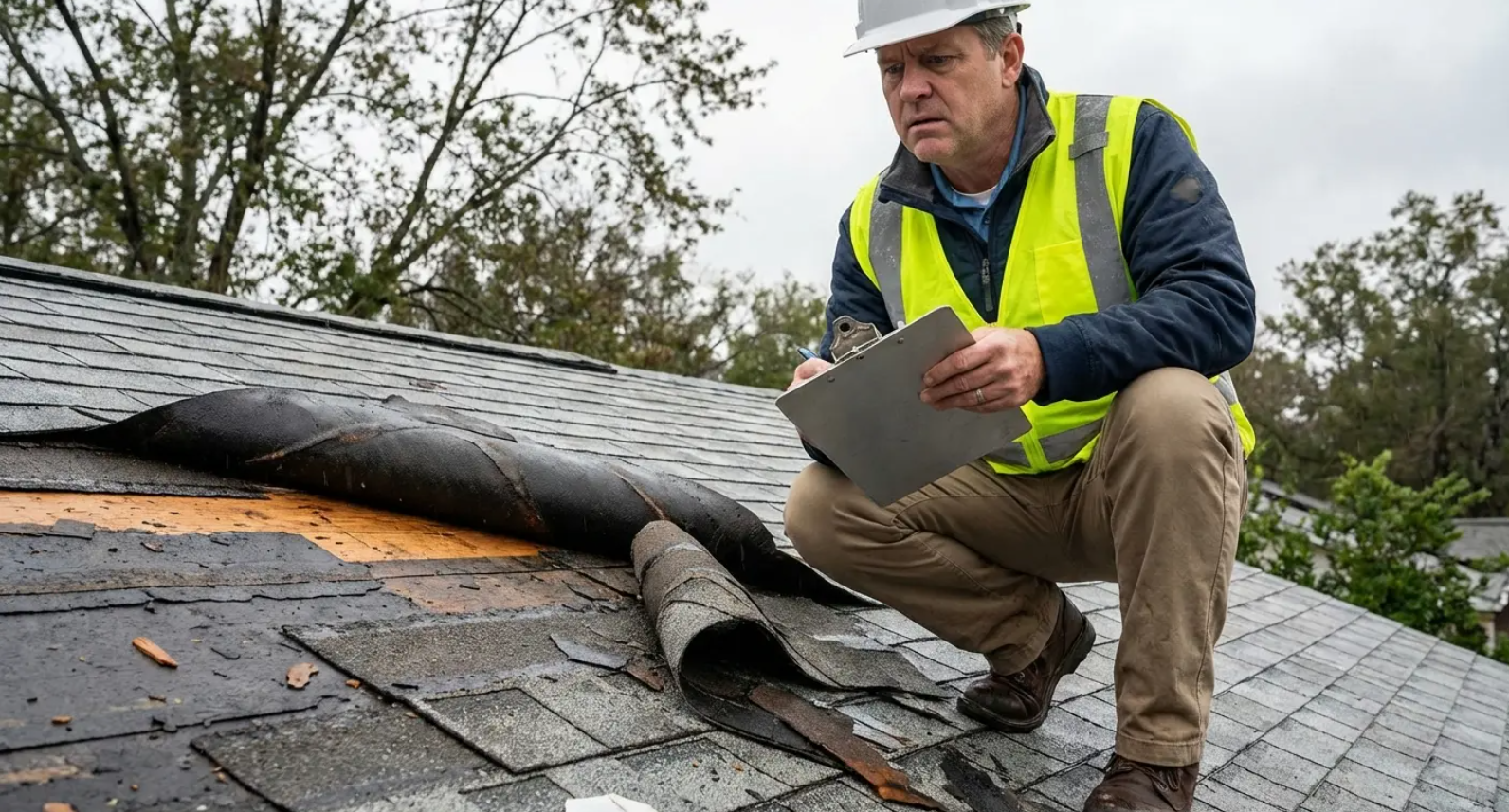
Some insurers explicitly exclude certain coverage on homes with overlay roofs, or they require higher deductibles. This isn't always disclosed upfront, and homeowners only discover it when filing a claim.
You might think you're saving money on the roof, but you're potentially reducing your insurance protection without realizing it. That's a bad trade.
The warranty thing? That's where they really get you. They don't mention it until you're signing, and by then you're exhausted from the whole process and you just sign.
While this might seem unrelated, recent developments in healthcare coverage offer a cautionary parallel about hidden coverage gaps. The CDC reports that Shingrix vaccine protection remains at least 85% effective for up to four years and nearly 80% effective for up to 11 years, yet many people don't realize their specific insurance plans may have coverage limitations for preventive care.
Similarly, homeowners often don't discover their overlay roof has created insurance coverage gaps until they need to file a claim, by which point it's too late to make a different choice.
Why Your Next Roof Will Cost More If You Overlay Now
Here's the math that contractors won't show you upfront.
Single-layer tear-off: $1.50 to $2.50 per square foot in labor and disposal. Two-layer tear-off: $2.50 to $4.00 per square foot. On a 2,000 square foot roof, that's an extra $2,000 to $3,000 just for removal.
Your overlay might last 12 to 15 years instead of 20 to 25 for a proper installation. You're accelerating your replacement timeline by nearly a decade, which means you're paying for two roofs in the timespan you could've paid for one.
The deck problems you hid will surface during that future tear-off, adding another $2,000 to $8,000 in repairs depending on how extensive the damage is.
Add it up: you saved $2,500 now, but you'll spend an extra $4,000 to $11,000 later. That's not savings. That's expensive procrastination.

Total Cost of Ownership Calculator Template
Use this framework to compare overlay vs. tear-off over your expected ownership period:
Option A: Overlay Now
- Initial overlay cost: $________
- Expected lifespan: ________ years
- Future two-layer tear-off cost: $________
- Future deck repairs (estimated): $________
- Future new roof cost: $________
- Total cost over ownership: $________
Option B: Tear-Off Now
- Initial tear-off + new roof cost: $________
- Expected lifespan: ________ years
- Future single-layer tear-off cost (if needed): $________
- Future deck repairs (minimal, caught early): $________
- Future new roof cost (if needed): $________
- Total cost over ownership: $________
Difference: $________
Break-even timeline: ________ years
The Compounding Effect of Deferred Decisions
Roof problems don't pause because you covered them up. They accelerate.
A small soft spot in your decking today becomes a three-sheet replacement area in five years. A minor leak becomes major water damage. Poor ventilation continues destroying your deck from the inside while your new shingles look fine from the street.
Every year you wait, the repair bill grows. Compound interest works against you when it comes to deferred maintenance.
The principle of addressing problems early applies across home maintenance. According to medical experts at SELF, starting antiviral treatment for shingles within 72 hours of spotting a rash can significantly reduce recovery time and prevent long-term complications like postherpetic neuralgia. The same urgency applies to roof problems: catching and fixing deck damage, leaks, or ventilation issues early prevents them from becoming catastrophic failures that cost exponentially more to repair.
The homeowners who regret overlay decisions most are the ones who discovered extensive hidden damage during their next roof replacement. They thought they were being financially prudent, but they turned an $8,000 problem into an $18,000 problem by waiting.
You can't pause deterioration. You can only choose when to deal with it, and dealing with it early is almost always cheaper.
I know some of you are reading this thinking I'm just trying to upsell you to the more expensive option. Fair enough. I get that a lot. But I've turned down overlay jobs when the conditions weren't right, even though it meant losing the sale. My reputation matters more than one job.
Getting Real About Your Specific Situation
Your roof isn't the same as your neighbor's. Your budget, timeline, and risk tolerance are yours alone.
I've given you the information that most contractors won't share because it complicates the sale. Now you need to sit with it honestly and figure out what makes sense for your situation.
Can you afford a tear-off right now? If not, is there a way to save for it over the next year, or is the roof failing so fast that you need action immediately?
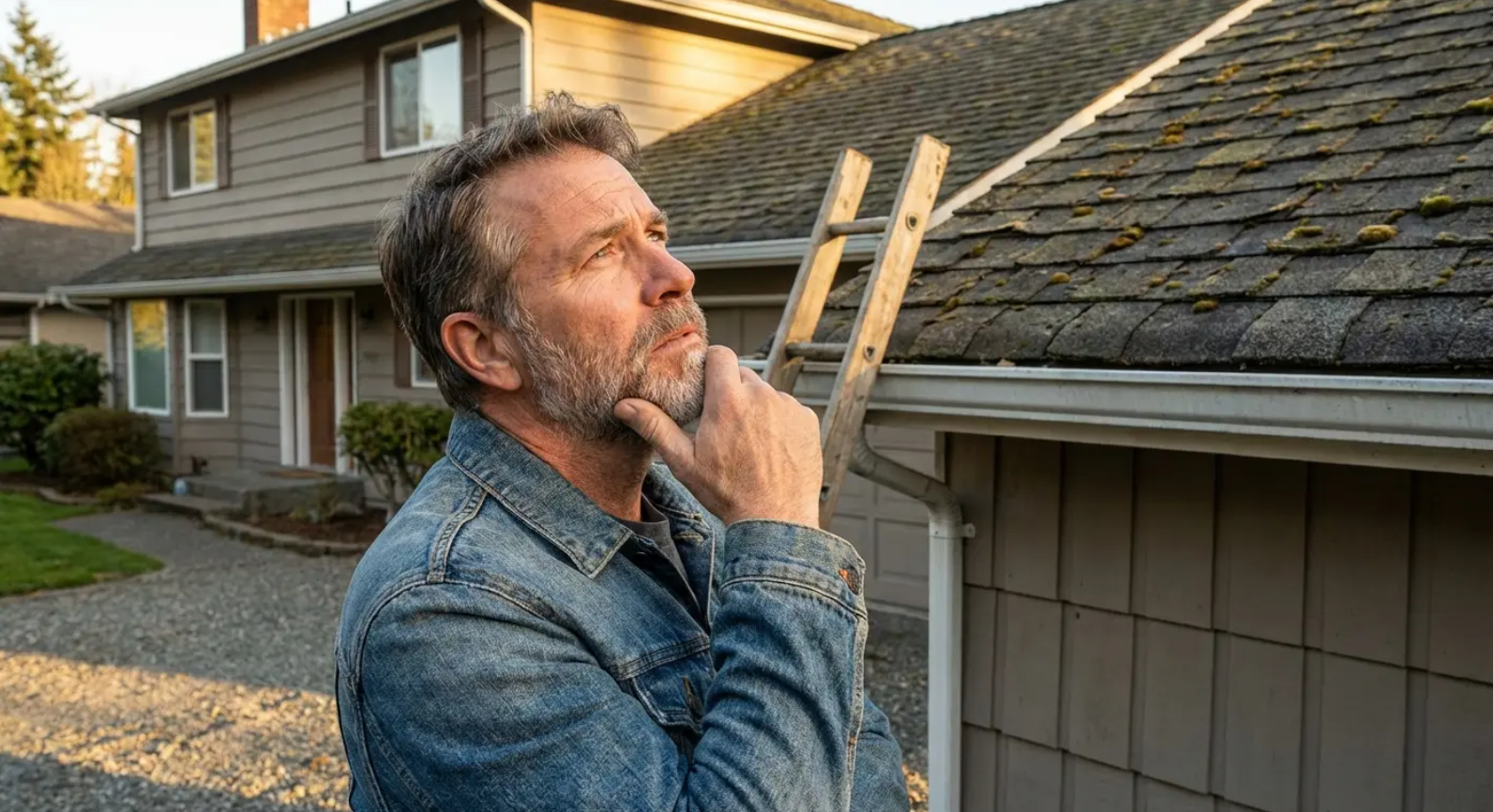
Are you planning to sell soon, or is this your forever home? That answer completely changes the calculation.
How old is your home, and what do you know about the roof structure? Older homes with unknown histories are riskier candidates for overlays than newer construction with documented maintenance.
There's no universal right answer, but there is a right answer for you. It requires honest assessment of your situation, not just wishful thinking about saving money.
Real Talk Section
Okay, professional advice hat off for a second. If you were my brother asking me this question, here's what I'd say: Don't do the overlay. I know it's cheaper now. I know you don't want to spend the money. But I've been doing this long enough to know how the story ends, and it usually ends with you spending more money anyway, just later and more stressed out.
Rip it off. Fix what's broken. Do it right. Sleep better.
Professional advice hat back on.
Final Thoughts
You can overlay shingles in most cases. The better question is whether you should, and that answer depends entirely on your specific roof, your timeline, and your willingness to accept certain risks.
The roofing industry hasn't done homeowners any favors by presenting overlays as simple money-savers without explaining the tradeoffs. You deserve to know what you're choosing.
A contractor in Phoenix told me about a client who insisted on an overlay despite warnings about her 1970s home with questionable decking. She saved $3,200 upfront. Four years later, during monsoon season, water infiltrated between the layers and rotted out six sheets of plywood before anyone noticed the interior ceiling stains. The emergency repair (done during active leaking) cost $6,800 and required temporary tarping that damaged her landscaping. She later called him and said, "You told me. You literally told me this would happen and I didn't listen because I wanted to save money. Now I'm out almost seven grand anyway and my ceiling's ruined." What do you say to that?
Overlays aren't inherently evil, and tear-offs aren't always necessary. But the decision needs to be based on facts about your roof's condition, honest assessment of future costs, and clear understanding of what warranties and protections you're giving up.
Whatever you choose, make sure you're choosing it with full information, not just reacting to sticker shock. Your roof is too important and too expensive to wing it based on incomplete information.
Look, I've probably scared you at this point. That wasn't the goal... or maybe it was a little bit. I just see too many homeowners get burned by the "easy" choice that turns into an expensive nightmare.
The cheapest option today might be the most expensive option tomorrow. Sometimes spending more now means spending less overall, and sometimes a strategic overlay buys you the time you need to plan properly for a full replacement.
Just make sure you know which scenario you're in before you sign anything.
If you take nothing else from this (yeah, I know it turned into a novel), take this: get three quotes, ask about warranties specifically, and if a contractor won't let you ask questions or makes you feel dumb for asking, walk away. Your roof's too expensive and too important to trust to someone who treats you like you're annoying them.
I don't have a crystal ball. Maybe your overlay would be fine for 15 years. I've seen it happen. But I've also seen it go sideways in 5 years, and when it does, it goes REALLY sideways. You're the one who has to live with the decision, so make it count.