
We didn’t know what 2020 had in store for us. Then 2020 bled into 2021 and here we are, just over 2 months away from 2022, and the effects of this crisis are still far reaching.
Roofing is an essential “life sustaining” business. To stay open and operate safely, we adjusted our process.
This new process proved to be more efficient for our team and we continue to tweak it today. Many other factors have impacted roof replacement and roof repairs.
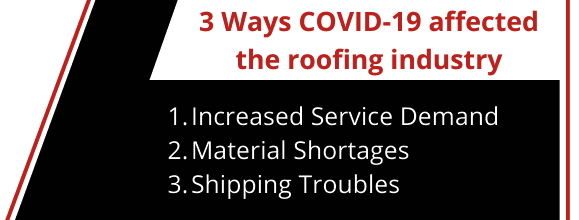
Increased Demand for Services
People stayed home in 2020 and started spending money on home improvements, like roofing. Families weren’t going on vacation, they were saving on commute money, and likely weren’t eating out as much. The extra cash allowed additional flexibility to fit in home projects they may not have otherwise been able to afford.
Going into the winter, manufacturers kept production at a lower level, thinking that 2021 would be a slow-starting year for roofing. To the contrary, everybody came out of 2020 ready to work and fix up their homes and buildings. This has continued to cause scheduling back ups due to limited materials.
Material Shortages
Because manufacturers had cut production in mid-2020, and kept it low through the beginning of the winter, the pent-up demand for products such as shingles and Poly-ISO quickly took all the inventory right out of the system. Roofing suppliers won’t sell their entire stock to one roofing company, and they have struggled to source all the materials to keep up with demand.
Many roofers have been sourcing materials from supply companies in surrounding states to fill work orders that have been sold.
Limited Color Selection
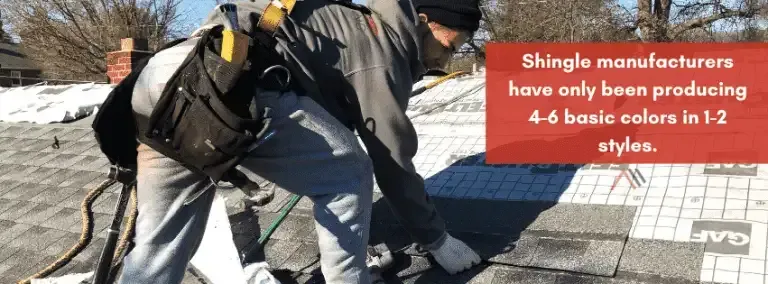
Since the middle of 2020, shingle manufacturers have been producing only four to six basic colors, and one or two styles, with occasional runs of other colors or styles. This will likely continue at least through the winter and into 2022.
So far, cutting production to these basics has allowed them to continue operating, and has kept shingle roof customers supplied with the necessary materials to get a new roof. However, customers today have much fewer options to choose from than customers in 2019.
We anticipate that these options will return once the supply/demand imbalance is rectified, but it could be another year or more before this happens.
Commercial Supply Deficit
On the commercial side, the production of TPO membrane, fasteners, and Poly ISO board continues to limp along at partial capacity. This is due to transportation issues in trucking and shipping. Combine this with the high demand for roofing, and manufacturers have a backlog of a year and more currently.
Here’s a problem: When a low-sloped roof is being replaced, building code requires that the roofing system include insulation (Poly ISO) as needed to bring total value up to R-30. Most old buildings don’t have this much insulation in the ceiling. They might have R-12, or R-19. The rest must be obtained by adding insulation in the roofing system.
In the current circumstances, a building owner may have an old flat roof that must be removed and replaced. The roof is leaking, damaging their goods. However, the roof can’t be completed, and the leaks can’t be fixed, because there is no roofing insulation available for the roofer to apply.
Many commercial roofers are simply telling clients, “We’ll get to you when we find materials.” Temporary patches and repairs can sometimes be a viable stop-gap solution, but not always.
Shipping Troubles
Thanks to the shortage of dock workers and shipping containers, the commercial roofing segment of the industry has seen significant delays. Many roofing companies are having to delay residential & commercial projects due to these delays.
Lack of Imported Steel
Although the American roofing industry is largely self-sufficient, there is some imported steel that gets used to make fasteners. Shingles need nails to hold them on. In most low-sloped roofing systems, stress plates and screws are needed to attach the materials to the roof deck.
John Esh | CEO & Master Installer
- 25+ Years Experience: From ground crew to Master Certified Installer.
- Local Roots: Serving Lancaster, Harrisburg, and SEPA since 1991.
- Credentials: GAF Master Certified (ME27586); Licensed in PA (PA124258) & MD (#137952).
- The "Why":
Obsessed with "radical transparency" to remove the fear factor from home improvements.
James Wesser | Content Producer
- Background: Former local news digital producer and journalist.
- The Mission: Turning complex roofing jargon into clear, "fluff-free" answers for homeowners.
- Local Tie: When not filming on-site, he’s likely roaming Hersheypark or building digital worlds.