Are Gutter Guards Worth It? Here’s What You Should Know
When it comes to gutter guards, there are a lot of options out there—some decent, some pretty ineffective, and some downright awful. The hard part is knowing which ones are actually going to do what they promise without costing you a small fortune.
How much should you pay for gutter guards? Do you ACTUALLY need them or not? Which style should I go with if I do?
Here’s a summary video where I go over the basics of gutter guards, including different styles, how to know whether or not you need them, and which styles are and are not effective. Down further, I’ll go into more detail on each specific type, pros and cons, and so forth.
A simple way to figure out whether or not you actually need gutter guards is to ask yourself these easy to answer questions:
- Are there tress overhanging the roof anywhere?
- Are there any trees within 50′ of the roof which are also higher than the gutters?
- Do I live in a windy area where dirt and debris gets blown around a lot?
- Do I live near a golf course or sports area where stray golf balls or tennis balls could land in my gutter?
- Have I had to clean out clogged gutters in the last couple years?
If you are one of the unfortunate souls who answers yes to any of these deep questions, then you’re probably going to want to keep reading. I’ll break down your next question – “Which gutter guard should I get so I don’t have to worry about this again?”
Solid-Style
gutter guards like Leafree
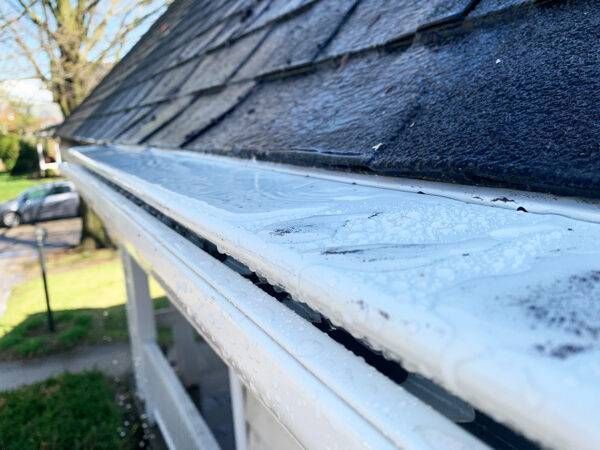
You’ve probably seen these before—brands like LeaFree or others. They’re solid metal – or sometimes plastic – covers that sit on top of your gutters and let water run over the edge and into the gutter through a narrow slit.
The idea behind them is simple: water clings to the metal surface and curves into the gutter while leaves and debris slide off.
In theory, it works. In practice? Sometimes.
Here’s the thing: these types of guards have big gaps along the front edge, so anything smaller than a full leaf (like pine needles, shingle grit, or small twigs) can still get in. They also have a flange that goes up under your shingles, which means you gotta break the tar strip seal on the bottom shingle to get these up under. And then, unless the installer re-applies new roof cement to bond the shingle back down to the top of the gutter guard flange, you’re left with a bottom row of shingles which could blow off in windy conditions.
Another thing: they’re bulky and easy to spot from the ground. If you care about the look of your roofline, this might not be for you.
And another thing: If your roof is too steep, these might not work well either.
Bottom line? It’s an okay option in some cases, but hardly ever my first pick:
- Higher material costs than many other options
- Higher labor costs due to having to integrate into the roof
- Can be hit-or-miss on how much debris it keeps out
- Can be seen from the ground
Set-In style gutter guards like GutterRX
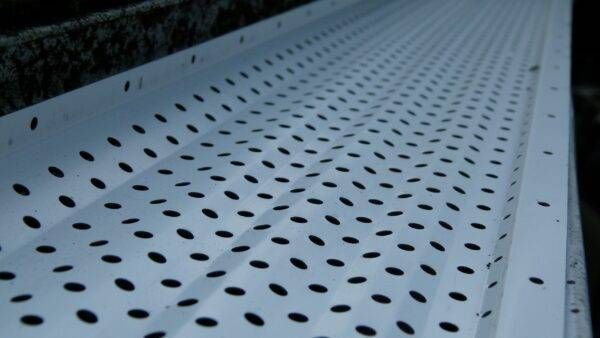
This is one I actually used on my own house. Gutter RX is one of many brands like this – a lightweight, perforated aluminum guard that sets right on top of your existing gutter. It’s low-profile, so you can’t see it from the ground, and it doesn’t mess with your roof at all.
What I like most is its design—those little ribs across the surface aren’t just for looks. They help debris like leaves dry faster and give the wind a way to lift them off, keeping the guard clear without you needing to do much at all.
It’s easy to install (just a few aluminum screws into the front and back), which means lower labor costs. And for most homes, especially those without pine trees nearby, this is a great solution.
The only downside? If you’ve got pine trees overhead, the needles can still slip through. Not usually enough to clog things up, but worth noting if you have lots of coniferous trees nearby.
But all things considered, this is definitly my go-to:
- One of the lowest-costing guards on the market giving you a great cost-to-benefit ratio
- Don’t wear out because they’re aluminum
- Very simple to install
- Doesn’t mess with the roof shingles at all
- Can handle large volume of water pouring off a roof
Micro-Mesh Style gutter guards like Gutter Xtreme
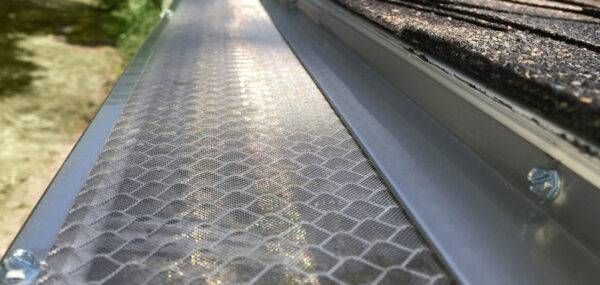
If there’s one gutter guard would turn to that does it all, it’s Gutter Xtreme.
Again, there many different brands that have a similar product, but this is the one I’ve used and landed on as a great balance between function and price.
It takes the same basic idea as Gutter RX—low-profile, non-invasive, and built to sit directly on the gutter—but adds a fine stainless steel mesh over the top. That mesh keeps out everything. Pine needles, shingle grit, bugs, leaves, squirrels, stray tennis balls – you name it.
Underneath, the mesh is supported by a strong expanded metal that holds up well to heavy rain and snow, and allows water to flow freely into your gutters without letting any debris sneak through.
It’s a little pricier than Gutter RX, but still nowhere near the cost of some of the big-name systems being sold for $25+ a foot that are arguably less effective.
For most homes, Gutter Xtreme hits the sweet spot when it comes to aesthetics, doing the job well, and not breaking the bank. It’s practically indestructible, is easy to install, and keeps out everything.
- Mid-range product cost, but easy to install
- Really is a fail-safe system – keeps everything out
- Can’t see it from the ground
- Doesn’t mess with the roof shingles
- High value-to-cost ratio – it works superbly, and doesn’t cost a fortune.
What About
the Cheap Big-Box Store Options like clip-on or plastic gutter guards?
You’ve probably seen the clip-on gutter guards at Home Depot or Lowe’s. Thin metal or plastic pieces you snap on, or foam inserts that sit inside the gutter channel.
Honestly, I think these are short-term fixes for the most part. Now I know that’s a broad statement. And I’m not here to say none of them ever work. It’s just hit-and-miss.
The snap-on styles tend to loosen and flip up with heavy rain or wind, and don’t stand up well over time. These products often have holes that are too big and so end up letting junk into the gutters anyway. Whatever you do, I’d at least recommend that you don’t get a plastic one, because these will likely break/crack due to heat and cold cycles, tree branches falling, etc…
The foam-type insert ones are even worse—they work initially, but clog up fast with fine debris. And then once they’re saturated, they actually cause more overflow issues than they solve. So just stay away from those.
If you’re desperate and on a tight budget, they might be better than nothing… but who wants to buy a product to do a job, and then go do that job anyway because the product failed (“you had ONE JOB!”)?
My final advice on gutter guards
Don’t Overlook the Color
Here’s something most people don’t think about: the color of your gutter guard actually matters.
We recommend darker colors, especially in places where you get snow and ice. A black or brown guard will absorb more sunlight and melt snow and ice faster than a light-colored one. That helps reduce ice buildup and strain on your gutters during the winter months.
Take my easy 5-question test above
It’s the tried-and-true evaluation for whether or not you need gutter guards. Some guys might try to say that you “should always have gutter guards because shingle grit will get in your gutters!” If that’s the only problem, I wouldn’t do it. I’ve never seen shingle grit/granules cause an issue in gutters. And I’ve been on thousands of roofs, and seen thousands of gutters with shingle grit in them.
Fact is, if you’ve never even thought of your gutters in years, you probably don’t need gutter guards. Despite how much the door-knocking salesman might wish to convince you otherwise.
Head over to my gutter pricing page
For the basics – you should be able to find gutter guards supplied and installed for between $12 and $20 per foot. But take a look at my gutter pricing page to get the details on how the prices work for each of the products listed above.
If your gutters are old and creaky, replace them first
Fair enough. While you can definitely install gutter guards on existing gutters (that’s what we do most of the time), you do need to be sure that they are still well fastened, sealed, and in solid condition. Nobody wants to install gutter guards on junky gutters that fall off a year later.
Don’t overspend…OR underspend!
They’re not all created equal. Some are overpriced and underperforming. Others are cheap and really don’t work all that great. If it’s on a TV commercial or being sold by a high-pressure salesman with an hour-long pitch, pass it up. It might work but it’s probably dreadfully overpriced.
But when you find a product that matches your home’s needs and is installed properly, gutter guards do make a big difference.
They cut down on maintenance, prevent clogs and overflows, and help protect your home from water damage. We’ve got various options, depending on your roof type, tree cover, and budget.
And by the way, I never had to clean out the gutters on my home after I put those GutterRX guards on. I didn’t have any pine/coniferous needle trees, only leafy trees.
We’d be happy to take a look at your setup and help you figure out the best option.
Have questions we didn’t answer here? You can
contact us anytime!